Special Series: Ismaili Expressions on the Imamat and Imam of the Time — (I) The Preamble of the Constitution of the Shia Imami Ismaili Muslims

LETTER FROM PUBLISHER

By Abdulmalik Merchant

Canada’s Confederation Day, the American Independence Day, Tanzania’s Saba Saba celebrations and the Imamat Day of His Highness the Aga Khan, all fall in the month of July.

Canada is already preparing for its 150th birthday two years hence when Ismailis around the world will, inshallah, celebrate the Diamond Jubilee of their beloved 49th Imam, whom they respectfully address as Mawlana Hazar Imam.

 A portrait of Mawlana Hazar Imam, His Highness Prince Karim Aga Khan, with a framed portrait of Mawlana Sultan Mahomed Shah in the background. Photo by Philippe Le Tellier/Paris Match via Getty Images. Copyright.

A portrait of Mawlana Hazar Imam, His Highness Prince Karim Aga Khan, with a framed portrait of Mawlana Sultan Mahomed Shah in the background. Photo by Philippe Le Tellier/Paris Match via Getty Images. Copyright.

His Highness the Aga Khan succeeded to the 49th hereditary throne of Imamat at the age of twenty by the will of his grandfather, Mawlana Sultan Mahomed Shah, His Highness the Aga Khan III, who served as the 48th Ismaili Imam for a record 71 years (August 17, 1885 – July 11, 1957).

Over the next week, Simerg will provide an insight into the principles of Imamat through short readings. We begin the series by posting the Preamble of the Ismaili Constitution, which is an introductory succinct statement giving the historical roots of the Ismaili Imamat, the principle of Imamat succession, and the permanency of the spiritual bond that exists between the Imam and his followers.

Another theme that will be explored in the coming few days through the writings of Ismaili Pirs, missionaries and philosophers is the principle of the Unity of Imamat, that is the Ismaili belief and understanding that each Imam, being the bearer of the Noor (Light) of Imamat, is the same irrespective of his own age or the time he lives in.

Finally, another aspect that will become apparent from the readings to follow is that the hereditary institution of Imamat can never become extinct. This is in accordance with the well known Muslim prophetic tradition, hadith thaqalain, which says, “I leave behind me two weighty things: The Book of Allah and my Progeny. If you keep yourselves attached to these two, never, never will you go astray. Both are tied with a long rope and cannot be separated until the Day of Judgement.”

The Preamble of the Constitution of the Shia Imami Ismaili Muslims

Please click on photo for enlargement

December 13, 1986, Geneva: On his 50th birthday, His Highness the Aga Khan is seen ordaining a new constitution for the worldwide Ismaili community.

December 13, 1986, Geneva: On his 50th birthday, His Highness the Aga Khan is seen ordaining a new constitution for the worldwide Ismaili community.

“Mawlana Hazar Imam Shah Karim al Hussaini, His Highness Prince Aga Khan, in direct lineal descent from the Holy Prophet (s.a.s.) through Hazrat Mawlana Ali (a.s.) and Hazrat Bibi Fatima (a.s), is the Forty-Ninth Imam of the Ismaili Muslims.”

BACKGROUND

In 1905, the 48th Ismaili Imam, Sir Sultan Muhammad Shah, His Highness the Aga Khan III, issued a written set of ‘Rules and Regulations’ for the Ismailis of East Africa which effectively served as their communal constitution. This constitution re-affirmed the centrality of the Imam’s authority over the affairs of his community and also articulated the distinctive religious identity of the Ismailis. This document was revised and published several times until 1954, and was made available to Ismailis and non-Ismailis alike. Similar rules were given to the Ismaili community in British India.

During the 1960’s, the 48th Imam’s grandson and successor, Mawlana Shah Karim al-Hussaini Hazar Imam, His Highness the Aga Khan IV, gave Constitutions to his followers in Africa and Pakistan in 1962, and to the Jamat in India in 1967.

A constitution review committee was then formed in the early 1980’s, and after exhaustive review, Mawlana Hazar Imam, in 1986, ordained a new Ismaili Constitution known as “The Constitution of the Shia Imami Ismaili Muslims.”

The Ismaili Constitution became applicable throughout the world, linking all Ismailis to the Imamat. His Highness did this with the belief that the Constitution would provide a strong institutional and organizational framework through which his community would be able to contribute to the harmonious development of the Muslim Ummah and of the societies in which his followers lived. He expressed confidence that the Ismaili Constitution would give a stronger integrated identity to his community, and that in abiding by it in letter and spirit, the Ismailis would achieve greater peace, unity, happiness, security and wellbeing. He futher hoped that the Constitution would become an enabling document for all his murids (followers) for an active role in institution building, for creative application of their abilities, for personal development and for intellectual and spiritual satisfaction.

The new constitution was ordained, signed and sealed by Mawlana Hazar Imam on December 13th, 1986, his fiftieth Salgirah (birthday) and thirtieth year of Imamat. The Constitution was revised by Mawlana Hazar Imam on July 11, 1998, when he completed forty one years of his spiritual leadership.

THE PREAMBLE

(A) The Shia Imami Ismaili Muslims affirm the shahādah lā ilāha illa-llāh, Muhammadur rasulu-llāh, the Tawhid therein and that the Holy Prophet Muhammad (s.a.s.) is the last and final Prophet of Allah. Islam, as revealed in the Holy Quran, is the final message of Allah to mankind, and is universal and eternal. The Holy Prophet (s.a.s.) through the divine revelation from Allah prescribed rules governing spiritual and temporal matters.

(B) In accordance with Shia doctrine, tradition, and interpretation of history, the Holy Prophet (s.a.s.) designated and appointed his cousin and son-in-law Hazrat Mawlana Ali Amiru-l-Mu’minin (a.s), to be the first Imam to continue the Ta’wīl and Ta‘līm of Allah’s final message and to guide the murids, and proclaimed that the Imamat should continue by heredity through Hazrat Mawlana Ali (a.s) and his daughter Hazrat Bibi Fatimat-az-Zahra, Khātun-i-Jannat (a.s).

(C) Succession of Imamat is by way of Nass, it being the absolute prerogative of the Imam of the time to appoint his successor from amongst any of his male descendents whether they be sons or remoter issue.

(D) The authority of the Imam in the Ismaili Tariqah is testified by Bay‘ah by the murid to the Imam which is the act of acceptance by the murid of the permanent spiritual bond between the Imam and the murid. This allegiance unites all Ismaili Muslims worldwide in their loyalty, devotion and obedience to the Imam within the Islamic concept of universal brotherhood. It is distinct from the allegiance of the individual murid to his land of abode.

(E) From the time of the Imamat of Hazrat Mawlana Ali (a.s), the Imams of the Ismaili Muslims have ruled over territories and peoples in various areas of the world at different periods of history and, in accordance with the needs of the time, have given rules of conduct and constitution in conformity with the Islamic concepts of unity, brotherhood, justice, tolerance and goodwill.

(F) Historically and in accordance with Ismaili tradition, the Imam of the time is concerned with spiritual advancement as well as improvement of the quality of life of his murids. The imam’s ta‘lim lights the murid’s path to spiritual enlightenment and vision. In temporal matters, the Imam guides the murids, and motivates them to develop their potential.

(G) Mawlana Hazar Imam Shah Karim al Hussaini, His Highness Prince Aga Khan, in direct lineal descent from the Holy Prophet (s.a.s.) through Hazrat Mawlana Ali (a.s.) and Hazrat Bibi Fatima (a.s), is the Forty-Ninth Imam of the Ismaili Muslims.

(H) By virtue of his office and in accordance with the faith and belief of the Ismaili Muslims, the Imam enjoys full authority of governance over and in respect of all religious and Jamati matters of the Ismaili Muslims.

(I) It is the desire and Hidāyat of Mawlana Hazar Imam that the constitutions presently applicable to the Ismaili Muslims in different countries be superseded and that the Ismaili Muslims worldwide be given this constitution in order better to secure their peace and unity, religious and social welfare, to foster fruitful collaboration between different peoples, to optimise the use of resources, and to enable the Ismaili Muslims to make a valid and meaningful contribution to the improvement of the quality of life of the Ummah and the societies in which they live.

Date posted: Saturday, July 4, 2015.

© Simerg.com

~~~~~~~~~~~

We welcome feedback/letters from our readers. Please click Leave a comment.  Your feedback may be edited for length and brevity, and is subject to moderation. We are unable to acknowledge unpublished letters.

Please Sign-up for blog subscription at top right of this page.

____________

References for this post:

(1) The Ismailis: An Illustrated History by Farhad Daftary and Zulfikar Hirji, published by Azimuth editions in association with The Institute of Ismaili Studies (2008).

(2) Wikipedia article on Imamah, with link to website, http://www.salmanspiritual.com/

(3) http://www.kamalzar.com, website of Alwaez Kamaluddin Muhammad and Alwaeza Zarina Kamaludin.

A Thank You Note to Pir Hasan Kabirdin by Navyn Naran

“…The Nav Chugga are our choice. In the poem, if all goes well, the inevitability is for the butterfly (or silk moth) to emerge and do its butterfly thing, remembering its delicate wings can intricately avert the forces of evil with strength of flight and purpose. Only by guidance, reflection and intention can this occur for the ruh (spirit)…”

Navyn Naran’s Ode to Pir Hasan Kabirdin – the Author of Anant Akhado and the Nav Chugga

Please click for “An Ode to Pir Hasan Kabirdin.” Image in frame is copyright Istockphoto.com.

_________________
For series, please click Thanking Ismaili Historical Figures

“What is Faith?” by Pir Shihabu’d-Din Shah and “Love for the Imam” by Imam Ja’far as-Sadiq

1. FAITH

by Pir Shihabu’d-Din Shah

Faith (Iman) is like a tree, the roots of which go into the heart: its trunk is in reason, and its branches are in the instincts, while imagination is its new shoots and leaves – (senses of) the body. The foundation (asl) of faith is love for the Imam-e-Zaman (the Imam of the Time). And if this foundation, that is, this love, and the roots of faith are strong and in good condition, all other parts of the tree, such as its trunk, its branches and leaves, can be expected to continue to flourish even if they are (accidentally) damaged. If, on the contrary, the roots are not well grounded, or even rotten, the whole tree will soon dry, and then will become good for nothing except to be used as fuel.

Thus love for Mawlana Hazar Imam is everything, being the root of faith. If it is not strong, all the acts of outward piety (a’mal-i zahiri) which are like leaves of the tree, will fade. If you have thousands of leaves, fresh and of good colour, they will dry in a short time, and then a very small fire will be sufficient to burn them completely.

~~~~

2. LOVE FOR HAZAR IMAM

by Imam Ja’far as-Sadiq

It is related from Imam Ja’far as-Sadiq (a.s.) that a group of Shias visited him one day. One in the group addressed the Imam and spoke of a man who was with them.

O Son of the Messenger of God: this man has love for you.”

On hearing these words, the Imam looked at the person and said:

“The best kind of love is the love for the sake of God and His Messenger. There is no gain in any other kind of love.”

The Imam then continued.

“Once the ansars [helpers] came to Hazrat Muhammad Mustafa (s.a.s.) and said, ‘O Messenger of God! We were on the wrong path and Allah guided us through you. We were destitute and we prospered by your blessings. For this reason, you may ask of anything you desire from our belongings and we shall give it to you.’

“At this, the following verse was revealed by Allah, ‘Say (O Muhammad): No reward do I ask (for my favours) except your love for my kith and kin’.”

Moved to tears, Imam Ja’far as-Sadiq then raised his hands and exclaimed:

“Praise be to God, Who has exalted us above all.”

___________

“Faith” adapted from Risala dar haqiqat-i din by Pir Shihabu’d-Din Shah Al-Husayni, translated as True Meaning of Religion by Wladimir Ivanow.  Pir Shihabu’d-Din Shah was the eldest son of the  47th Ismaili Imam, Aga Ali Shah, also known as Aga Khan II. The Pir was only 33 when he died due to a chest related illness, a few months before the demise of his own father, Imam Aga Ali Shah. Mawlana Shah Sultan Mahomed Shah, His Highness the Aga Khan III, then only 8 years old, succeeded to the throne of Imamat as the 48th Imam.

“Love for Imam” excerpted from article by Jehangir Merchant and Alnoor Bhatia published in Ilm, Volume 5, Number 1 (July 1979). The article was based on the Gujarati edition of Qadi al-Numan’s work, Da’aim al-Islam.

An Interview on Nasir Khusraw: Australian Broadcaster in Conversation with Alice Hunsberger

Rachael Kohn: Hello, this is “The Ark”, and I am Rachael Kohn. A thousand years ago a Persian poet defied the conventions of the day. His name was Nasir Khusraw, an Ismaili Muslim, a branch of Shi’a Islam. Instead of lavishing praise on the sultan or his horse, he praised learning and spiritual purity…..Click to read the Australian broadcaster’s interview with Nasir Khusraw specialist Alice Hunsberger

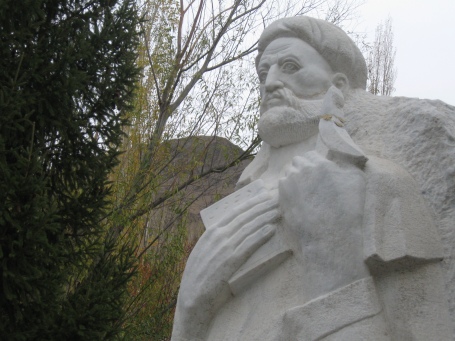
A statue of the famous Ismaili dai Nasir Khusraw in Badakhshan. Please click on image for interview.

A statue of the famous Ismaili dai Nasir Khusraw in Badakhshan. Please click on image for interview.

Poems for Salgirah: ALI by Sherali Kara

(English translation follows this transliteration from Hindi)

ALI

By Sherali Kara

Hum jiyenge aur jiyenge sirf ALI tere liye. 
Ruhani bache tere hai, Haath thaam ke rakhna ALI. 

Tub bhi ALI he thaa, Ab hai tu Hazar Imam ALI.
Taa qayamat tak rahenga Hayul Qayum ALI ALI.

Kya tariqat shaan hai teri.
Khub haqiqi jalwa hai tera.
Kya noorani tevar tere hai.
Shaan e Khuda tu hi ALI hai.

Teri Hidayat se ALI hum jaamat ne taraqi ke.
Lakho Abjo sukhran karo ‘Sukran ALI Sukhran ALI

Is salegrah ke jasn me kya dena hai tujhe ALI.
Khub ibaadat aur khidmat jum kar karna hume ALI.

English Translation

We will again and again serve ALI, you and you only.
We are your spiritual children, hold our hands tight. 

You were ALI of the past, now you are Hazar Imam ALI.
You will be physically forever, Always Present and Everliving ALI ALI

What a tariqat greatness you have.
What a haqiqi brightness you posses.
With the Noorani enlightenment in you O ALI.
You are the greatness of GOD, only you ALI.

With your guidance, we jamat have prospered.
Millions and billions of thank you ALI, thank you ALI

On this Occasion of your Salgirah (Birthday),
what do we need to give you? O ALI.

Lots and Lot of Ibaadat and Khidmat by us is our gift to you. O ALI

Date posted: Friday, December 13, 2013.

___________

Author’s note: When I mention the word ALI, I am referring to the ALI who has been with us from the beginning of time and will remain with us till the end of time. Also, ALI here refers to all the Imams and not simply the first Imam, Hazrat Ali.

About the author: Since his teenage years, Sherali Kara, now fifty-three, has taken a keen interest in furthering his spiritual knowledge, and over the years has developed a deep spiritual and esoteric insight into several ayats from the Holy Qur’an, Ismaili ginans and qasidas. He hails from a family that has a long tradition of Khidmat (service) in the Ismaili Jamat. His mother, Malekbibi Kara, was called the “ginan queen” of her time. Mr. Kara composes poems and couplets specifically on the theme of ALI.  He lives in Andheri, a suburb of Mumbai, and provides Realty Advisory services.

Pir Sadr al-Din’s Ginan “Eji Dhan Dhan Aajano” with Meaning, and Other Readings for the 77th Salgirah of the 49th Ismaili Imam, His Highness the Aga Khan

Spread in various countries around the world, the Shia Imami Ismailis have their own innumerable ways for celebrating important religious occasions according to their various cultural, social and religious traditions and backgrounds. One very important occasion in the annual calendar of the Ismailis is the Salgirah, or the birthday of their spiritual leader (Imam). His Highness the Aga Khan is their present Imam, and Ismailis around the world will be marking his 77th Salgirah on December 13, 2013. The following readings will enhance the readers’ understanding about the occasion as well as the special relationship that binds the Imam of the Time with his spiritual children.

Mawlana Hazar Imam’s Salgirah and the Depth of His Love for the Jamat

The term Salgirah is of Persian origin. Sal means anniversary and girah means knot and hence Salgirah literally means ‘an anniversary knot added on to a string kept for the purpose’. This article approaches the subject of Mawlana Hazar Imam’s birthday in terms of the Imam’s love for his murids and the love and devotion of the murids for their Imam.

In Metaphoric Ginan “Eji Dhan Dhan Aajano” Pir Sadr al-Din Asks Mu’mins to Act Righteously and Gain Spiritual Recognition of Imam-e-Zaman

The Ginan has attained a very special status because it is primarily recited during the festivities marking the Salgirah of the Imam. The appropriateness of reciting Eji Dhan Dhan Aajano during the Salgirah will become apparent as we try to understand the ginan and its underlying spiritual teachings.

The Preamble Of “The Constitution of the Shia Imami Ismaili Muslims”

The new Ismaili Constitution was ordained, signed and sealed by His Highness the Aga Khan on December 13th, 1986, his 50th birthday. His Highness did this with the belief that the Constitution would provide a strong institutional and organizational framework for his Ismaili community to contribute meaningfully to the societies among whom they live.


His Highness the Aga Khan and the Ismailis

.

.

On the occasion of His Highness the Aga Khan’s 75th birthday on December 13, 2011, Simerg published a three-part photo essay tribute to the 49th Ismaili Imam. For those who may have missed, the series has been consolidated into a captivating one piece photo essay, which can be read at Simerg’s companion photo blog, Simergphotos, by clicking on the above link.

Date posted: December 7, 2013

___________________

A Note to Readers: Please scroll down or click Home page for other recent posts and click What’s New for links to all articles published on this blog since March 2009. Subscribe to this Website via the box near the top right of this page.

35 Short Readings and Messages on Didar and Imamat in Anticipation of Mawlana Hazar Imam’s Visit to Bangladesh and India

PLEASE CLICK: Simerg’s Imamat and Didar Series

INTRODUCTION: His Highness the Aga Khan, or Mawlana Hazar Imam as he is affectionately and respectfully addressed by his Ismaili followers, will be visiting Bangladesh and India during the coming month. In July 2011, the 49th Ismaili Imam who is the direct descendant of the Prophet Muhammad (s.a.s.) made a highly successful visit to East Africa and Simerg provided a religious context of the visit by publishing a seven-part series on Imamat and what didar (lit. glimpse of the Imam of the Time) represents to an Ismaili.

Please click on photo to download Imamat and Didar series

Please click on photo to download Imamat and Didar series. Photo: Jehangir Merchant Collection.

We are pleased to provide the entire series which consists of  thirty-five brief  readings such as “Didar: Life’s Ultimate Purpose” by Imam Mustansir-Billah in PDF format. To download this highly educational and inspiring series, please click Simerg’s Imamat and Didar Series. We invite you to share this post with your contacts around the world. 

~~~~~~~~~~~~

A Note to Readers: Please scroll down or click Home page for other recent posts and click What’s New for links to all articles published on this blog since March 2009. Subscribe to this Website via the box near the top right of this page.

Remembering Laila Lokhandwalla Through Her Loving Golden Jubilee Tribute to Mawlana Hazar Imam

LAILA LOKHANDWALLA

It is with deep regret and sorrow that we announce the passing of Laila Lokhandwalla in Toronto, Canada, on Sunday May 5, 2013 at the age of 55. Our heartfelt condolences go to Ms. Lokhandwalla’s family and friends, and we pray for the eternal peace and rest of Laila’s soul. Her funeral ceremonies took place at the Scarborough Jamatkhana on Thursday, May 9th, with special religious ceremonies for the departed soul later during the evening at the Headquarters Jamatkhana.

Laila Lokhandwalla was born and raised in India. Following her graduation in the early 1980’s from the Institute of Ismaili Studies in London, England, Laila moved to Canada where she served with the Ismaili Tariqah and Religious Education Board for a number of years. She obtained her B.A. in Sociology from York University, Toronto, and thereafter, her graduate level Certificate in Teaching ESL, from George Brown College, Toronto. Professionally she was a teacher of ESL (English as a Second Language).

An articulate and engaging teacher as well as an Alwaeza (missionary), Laila also wrote beautiful and stirring poetry. Several of her poems and writings were published in Ismaili literary magazines around the world, including the flagship quarterly periodical Ilm published by the UK Ismaili Tariqah Board. In many of her poems, she sought to capture her immense love, affection and devotion to Mawlana Hazar Imam (His Highness the Aga Khan, the 49th Imam of the Ismaili Muslims).

Following the completion of Mawlana Hazar Imam’s Golden Jubilee, Laila penned a special poem “Reflections of the Golden Jubilee” which was published on this website, along with a personal statement expressing her fondness for writing.

We pay our respect and tribute to Laila Lokhandwalla by re-publishing some of her pieces below, and invite the readers to also click on A Spring Poem for Shah Karim. We begin though with reflections about Laila from her former colleagues at the Institute of Ismaili Studies.

~~~

Tributes to Laila from Her Colleagues

From Mumtaz Virani, Toronto

Further to the above sad announcement about Laila, I would like to inform readers that a collection of Laila’s poems that has been published is available on-line at the following link: http://thewisdomofourhearts.com/.

Laila had been a bright student during her school career. She had inherited melodious voice from her mother who used to sing at the radio station in 1960’s in India. Laila had a special flair for arts and culture and had a strong command on English language because of her convent education.

She loved music and dancing. We witnessed her Kathak dance presentations at the parties during our student days at the Institute of Ismaili Studies in early 80’s. When in good spirit she was a well rounded person and it was easy to fall in love with her.

We pray that her soul may rest in peace. Ameen.

* * *

From Alnoor B. Kassam

At heart, Laila was one of a kind… a flower ripe for He Who Is, departed at our loss, well before her time…  Her effervescence of mind was known only to those who’d sat with her during sessions of learning.  How she challenged anyone shy of intellectual rigour, and yet was always keen to adapt to innovative trends of thought!  Hers was a life we may thus celebrate.

Sure, there were challenges.  She bore them with grace.  And we know that Allah SubhaanaHu wa Ta’ala is Gracious, and He has now bestowed her with liberation of spirit.  As it says in the Qur’an ash-Sharif, those who have passed on are even more alive than we are in this world, only we lack capacity in that we neither sense nor fathom it…

Her zeal each time we had an IIS alumni conference will be held in fond memory.  Her intellectual honesty coupled with dedication to her vocation, was just as remarkable as it was sincere.

May she have well earned rest, in eternal peace, grace and blessing…

Please also see comments.

~~~

My Interest and Love for Poetry

By Laila Lokhandwalla

I have been writing poetry in English since childhood. I started out with writing devotional poems in praise of Mawlana Hazar Imam (His Highness the Aga Khan, the 49th Imam of Shia Imami Ismaili Muslims), but I now have a collection of more than forty poems on various subjects, including politics, women’s and social issues as well as inspirational poems and poems celebrating nature. Besides poems, I have also written some geets (devotional songs set to music), in praise of Hazar Imam, in Gujarati and Urdu. I sometimes also write poetry in Gujarati and Urdu. However, most of my literary work is in the English language.

The love of religion, philosophy and social work, besides of course the pure love of language, especially the English language, have resulted in the poetry that has literally poured out of my soul. I have never really had to make an effort to write poetry. It has always automatically poured forth from my very being whenever I have been moved by anything in life. My poetry is the result of my life experiences and my feelings and thoughts on whatever I have experienced and lived.

_______________

Reflections on the Golden Jubilee

By Laila Lokhandwalla

The sun dawned in the East and slowly but surely,

Lighted up every corner of the globe, in stages, successively,

The earth looked like a newly wedded bride in its enlightened décor,

Even as my Mawla was visiting Jamats, scattered across the globe, one after another,

Illuminating hearts and sparking minds, spreading joy and enlightenment,

Bringing prosperity and progress, breeding hope and encouragement…

This was indeed a special dawn…the dawn of a golden era,

The celebration of the Golden Jubilee of my beloved Mawla!

Excitement within, the tempo building,

Hearts in unison, merrily dancing…

Celebrating in a multitude of ways,

These unique, precious, historic days!

Canada launches several projects new,

To commemorate and celebrate this event…

And to their Imam, their vows they renew,

Pledging love and loyalty with this golden advent!

The Aga Khan Museum and for Pluralism – The Global Centre,

The Delegation of the Ismaili Imamat and The Ismaili Centre,

In their wake, planning a renewal,

A renaissance: cultural, social, intellectual and spiritual!

What exciting times, the future seems bright in prospect,

How immense the bounties, the blessings of the Imamat!

Could this be real, I am moved,

May I help build this future, as I am encouraged?

For that’s not all, there’s more to come…

My Imam directs, these things must be done:

Poverty must be eliminated,

Seniors must be supported,

Education and Religious Education, quality should reflect,

And walls that divide, must be replaced with bridges that unite…

Witnessing these times, I am blessed, I am thinking…

Even as I see the sun setting,

Slowly also setting upon this golden time…

Yet, the hope, the courage, the happiness, does not seem to dim!

The impact was so strong,

The memory shall linger on…

Forever more, to fuel energies and to inspire,

As to accomplish tasks and resolutions pledged, we thus aspire.

Spiritually renewed, yet humbled by all these graces,

I fall into a prayerful ecstasy, my heart races…

“Shukran, shukran, shukran”, repeats my inner soul’s voice,

In a rhythm that is endless and continuous…

For I envisage my Mawla, you’ve opened up the doors graciously,

To ever-increasing happiness and prosperity, endlessly…

Shukranalhamdulillah!

Date posted: Tuesday May 7, 2013
Date updated: Saturday, May 11, 2013.

_______________

We welcome your messages and feedback. Please complete the comments box below or send  your an email to simerg@aol.com.

Journey Towards the Nur (Light) – An Ismaili Reflection on the Prophetic Tradition “Die Before You Die”

PLEASE CLICK: “Die Before You Die” – Journey Towards the Nur by Shiraz Pradhan

Please click for article "Journey Towards the Nur". Photo: Muslim Harji, Montreal, Copyright.

Please click for article “Journey Towards the Nur”. Photo: Muslim Harji, Montreal, Copyright.

Amidst all this greatness,
this splendour
this glory of Your Majesty
I feel like a poor peasant
as I follow my inadequacy!
I see these Times
and Your Magnanimity
 and look at my humble affordings —
In this phase
and to this Light
all the World’s treasures
 would be a trifling

(From a poem by Laila Lokhandwalla)