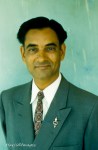
Premji Vaghela, Now a Centenarian, Shares Early Memories of Cricket in Dar-es-Salaam and a Rare Historical Photo of His Highness the Aga Khan

Editor’s note: Naren Varambhia, an avid reader of Simerg residing in London, England, recently brought to our attention a piece on cricket which Premji Vaghela had contributed for a “Dar-es-Salaam Jambo Reunion” that took place in Toronto, Canada, on August 9-10, 1997.
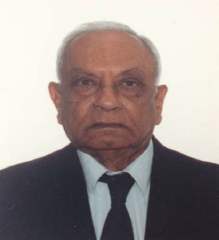
Mr. Premji Vaghela is now a hundred years old and lives in Toronto, Canada: Photo: Premji Vaghela Collection. Copyright.

Mr. Premji Vaghela is now a hundred years old and lives in Toronto, Canada: Photo: Premji Vaghela Collection. Copyright.

We are pleased to publish this highly interesting piece after contacting Mr. Vaghela’s sons, Rajnikant and Niranjan of London and Toronto respectively. We learnt from them that their beloved father has been living in Toronto since 1985, and that the family celebrated his 100th birthday last December! We offer our good wishes to Mr. Vaghela and his entire family for this blessing of a long life.

Both Rajni and Niru mentioned that they have stayed in touch with several Dar-es-Salaam cricketers, including Ismaili cricketers Hasnu Kalyan, Mamda Kassam and Badru Bhamji who played for the Aga Khan Club and Tanzanian national cricket squad for many years.

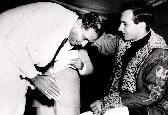
We are indebted to Mr. Vaghela’a family for this memorable and historical piece, which includes a very rare photo of the 48th Imam of Ismaili Muslims, His Highness the Aga Khan, Mawlana Sultan Mahomed Shah, meeting cricketers Mamda Kassam and Premji Vaghela, among others, at Dar-es-Salaam’s Gymkhana cricket ground.
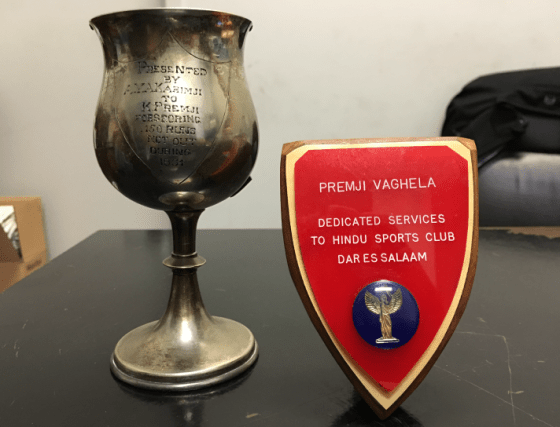
Mr. Premji Vaghela was awarded the cup on the left for scoring 150 runs in a cricket match. The plaque on the right was given to him for his contribution to the Hindu Sports Club. Photo: Premji Vaghela Family Collection. Copyright.

Mr. Premji Vaghela was awarded the cup on the left for scoring 150 runs in a cricket match. The plaque on the right was given to him for his contribution to the Hindu Sports Club. Photo: Premji Vaghela Family Collection. Copyright.

My School Days and Cricket

BY PREMJI VAGHELA 

I was born in Dar es Salaam in 1915 when the British were bombing Dar, when it was under German rule, and the people took shelter in the Jangwani Creek.

I started playing cricket bare-footed at the age of seven with a tennis ball and a locally made wooden bat. Dar streets were our  playgrounds and street lamp posts or dust-bins were our wickets. Those days, in the early twenties, the streets were safe to play in as there were no cars — only rickshaws. Few cars were seen after 1931.

I studied in a Gujarati school called Lokmanya Tilak Memorial School, where Arya Sukh Shanti Lodge is presently situated. After 1918, Tanganyika was called British Protected Territory. The Indian Central School (ICS) was built by the Government in 1929. All the teachers were recruited from India. All the students — boys and  girls — from Tilak school were transferred to this new school. The first headmaster of the new school was Mr. N. O. Mody, a very strict disciplinarian He introduced cricket in the school. It was this school that supplied the most cricketers to all the communal teams in Dar-es-Salaam till 1960.

I earned my name as a bowler and batsman. My first century came in 1932 against the Punjebhai Club (later known as the Aga Khan Club). We did well in the League Tournament. In the knockout tournament in 1934, the school came in the final against the British Gymkhana Club. I scored 150 runs and we piled up a huge score of over 300 runs. We won the knock-out Cup.

In 1932, Mr. A.A. M  Isherwood, then the Director of Education, donated a cup called the “Isherwood Cup”* (see note below) for cricket to be competed by the schools in Dar. There were only two schools at that time: the ICS and the Aga Khan School. We won the trophy  in 1932. It was a coincidence that in 1956 — almost after 25 years —  my son Rajni, when he was school captain, brought the same trophy home. I left the school in 1935. The school had a very good reputation in cricket.

Please click on photo for enlargement

His Highness the Aga Khan (1877 - 1957), 48th Imam of Ismailis, meeting with Mamda Kassam, Premji Vaghela and others at the Gymkhana Cricket Ground in Dar-es-Salaam. Photo: Premji Vaghela Family Collection. Copyright.

His Highness the Aga Khan (1877 – 1957), 48th Imam of Ismailis, meeting with Mamda Kassam, Premji Vaghela and others at the Gymkhana Cricket Ground in Dar-es-Salaam. Photo: Premji Vaghela Family Collection. Copyright.

In 1936, I joined the Indian Sports Club. At that time there were few teams competing in the League Tournament – the “Sachu Pira Shield”. One of the conditions of League matches was that whichever team won for three consecutive years, would retain the Shield forever. In 1936, 1937 and 1938, the Indian Sports Club were the winners and won the Shield permanently. Today, the Shield is on  display in G.M. Sulemanji’s Hardware shop window on Independence Avenue (then Acacia Avenue).

Many young and promising players were coming out from the school, and there were not sufficient teams to accommodate them.  Consequently, the Indian Sports Club was split into two communal teams: the Hindus and the Bohras. The Goans, the Ithnasharis and the Aga Khan teams were already there. By 1940, many other teams cropped up; Punjab Sports Club, the Maratha Mandal, Sinhalese Sports Club  and Malabar Sports Club were new additions. Customs Sports Club and the P.W.D. also joined the cricket competition. The Khalsas and the Goans were the main hockey rivals.

On match days, the whole Asian population turned out on the Gymkhana and the Government Service cricket grounds which were adjacent to each other. The whole atmosphere was like festivals. Machunga (oranges), makai (corn), madafu (coconut), sekela-bafela jugu  (fried-boiled peanuts) and ndhizi (plantains) were always in demand.

I must also mention names of two Englishmen: Mr. F. H. Woodrow, the Director of P.W.D, and Mr. Hudson, the Commissioner of Customs and Excise. They both took keen interest in promoting cricket. There were not enough cricket grounds in Dar then. Mr. Woodrow gave the P.W.D. ground, and Karimjee donated the Bohra’s ground. I consider it only fair to mention the name of Seth Abdulkarim Y.A. Karimjee, of the wealthy and philanthropic Karimjee Jivanjee family. He always supported the cause of cricket  in Dar. He was a good cricketer himself and a thorough sportsman. He was kind, helpful and unassuming.

I should not also forget the grand old man, Count Kassum Sunderji Samji, who donated trophies to cricket and tennis competitions in Dar. He always supported sports one way or the other.

Cricket was the most popular sport in Dar. The competitors were keen and played in high spirit. Sometimes, the communal tension was high, particularly when the Hindus and the Aga Khan Clubs were playing. At times the police were called to control the overenthusiastic supporters of both sides! However, on and off the field, the personal relationship between the players was always cordial and friendly.

Cricket was also played in Mwanza, Tabora, Dodoma, Moshi and Tanga. Cricket was particularly popular in schools and carried on by kids playing in the streets.

Perhaps the most enjoyable competition, for almost all cricketers, was when Dar and Zanzibar used to visit each other every year in early August. Every alternate year we used to play in Zanzibar and vice versa. Many tourists used to accompany the teams and create considerable excitement and jubilation, just like a big festival!

In order to strengthen their side during the final or critical stage in the competition, it was a practice among certain teams to import players from Zanzibar, Mombasa and other centres, during the weekends. Such practices later on were banned by the Dar-es-Salaam Cricket Association.

Unfortunately, the status of cricket has changed considerably due to various reasons: shortage of cricket grounds, lack of encouragement in schools and the high cost of cricket gear·. Considering all these factors, I think cricket will eventually die out in Dar. This is the unfortunate reality of life.

During my cricket career in Dar-es-Salaam, I scored five centuries and taken a great many wickets. These were, undoubtedly, the happiest years of my life.

Date posted: June 5, 2016.

Copyright: Premji Vaghela.

__________

*The Isherwood cup was played in Dar for many years until the late 1960’s. The editor of this blog played in the Isherwood cup for Shabaan Robert from 1967-1969, and featured prominently in the school’s victories during the 3 year period. Pranlal Divecha and Tahir along with Ismaili brothers Shiraz and Abdul Sumar were the top ranked players for Shabaan Robert when they shockingly defeated the favourites Aga Khan Secondary in the 1965 semi-finals/finals. All four went on to play for the Tanzanian squad. Prior to 1965, the cup was dominated for several years by Aga Khan School, whose arch rival was Azania School, located near Muhimbili Hospital. All rounder John Solanki was one of the most well-known players for Aga Khan Secondary — the all-rounder went on to play for England’s county team, Glamorgan, during the 1970’s. By 1971, the Isherwood cup became a non-entity, as there wasn’t any competitive spirit or interest left in the game at the school level. We will be happy to receive an update on the state of Tanzanian school cricket today, and whether the Isherwood has been revived– ed. 

Share your cricket memories of Dar-es-Salaam and other parts of East Africa. Click Leave a comment or write/send photos to Simerg@aol.com. All correspondence will be promptly acknowledged.

What is the state of cricket in Dar-es-Salaam today? Has cricket become a mainstream sport? Please submit your feedback at Leave a comment.

35 Historical and Rare Photos of His Highness the Aga Khan by “Papa Jaan” On One Image

Please click on the following image to zoom on an excellent PDF version of the photo

Please click on image to view PDF file. Copyright Simerg/Abdul M. Ismaily Family Collection.

Please click on image to view PDF file. Copyright Simerg/Abdul M. Ismaily Family Collection.

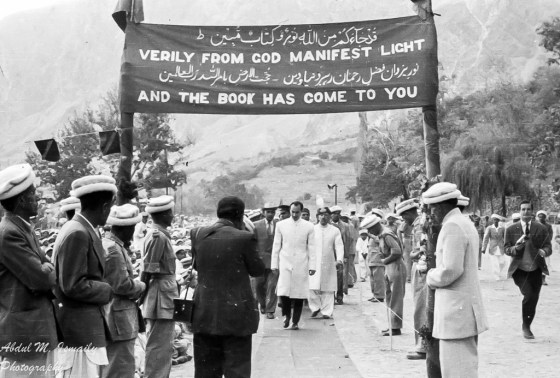
Simerg was thrilled and privileged to recently publish on its sister photoblog never-before-seen photos of Mawlana Hazar Imam, His Highness the Aga Khan, which were captured by Abdul M. Ismaily (1926-1981) during Hazar Imam’s visits to Hunza, Uganda and Pakistan in the early 1960’s. The collection was provided for exclusive publication on Simerg by the family of the late “Papa Jaan,” through Muslim Harji of Montreal.

We pay a small tribute to the memory of “Papa Jaan” for his outstanding photos by presenting a PDF image (click image on top) which contains 35 images from more than fifty that appeared in the Hunza, Uganda and Pakistan pieces. First time visitors to this website as well as readers who may have overlooked one or more photo posts are invited to click on the following links:

Copyright. Simerg.

Date posted: February 23, 2016

________________

We welcome your feedback. Please click Leave a comment

Egyptian President al-Sisi Meets His Highness the Aga Khan and Hails AKDN’s Work + Memorial Photo

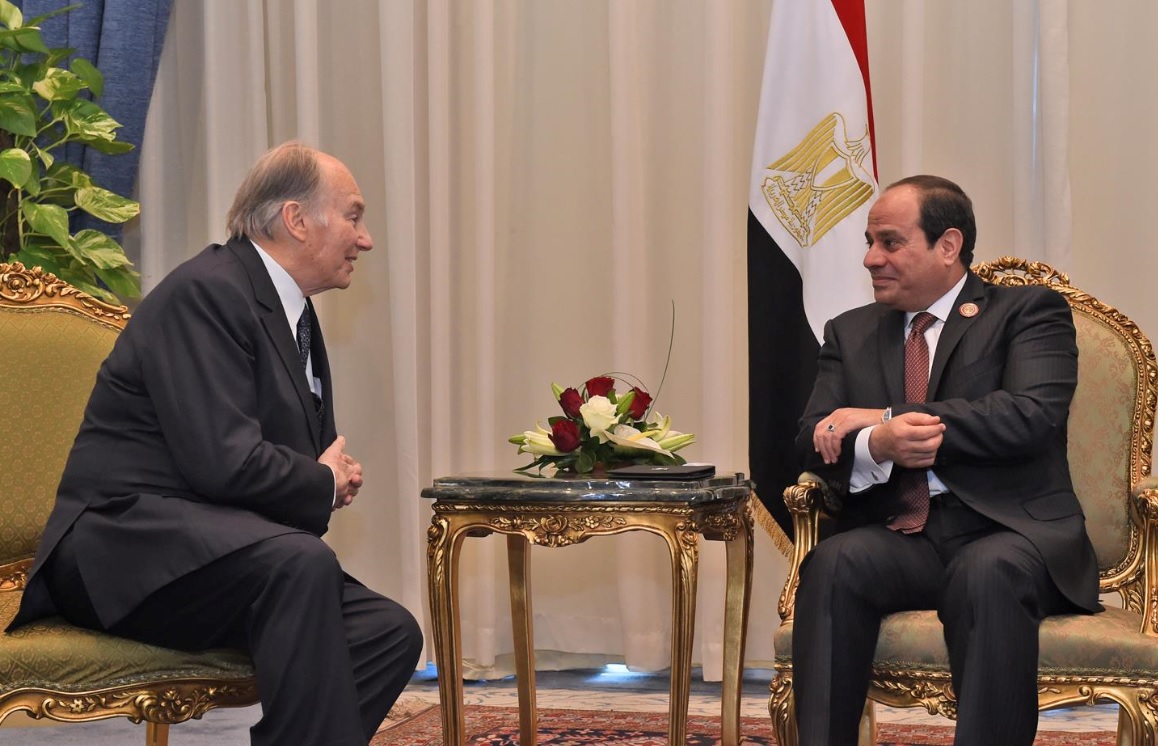
Alaa Youssef, spokesperson for President Abdel Fattah al-Sisi, said that the President met with Mawlana Hazar Imam, His Highness the Aga Khan, on Saturday, February 20, 2016,  and hailed the positive role played by the Aga Khan Development Network (AKDN) which he considered as an example of non-governmental organizations contributing to development in the society and creating jobs. President Sisi also praised the AKDN’s efforts in Egypt, especially in the area of childhood development. [1]

Please click on photos to enlarge

Mawlana Hazar Imam, His Highness the Aga Khan, pictured with Egypt's President al-Sisi on February 20, 2016. Photo Credit: The Egyptian Presidency.

Mawlana Hazar Imam, His Highness the Aga Khan, pictured with Egypt’s President al-Sisi on February 20, 2016. Photo Credit: The Egyptian Presidency.

The 49th Ismaili Imam said that he was looking forward to boosting the Network’s activities in various Egyptian cities, referring to AKDN’s projects in Aswan. He added that the foundation plans to finance more projects for the needy segments, especially in the health and educational sectors. His Highness the Aga Khan was in Egypt to deliver the keynote address at the Africa 2016 investment forum in Sharm el Sheikh. Thematic excerpts of the speech will appear on this website during the week of February 22, 2016.

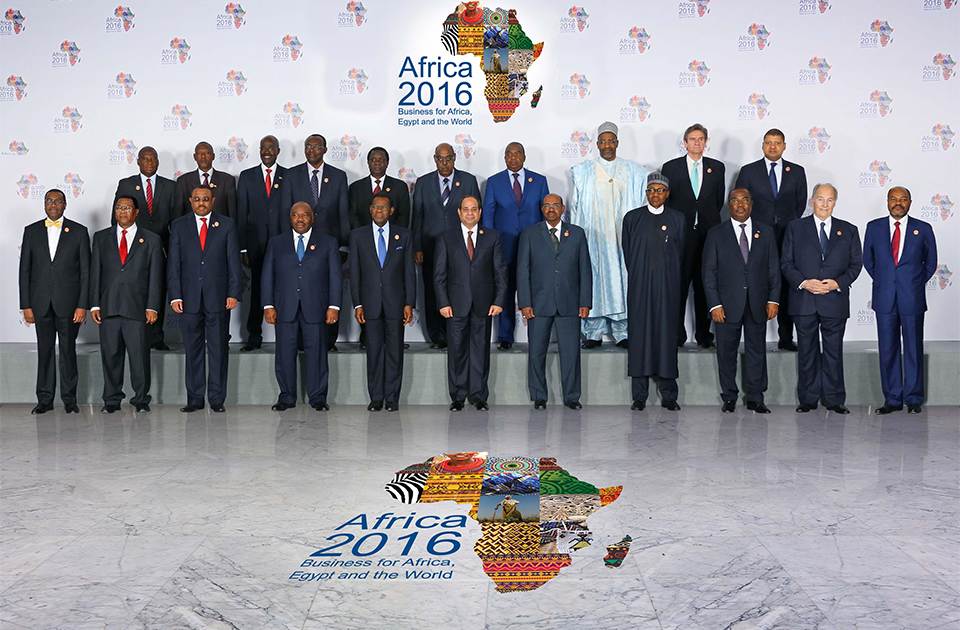
Egyptian President Abdel Fattah al-Sisi (C) takes a memorial photo with other heads of state and government and the participating delegations during the Africa 2016 Business for Africa, Egypt and the World Forum in the Red Sea resort of Sharm el-Sheikh, Egypt, February 20, 2016. His Highness the Aga Khan is pictured second from right in the front row. The 49th Ismaili Imam will be giving a key note speech at the forum on Sunday, February 21, 2016 at approximately 9:00 am (Cairo Time). Photo Credit: The Egyptian Presidency.

Egyptian President Abdel Fattah al-Sisi (C) takes a memorial photo with other heads of state and government and the participating delegations during the Africa 2016 Business for Africa, Egypt and the World Forum in the Red Sea resort of Sharm el-Sheikh, Egypt, February 20, 2016. His Highness the Aga Khan is pictured second from right in the front row. The 49th Ismaili Imam will be giving a key note speech at the forum on Sunday, February 21, 2016 at approximately 9:00 am (Cairo Time). Photo Credit: The Egyptian Presidency.

Egyptian President Abdel-Fattah El-Sisi delivers his speech during the opening session of the African international business forum in the Red Sea resort of Sharm El-Sheikh in the South Sinai governorate of Egypt, 20 February 2016. Photo Credit: The Egyptian presidency.

Egyptian President Abdel-Fattah El-Sisi delivers his speech during the opening session of the African international business forum in the Red Sea resort of Sharm El-Sheikh in the South Sinai governorate of Egypt, 20 February 2016. Photo Credit: The Egyptian presidency.

We invite our readers to click on the following exclusive pieces published recently at Simergphotos:

Date posted: February 20, 2016.
Last updated: February 21, 2016.

_________

[1] Report compiled from the website of Egypt’s State Information Service, http://www.sis.gov.eg/en/.

An Anecdote Illustrating the Wisdom and Judgement of His Highness the Aga Khan: “I was Serving No Ordinary Man” by the Late Michael Curtis

Aga Khan Photos by Azhar Chaudhry - 004

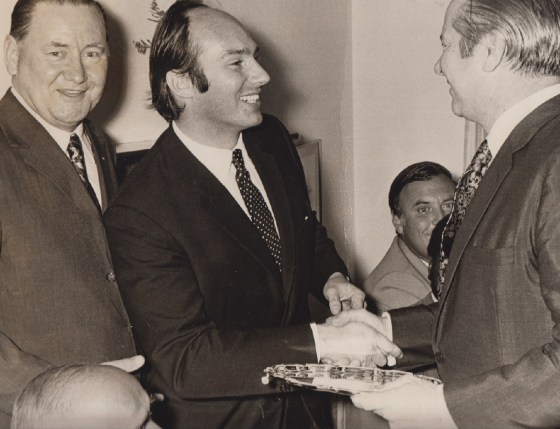
His Highness the Aga Khan being greeted by Mr. Michael Curtis of the Nation Group. Photo: Azhar Chaudhry. Sultan Jessa Collection.

Mr. Michael Curtis, a British Fleet Street editor and executive, was introduced to Mawlana Hazar Imam, His Highness the Aga Khan, just as he had been proclaimed the 49th Ismaili Imam by his grandfather, Imam Sultan Mahomed Shah, His Highness the Aga Khan III.  His recruitment as a staff of His Highness was intended as a short term assignment as a speech writer and publicity organizer during a series of public appearances in Asia and Africa related to the Aga Khan’s installation as Imam. This brief assignment, however, grew into an engagement with His Highness that spanned several decades. The visionary Michael Curtis — who was noted by UK’s Guardian Newspaper as being 50 years ahead of his time in the paper’s obituary to the journalist — was asked to establish the Nation Media Group, which started publishing the Sunday Nation and subsequently the Daily Nation in Kenya, competing successfully with the existing colonial newspapers, the Tanganyika Standard and the East African Standard. At the culmination of the process of Africanising the Nation Group, Michael Curtis stepped down in 1977, after pioneering the introduction of the first web-offset presses installed outside the United States as well as increasing the Nation’s circulation to 165,000 and a readership reputed to touch three million.

Mr. Curtis moved to His Highness the Aga Khan’s Headquarters in Aiglemont, France, where he oversaw the Ismaili Imamat’s rapidly expanding non-denominational health and educational activities throughout South Asia and East Africa, until his retirement in 1994.

Michael Howard Curtis, who was born in Cambridge in 1920, died from cancer in 2004 at the age 84.

The following is an excerpt from a piece written by Mr. Michael Curtis for the Daily Nation’s special souvenir published on the occasion of His Highness the Aga Khan’s wedding in 1969 to Princess Salimah.

“I was Serving No Ordinary Man”

BY MICHAEL CURTIS (1920 – 2004)

It was 12 years ago in Dar-es-Salaam in October 1957. Prince Karim, His Highness the Aga Khan, was to be installed as successor to his grandfather in the first of a series of elaborate ceremonies to be held that year throughout Africa and Asia.

As personal aide to His Highness, I had gone ahead as part of an advance party and was greeted by the local leaders who told me that a serious problem had arisen. The only other such ceremony in living memory had taken place 72 years before in Bombay, when Aga Khan III had succeeded to the Imamate.

Not surprisingly, there was some doubt about the form the service would take and it seemed that an acute difference of opinion had arisen as to which verses of the Koran should be included. There was clearly nothing to be done but to await a ruling from the Aga Khan himself.

It was an unforgettable scene and took place in one of the state rooms of Government House where the Aga Khan was guest of the Colonial Governor at that time, the late Lord Twining. The Ismaili leaders were seated, as is their custom, cross-legged in a semi-circle around their young Imam and the two factions elaborated their different points of view.

To a non-Muslim the arguments were difficult to follow, but it was clear to me that a strong difference of opinion existed and that the Aga Khan would be called upon to resolve a ticklish point of theological doctrine.

This was the first occasion on which he had been called to exercise the responsibilities bequeathed to him by his grandfather. Still an undergraduate at Harvard, he looked very young, a trifle pale and tense as he listened to the rival claimants. There was a pause as they finished. Then the Aga Khan asked a question which obviously puzzled his followers. “Who,” he asked, “will recite the verses you wish me to decide upon?”

A chorus of voices assured him that a young man from Zanzibar had been procured for the recitation and that his fame as a psalmodist of the Koran was acclaimed far and wide.

“If that is so,” said His Highness, “let this young man suggest those verses in which his ability is most outstanding and thereafter I shall decide which particular chapters and verses will be selected.”

It was a solution that delighted everyone. The opposing factions accepted it gladly, for neither had lost face. The choirboy for certain would sing as he had never sung before — which in truth he did the following afternoon. It was a decision which reflected the instinctive simplicity of true wisdom and first revealed to me that I was serving no ordinary man.

I have related this tale before, and if I repeat it today it is because I know of no other anecdote which more aptly illustrates his wisdom and judgement.

Date posted: February 15, 2016.

____________

Profile of Mr. Michael Curtis compiled from Wikipedia, The Guardian and the Daily Telegraph. Please click on https://en.wikipedia.org/wiki/Michael_Curtis_(journalist), and the references cited in the article.

Uganda: Exclusive Photos of Mawlana Hazar Imam, His Highness the Aga Khan, by Abdul M. Ismaily (“Papa Jaan”)

PLEASE CLICK: Exclusive: Photos of Mawlana Hazar Imam’s Visit to Uganda by the Late Abdul M. Ismaily (“Papa Jaan”) 

Please click on image for more photos by "Papa Jaan" of His Highness the Aga Khan's visit to Uganda. Photo: Abdul M. Ismaily. Copyright.

Please click on image for more photos by “Papa Jaan” of His Highness the Aga Khan’s visit to Uganda. Photo: Abdul M. Ismaily. Copyright.

Editor’s Note: Following our recent posting of the late Abdul Mohamed Ismaily’s photographs of His Highness the Aga Khan’s historical first visit to Hunza in 1960, we now present you a collection of his photographs taken in Uganda. Please share this website with your family and friends via email and the social media. We thank our readers for their excellent response to the Hunza photos, and welcome your feedback by completing the applicable comments box or by sending an email to simerg@aol.com.

PLEASE CLICK: Exclusive: Photos of Mawlana Hazar Imam’s Visit to Uganda by the Late Abdul M. Ismaily (“Papa Jaan”) 

Date posted: February 14, 2016.

____________

For Hunza photos, please click Exclusive: Photos of Mawlana Hazar Imam’s 1960 Visit to Hunza by the Late Abdul M. Ismaily (“Papa Jaan”)

Special Series: Exclusive Photos of His Highness the Aga Khan by “Papa Jaan”

PLEASE CLICK: Exclusive: Photos of Mawlana Hazar Imam’s 1961 Visit to Hunza by the Late Abdul M. Ismaily (“Papa Jaan”)

Photo: Abdul M. Ismaily. Copyright. Please click on image for more photos.

Photo: Abdul M. Ismaily. Copyright. Please click on image for more photos.

Editor’s Note: Over the coming weeks Simergphotos, the sister blog of this literary website, will be publishing historical photos of His Highness the Aga Khan that were captured by the late Abdul Mohamed Ismaily, lovingly known to his family and friends as “Papa Jaan.” A passionate amateur photographer, Mr. Ismaily followed His Highness and his entourage during the Ismaili Imam’s visits to his followers in Hunza, Kampala, and Dar-es-Salaam.

"Papa Jaan"

“Papa Jaan”

Papa Jaan passed away in 1981 at the age of 55, and his photos remained part of his estate. They have been reproduced here with the permission of his family. We commence the series with Mr. Ismaily’s photos of Mawlana Hazar Imam’s visit to Hunza in 1961, which also includes a  rare anecdote by a journalist who accompanied  His Highness to Hunza. Please click Exclusive: Photos of Mawlana Hazar Imam’s 1961 Visit to Hunza by the Late Abdul M. Ismaily (“Papa Jaan”)

~~~~~

NEXT: PHOTOS OF HIS HIGHNESS THE AGA KHAN IN UGANDA

Mawlana Hazar Imam, His Highness the Aga Khan, arriving at Kampala's Entebbe Airport. Photo: Abdul M. Ismaily ("Papa Jaan"). Copyright,

Mawlana Hazar Imam, His Highness the Aga Khan, arriving at Kampala’s Entebbe Airport. Photo: Abdul M. Ismaily (“Papa Jaan”). Copyright,

His Highness the Aga Khan and Pope Benedict XVI: A Very Special Photo of Two Faith Leaders Meeting Each Other at the Institut De France in Paris

PREPARED AND COMPILED BY ABDULMALIK MERCHANT
(Publisher-Editor http://www.simerg.com and http://www.simergphotos.com)

As part of his famous Apostolic Journey to France in 2008, Pope Benedict XVI, on September 13, paid a visit to the “Institut De France” in Paris. The Pope, who had been elected as the 265th Pope of the Roman Catholic Church in 2005, was presented with a gold medal by the Institut, and also unveiled a plaque commemorating his visit. During his very brief remarks to the audience, the Pope expressed his gratitude to the Institut “both personally and as the successor of [Simon] Peter.”

His Highness the Aga Khan, Mawlana Hazar Imam, was also in attendance at the Institut de France as the Associate Foreign Member of the Académie des Beaux-Arts (Academy of Fine Arts), one of five learned societies within the Institut which was founded in 1795.

Everyone’s attention in the hall was drawn to Mawlana Hazar Imam and the Pope, with an extraordinary sense of interest and keenness, as the two faith leaders greeted each other with a handshake. Simerg is pleased to present this licensed copyright photo with permission from Getty Images.

Pope Benedict XVI is seen greeting His Highness the Aga Khan on September 13 at the Institut de France in Paris during an official visit to France in 2008. Photo: Copyright. Getty Images. Published on Simerg/Simergphotos with a Licencing arrangement with Getty Images. Fench caption: Vue plongeante du pape BENOIT XVI serrant la main de l'AGA KHAN à son arrivée sous la coupole de l'Institut de France à PARIS entouré de nombreux académiciens et autres personnalités dont Gabriel DE BROGLIE, Hélène CARRERE D'ENCAUSSE, Jean-François JARRIGE, Jean-François BACH, Arnaud D'HAUTERIVES, Michel ALBERT, Christian PONCELET président du Sénat, Jean TULARD, Alain DECAUX, Pierre-Jean REMY, Michel MOHRT, Max GALLO, le cardinal André VINGT-TROIS archevêque de Paris et le cardinal Paul POUPARD. (Photo by Philippe Petit/Paris Match via Getty Images)

Everyone’s attention is drawn to Pope Benedict XVI and His Highness the Aga Khan as they greet each other on September 13, at the Institut de France in Paris during an official visit by the Pope to France in 2008. Photo: Copyright. Getty Images. Published on Simerg/Simergphotos with a Licensing arrangement with Getty Images. Fench caption: Vue plongeante du pape BENOIT XVI serrant la main de l’AGA KHAN à son arrive sous la coupole de l’Institut de France à PARIS entouré de nombreux académiciens et autres personnalités dont Gabriel DE BROGLIE, Hélène CARRERE D’ENCAUSSE, Jean-François JARRIGE, Jean-François BACH, Arnaud D’HAUTERIVES, Michel ALBERT, Christian PONCELET président du Sénat, Jean TULARD, Alain DECAUX, Pierre-Jean REMY, Michel MOHRT, Max GALLO, le cardinal André VINGT-TROIS archevêque de Paris et le cardinal Paul POUPARD. (Photo by Philippe Petit/Paris Match via Getty Images).

In 2013, Pope Benedict dramatically resigned his position as the Head of the Catholic Church due to his deteriorating strength, advanced age and the heavy demands of being Pope, and retired at the Mater Ecclesiae, a small monastery located inside the Vatican State City. His present successor is Pope Francis I, born Jorge Mario Bergoglio.

SOME BRIEF NOTES ON THE PAPACY AND THE IMAMAT, AND SIMON PETER IN THE ROMAN CATHOLIC AND ISMAILI TRADITIONS

The Catholics adhere to the belief that the Pope is a successor of St. Peter. The succession of the pope is determined by a college of cardinals who elect the pope, while the office of the Imam of the Ismailis is a hereditary position. The Ismailis regard their 49th hereditary Imam as the direct descendant of the Prophet Muhammad (s.a.s) through Hazrat Ali (a.s.) and Hazrat Bibi Fatima (a.s.). In a speech made at the Canadian Parliament in 2014, the Aga Khan declared that “the Ismaili Imamat is a supra-national entity, representing the succession of Imams since the time of the Prophet.” And, in an interview with Politique International he said, “The religious leadership of the Ismaili Imam goes back to the origins of Shia Islam when the Prophet Muhammad appointed his son-in-law, Ali, to continue his teachings within the Muslim community. The leadership is hereditary, handed down by Ali’s descendants, and the Ismailis are the only Shia Muslims to have a living Imam, namely myself.”

In the Catholic tradition, the foundation for the office of the Pope is found primarily in Matthew, where Jesus is quoted as telling Simon Peter:

“You are ‘Rock,’ and on this rock I will build My Church and the gates of hell shall not prevail against it. And I will give unto thee the keys of the kingdom of heaven: and whatsoever thou shalt bind on earth shall be bound in heaven: and whatsoever thou shalt loose on earth shall be loosed in heaven.”

This series of successions of the Pope is known as “Apostolic Succession,” with the line of Bishops stretching back to the apostles, who lived during the time of Jesus. Simon Peter is recognized as having been the first Pope. Early Christians reserved the title of “Pope” for St. Peter’s successors.

However, in branches of Shia theology as well as Ismailism, Simon Peter’s role is seen as the direct parallel to that of Hazrat Ali as the first Imam. Ismailis along with some other Shia groups maintain that every major Prophet had a spiritual legatee (Waṣi) or successor called the Asas (foundation) who taught the inner meaning to those who had the capacity to understand it. In this regard, Adam had Seth; Noah had Shem; Moses had Aaron, and Jesus had Simon Peter. A well known sacred tradition of the Prophet Muhammad says that “Ali is to me as Aaron was to Moses,” confirming that Ali held the same level of authority as Aaron did.

Date posted: December 31, 2015.
Last updated: January 1, 2015.

_______________

We welcome your feedback, please click Leave a comment or send it to simerg@aol.com, subject: Aga Khan and Pope.  Your feedback may be edited for length and brevity, and is subject to moderation. We are unable to acknowledge unpublished letters.

The following were used as references for the compilation of this piece:

  1. Apostolic Journey to France: Greeting by the Holy Father during the visit at the Institut de France (September 13, 2008)
  2. The Popes: From St. Peter to Pope Frances by Rupert Matthews,  2014 Edition published by arrangement with Moseley Road Inc.
  3. http://www.catholic-pages.com/pope/peter.asp
  4. Peter in Islam, at Wikipedia.
  5. Comparing the Imamat and the Papacy: Some Short Notes (at Ismailignosis.com).
  6. The Delegation Decoded – An Esoteric Exegesis of the Delegation of the Isma‘ili Imamat, by Khalil Andani.
  7. Concise Encyclopedia of Islam, C. Glasse.
  8. Voices: “The Power of Wisdom” – His Highness the Aga Khan’s Interview with Politique Internationale (English translation)
  9. In a Dynamic and Stirring Address to Members of the Canadian Parliament, His Highness the Aga Khan Shares His Faith Perspectives on the Imamat, Collaboration with Canada, the Muslim World Community (the Ummah), the Nurturing of Civil Society, Early Childhood Education, Voluntary Work, and the Unity of the Human Race

Also see the following important features to learn more about the Aga Khan and the Ismaili Imamat:

in which His Highness the Aga Khan responded to Pope Benedict’s controversial remarks concerning Islam that he had made in 2006; and Special Series: Ismaili Expressions on the Imamat and Imam of the Time — (I) The Preamble of the Constitution of the Shia Imami Ismaili Muslims

A Marvellous Collection of Photos of His Highness the Aga Khan’s Visits to Canada, India and Greece

Editor’s note: In Part II of a special series on the 49th Ismaili Imam’s visits to numerous countries that he undertook during 2015, we cover India (April), Canada (May) and Greece (September). Please click A Marvellous Collection of Photos of His Highness the Aga Khan’s Visits to Canada, India and Greece.

Please click on photo for complete story and more pictures. Photo: Ontario Liberal Part. Copyright. Published with permission.

Please click on photo for complete story and more pictures. Photo: Ontario Liberal Part. Copyright. Published with permission.

Poems “Anand” and “Intezaar” in Joyous Anticipation of the Diamond Jubilee of Mawlana Hazar Imam, His Highness the Aga Khan, on July 11, 2017

Anand

The Imam Blessing with Hand on Shoulder

BY SHARIFFA KESHAVJEE

Oft I sing Anand Anand
Lip service alone stirs
Not the heart to joy
Enshrined in us all
Is the primordial joy
Who will awaken it ?

Come ye Gardner of
The soul awaken in me
Open the door of joy
Lift the veil so I may see
The joy of perfection
In each cell the miracle

I am not so worthy
I need not strive
I live in the perfection
Of your creation
For you have laid
Your hand upon
My shoulder bowed

This Jubilee I await
To feel at depth
That resonance
That symphony
Come together in
Perfect harmony
Sat chit Anand

~~~~~~

Jubilee Intezaar

A prayer left my lip

Being asked
Is your heart jumping with joy?
My heart in reflective pause
Shed a tear of inquiry
Nay! where is joy I asked
It is in your visage?
A prayer left my lip

I asked
Is joy a heart searching seed
Is it locked in the bud of the rose
In the first ray of sunlight
In the rising companion star
Counting hues of green in nature
A prayer left my lip

I asked
Will it grow for me?
Experience a petal of the rose
The hint of morning light
A naked sight the first star
In ever surrounding verdure
A prayer left my lip

The answer came
There it ever is
In the heart of man
In every sinew and pore
In every breath
In every smiling blink

The prayer left my lip
Travelling heavenward
Ricocheting resounding
Hymnal songs of yore
It came back
To settle in my heart
Poured forth in song

In joy is enshrined
A dance of creation
A harmonious rhythm
A fine tuned fork
A Resonating universe
Is my Gods love
Is in my prayer

Life no Ponderous task
For in its joy of being
The incredible lightness
Leads moment to moment
To the Sirat of sat chit anand
The prayer left my lip
The answer is yout Jubilee

Date posted: December 15, 2015.

Copyright: Farida Keshavjee/Simerg.

__________

Sat – Truth; pure and eternal that never changes.
Chit –
Vision, knowledge.
Anand – Ecstasy, bliss, happiness.

Shariffa KeshavjeeEditor’s note:  Shariffa Keshavjee of Kenya, a regular contributor to Simerg, recently heard a tape of Mawlana Hazar Imam’s Golden Jubilee Farman that was made in Kenya in which he asked “Are your hearts jumping with joy?” Tears flowed and the intezaar of the coming Diamond Jubilee came to her mind, inspiring Shariffa to pen the two poems. The Diamond Jubilee of His Highness the Aga Khan, inshallah, will be celebrated on July 11, 2017, when he will complete 60 years as the 49th hereditary Imam of the Shia Imami Ismaili Muslims, in direct lineal descent of the Prophet Muhammad (s.a.s.) and Mawlana Ali (a.s.), the first Imam. Co-incidentally, on July 1, 2017, Canadians will begin celebrating the 150th anniversary of their country with major events, festivities and programs around the country.

Simerg welcome’s your feedback. Please click Leave a comment.