Simerg is an independent initiative dedicated to Ismaili Muslims, the Aga Khan — their Hereditary Imam — and the Ismaili Imamat, and Islam in general through literary readings, photo essays and artistic expressions
Author Archives: Malik Merchant, Editor
Founding publisher and editor of www.barakah.com, www.simerg.com and www.simergphotos.com.
Editor’s note: In the aftermath of the knife attack at the Ismaili Centre in Lisbon that killed Farana Sadrudin and Mariana Jadaugy, condolences have been expressed to the families of the victims privately, in public statements or through the media. One such expression was received by Simerg from Paris based Moez Nato in response to our report on the funeral of Farana Sadrudin that took place in Lisbon on Friday, March 31, 2023. We publish Nato’s expression of sympathy that we feel is representative of how hundreds of thousands of members of the Ismaili community in Portugal and around the world feel about the tragedy that has taken place. The image at top of this post features Mariana Jadaugy (left, photo credit: NOVA FCSH) and Farana Sadrudin (photo credit: Polytechnic Institute of Setúbal).
By MOEZ NATO
French (English follows)
Chers soeurs et frères de foi, Chers amis,
Cette horrible nouvelle de Lisbonne ne peut que nous fendre le coeur et nous attrister profondément. Nous sommes touchés dans notre chair. Quelle douloureuse nouvelle! Quels malheurs! Mais pourquoi ce geste fou, violent?
Nos prières et nos pensées pour les parents et les proches des innocentes victimes. Nos prières pour que Allah, dans toute Sa Miséricorde et Sa Clémence ouvrent à leurs âmes en paix le Royaume de Lumière.
Que les Bénédictions de Mowlana Hazar Imam soient pour les parents des victimes une source de réconfort spirituel.
Nos condoléances attristées à toute la communauté ismailie de Lisbonne . Nos pensées et notre soutien moral au Peuple Portugais et aux Autorités Politiques Institutionnelles qui ont toujours manifesté leur bienveillance à l’ Imamat Ismaili et soutenu l’ intégration loyale, harmonieuse de notre Jamat au sein de la société civile portugaise.
Avec nos affectueuses pensées et l’ expression de notre solidarité, de notre fraternité, à toutes les personnes qui ont acceuillie cette affreuse nouvelle de Lisbonne avec beaucoup de tristesse.
___________
English
Dear sisters and brothers of faith, Dear friends,
This horrible news from Lisbon can only break our hearts and sadden us deeply. We are touched in our flesh. What painful news! What misfortunes! But why this crazy, violent gesture?
Our prayers and thoughts for the parents and loved ones of the innocent victims. Our prayers that Allah, in all His Mercy will open the Kingdom of Light to their souls in peace.
May the Blessings of Mawlana Hazar Imam be a source of spiritual comfort to the relatives of the victims.
Our heartfelt condolences to the entire Ismaili community of Lisbon.
Our thoughts and our moral support to the Portuguese People and to the Institutional Political Authorities who have always shown their benevolence to the Ismaili Imamat and supported the loyal, harmonious integration of our Jamat within Portuguese civil society.
With our loving thoughts and the expression of our solidarity, our fraternity, to all the people who have received this dreadful news from Lisbon with great sadness.
Date posted: April 2, 2023.
_______________
As a follow up to Moez Nato’s message of condolence posted above as well as others that we have received, Simerg invites its readers to submit their thoughts, reflections and condolences on the tragedy that took place on March 28, 2023, in Lisbon. Please submit your feedback by clicking Leave a comment. Also, please click HERE to read other messages of condolence.
Before departing this website, please take a moment to review Simerg’s Table of Contents for links to hundreds of thought-provoking pieces on a vast array of subjects including faith and culture, history and philosophy, and arts and letters to name a few. Also visit Simerg’s sister websites Barakah, dedicated to His Highness the Aga Khan, and Simergphotos. The editor may be reached via email at mmerchant@simerg.com.
Farana Sadrudin, aged 49, who was killed in a knife attack that took place on March 28, 2023, at the Ismaili Centre Lisbon was buried on Friday, March 31, the 9th day of the Muslim month of Ramadhan, at the Cemitério do Lumiar following a funeral ceremony that was held at the Ismaili Centre and attended by more than 1,500 people.
The cemetery has burial zones for numerous faith groups including Muslims, Christians and Jews. The funeral for the 2nd victim, Mariana Jadaugy, aged 24, will be held Saturday, April 1, in Sintra, a resort town near Lisbon. The horrible crime, that also injured a 3rd person, was committed by Abdul Bashir, a refugee who had been living in Portugal for the past 12 months.
The traditional Ismaili Muslim post burial prayers of zyarat and samar for the soul of Farana were held at the Ismaili Centre Jamatkhana immediately after the completion of the burial rites.
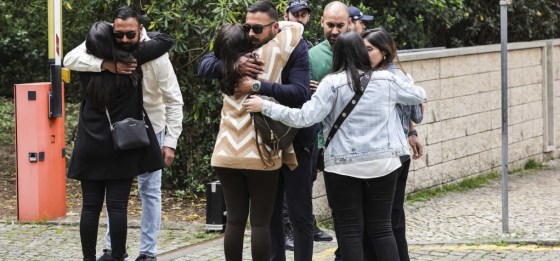
Numerous Portuguese newspapers carried reports and photographs of the hearse’s arrival at the Ismaili Centre before the funeral ceremony as well as scenes of bereavement outside the Ismaili Centre as families, friends and members of the public gathered to mourn and pay respects to the deceased.
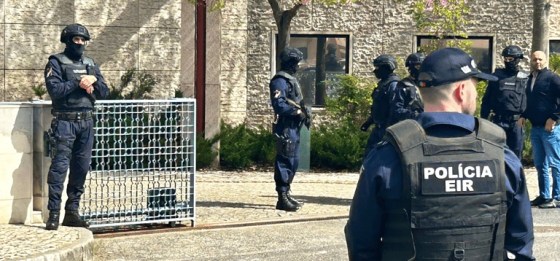
The largest Portuguese circulated newspaper Correio da Manhã (CM Journal) noted that the hearse to carry the body for burial at the cemetery arrived at the Ismaili Centre at 9:00 AM local time, two hours ahead of the funeral ceremonies at 11:00 AM. Please click HERE for CM’s report and photos of the hearse. The newspaper further reported that dozens of heavily armed police officers were at the Ismaili Center as funeral ceremonies took place for Farana. The newspaper also put out a short video Farana’s funeral marked by emotion and tears from family and friends in Portuguese.
A scene of bereavement at the funeral ceremony for Farana Sadrudin that took place at the Ismaili Centre Lisbon on Friday, March 31, 2023. Photograph: Jornal de Noticias. Please click on photo for numerous reports and more photographs.
The Jornal de Notícias, one of Portugal’s oldest newspapers, carried photographs of scenes of bereavement outside the Ismaili Centre Lisbon, as a vast crowd gathered to pay respects at the funeral ceremony for Farana. The newspaper has also grouped links to various reports related to the attack at the Ismaili Centre under one special section; please click HERE.
According to the Portuguese media, the funeral for the second victim, Mariana Jadaugy, will take place in Sintra, a town near Lisbon. Earlier, the Lisbon School of Economics and Management (ISEG) had issued the following In Memoriam statement for the 2 victims:
“ISEG deeply regrets the deaths that occurred yesterday at the Ismali Center in Lisbon, in particular that of student Mariana Jadaugy, ISEG student, master in Development and International Cooperation. Mariana finished her master’s degree in December 2021 with an average of 15 out of 20, where she defended her thesis on the theme “Women’s Participation in Non-Governmental Organizations: Contributions to Your Study”.
“ISEG vehemently repudiates any type of violence and discrimination, and associates itself with the pain of the Ismaili community in Portugal, also conveying its deepest feelings to the families, colleagues and friends of the victims.”
OTHER NOTES AND STORIES OF INTEREST FROM THE PORTUGUESE MEDIA
REPORT SUMMARY — “The Assembly of the Republic on Friday, March 31, 2023, approved a vote of condolence for the victims of the attack that took place on Tuesday, March 28, 2023, at the Ismaili Center in Lisbon. The members of the assembly gave a a long standing applause to the families, those responsible for the center and the representative of the Ismaili Imamat in Lisbon who were present in the galleries.”
This post will continue to be updated with emerging stories, including Mariana Jadaugy’s funeral that is scheduled to take place later today, Saturday, April 1, 2023.
Date posted: March 31, 2023. Last updated: April 3, 2023 (CM Jornal link to video of funeral)
____________
Simerg invites readers to submit their thoughts, reflections and condolences on this tragedy that brutally took away the lives of two individuals at the Ismaili Centre Lisbon. Please submit your feedback by clicking Leave a comment.
Before departing this website, please take a moment to review Simerg’s Table of Contents for links to hundreds of thought-provoking pieces on a vast array of subjects including faith and culture, history and philosophy, and arts and letters to name a few. Also visit Simerg’s sister websites Barakah, dedicated to His Highness the Aga Khan, and Simergphotos. The editor may be reached via email at mmerchant@simerg.com.
The official website of the Ismaili community in a brief report states that at around 11.30 AM (Lisbon time) on Tuesday, March 28, 2023, a man armed with a knife entered the premises of the Ismaili Centre in Lisbon and attacked three people, killing two Ismaili women and injuring the third. The police and security services immediately responded, and the attacker has been taken into custody.
Naming the two victims as Mariana Jadaugy, 24, and Farana Sadrudin, 49, CNN Portugal stated that the latter victim is the niece of Nazim Ahmad, the diplomatic representative of the Ismaili Imamat in Portugal. The news of the attack has been reported by media around the world including Reuters and the BBC (please click on the links.) Click HERE to watch Reuters video report.
Farana’s funeral ceremony took place at the Ismaili Centre Lisbon at 11 AM local time on Friday, March 31, 2023. It is estimated that more than 1,500 people attended the ceremony.
The Lisbon School of Economics and Management (ISEG) issued the following In Memoriam statement on its website in honour of Mariana Jadaugy who was a student at the institution:
“ISEG deeply regrets the deaths that occurred yesterday at the Ismaili Center in Lisbon, in particular that of student Mariana Jadaugy, ISEG student, master in Development and International Cooperation. Mariana finished her master’s degree in December 2021 with an average of 15 out of 20, where she defended her thesis on the theme “Women’s Participation in Non-Governmental Organizations: Contributions to Your Study. ISEG vehemently repudiates any type of violence and discrimination, and associates itself with the pain of the Ismaili community in Portugal, also conveying its deepest feelings to the families, colleagues and friends of the victims.”
Mariana’s funeral ceremony will take place on Saturday, April 1, in Sintra, a town near Lisbon.
Portugal’s Prime Minister António Costa conveyed his solidarity to the victims’ families and to the Ismaili community. He said: “Everything points to this being an isolated incident.” According to the BBC, the Portuguese home affairs Jose Luis Carneiro has said that the alleged attacker was a “relatively young man” with three young children whose wife had died earlier. The minister went on to say said the man often visited the centre to to study Portuguese, collect food donations and for childcare. He added that the victims worked at the centre’s refugee support programme.
Simerg will continue to follow and report on this unfolding tragic news that has brought immense shock to the Ismaili world. The news is unthinkable coming a week after the community celebrated Navroz, the Persian New Year, on March 21, 2023, and on the 6th day of the Muslim holy month of Ramadhan, which commenced on Thursday, March 23.
We grieve with the families of the victims and convey our deepfelt condolences to them as well as members of the Ismaili Jamat in Portugal and around the world.
Featured photo at top of post: Security at the Ismaili Centre Lisbon following knife-attack.
Date posted: March 28, 2023. Last updated: April 1, 2023 (added link to Reuters video report.)
Simerg invites readers to submit their thoughts, reflections and condolences on this breaking story that has emerged from Lisbon, Portugal. Please submit your feedback by clicking Leave a comment.
Editor’s note: Rachael Kohn, a broadcaster, author, and speaker on religion and spirituality, conducted an interview with Alice Hunsberger on her former Australian program, “The Ark”, on the occasion of the millennium birth anniversary of Nasir Khusraw. A shorter version of the interview was prepared and presented by Mashal Ali (acting as Rachael) and Nurin Merchant (acting as Alice) at a literary night event hosted in Ottawa to celebrate the Golden Jubilee of His Highness the Aga Khan. Their presentation is produced below with the kind consent of Ms. Kohn. It is followed by a brief History Pod video presentation on Nasir Khusraw and his travelogue Safarnama.
~~~~~~
Hello, this is “The Ark”, and I am Rachael Kohn.
A thousand years ago a Persian poet defied the conventions of the day. His name was Nasir Khusraw, an Ismaili Muslim, a branch of Shi’a Islam.
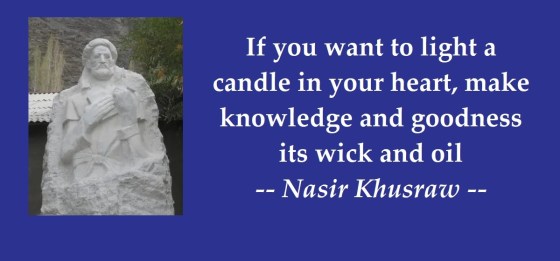
Instead of lavishing praise on the sultan or his horse, he praised learning and spiritual purity. For example he beautifully wrote:
The world is a deep ocean Its water is time. Your body is like a shell, Your soul the pearl. If you wish to have the value of a pearl, Raise up the pearl of your soul with learning.
Rachael Kohn: Unlike Rumi or Omar Khayyam, Nasir Khusraw isn’t well-known in the West. Yet! But New Yorker Alice Hunsberger may change that, with her book on his life and work. She was particularly interested in how different Khusraw’s poetry was at the time.
Alice, when one thinks about the period, the Persian poet that comes to mind is Omar Khayyam who was almost a contemporary of Khusraw, I guess he was about a generation later. Now he is much more well known in the West; how would you compare Omar Khayyam and Khusraw?
Alice Hunsberger:Yes, Omar Khayyam is best known because of the wonderful and inspired translation a century and a half ago by Edward Fitzgerald, and one of the tricks to becoming well-known, is finding a good translator.
Right now for example, Omar Khayyam is best known as a poet to the West but in the East he was primarily known as a brilliant mathematician and astronomer. Nasir Khusraw on the other hand is one of the best, highest ranking poets in the Persian speaking world.
Nasir Khusraw really is not a love poet, so you will not find mystical expressions of love. What he calls for is the use of intellect in religion in one’s life; and in contrast to Omar Khayyam, who was, we could say, cynical toward religious people.
Rachael Kohn: Well, Khusraw himself was something of a religious seeker. He seems to have even read about other religions as well as philosophy. What faction or what tradition of Islam did he align himself with?
Alice Hunsberger: He was very well educated and did look at lots of different religions. At some point in his life, he had a spiritual awakening, and in one place he tells it as a dream, and in another its a more journey-like kind of story.
He finally found the truth and the peace in faith that he was seeking in the Ismaili faith, that is a branch of the Shi’ites. He believes that what God sent down is the external, and that the internal meaning is what needs to be brought out and that needs an Imam, an interpreter.
ARTICLE CONTINUES BELOW
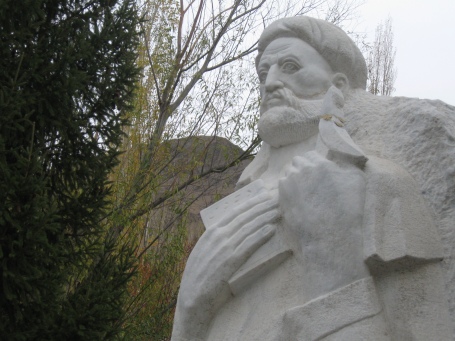
A statue of the famous Ismaili philosopher, poet and missionary Nasir Khusraw in Badakhshan.
Rachael Kohn: Well, Nasir Khushraw, I think was referred to as ‘the real wisdom of the East’; how did he earn that accolade?
Alice Hunsberger: Well I would think that would refer to this inner wisdom which beyond the scientific knowledge, beyond external religious practices, there’s an inner truth that underlies the teachings. This is what he was preaching. So we have to get to the inner truth.
Rachael Kohn: What sort of personality or character comes through in his writing?
Alice Hunsberger: When you read his works you feel right away, ‘Here’s a strong person, a strong, definite individual’. You feel him in many emotions; he opens up some of his poems with sadness, other ones he begins with beautiful springtime visions of trees and flowers so that you see a person in all his complexity.
Rachael Kohn: Is there a strong ethical sense that comes through in his poetry? Is he a critic, a sharp observer of the religious life around?
Alice Hunsberger:Absolutely. As a member, as a leading intellectual of the Ismaili faith, he came under the criticism and enmity of the other schools of the Sunnis and others, so he used his pen very forcefully to defend the faith and to defend his actions.
Rachael Kohn: Alice, are Nasir Khusraw’s poems used today as an inspiration for progressive thought in Islam?
Alice Hunsberger: I think so. I haven’t been back to Iran for a while but they’re having conferences about him now and, even though he is from another branch of Shi’ism, they certainly respect his ethics and his strong personality.
Rachael Kohn: Well Nasir Khusraw ended his days rather sadly, exiled. Why was he exiled?
Alice Hunsberger: After his journey which he undertook as a result of the spiritual awakening, he stayed in Cairo because it was a very powerful Ismaili seat; for about 200 years there was an Ismaili caliph in Cairo, and so he studied there. He left to become a preacher back in his homeland of Khurasan and converted many people.
His success brought enmity and danger to his life, so he fled into a region of Badakhshan where he lived out his life under the protection of a local prince and he wrote much of his sad poetry of his exile from there. Here is a short verse of one of these poems:
But it doesn’t matter where we are, Sometimes we’re in bad places; But no-one values a ruby less for coming out of dirty soil And no-one criticises roses for coming out of manure. So we all are like a ruby and like a rose. We need to blossom and shine wherever we are.
Rachael Kohn: Wise words a thousand years ago and today. That was Alice Hunsberger speaking about the poetry of Nasir Khusraw, who’s been the subject of celebrations by Ismaili communities around the world.
_____________
YouTube Video
Date posted: March 5, 2023. Last updated: March 25, 2023.
___________
Before departing this website, please take a moment to review Simerg’s Table of Contents for links to hundreds of thought-provoking pieces on a vast array of subjects including faith and culture, history and philosophy, and arts and letters to name a few. Also visit Simerg’s sister websites Barakah, dedicated to His Highness the Aga Khan, and Simergphotos. The editor may be reached via email at mmerchant@simerg.com.
The publisher and editor of Simerg and its two sister websites, Simergphotos and Barakah, along with his family members, wishes all readers Navroz Mubarak with a prayer that the coming year bring with it joy and happiness in all our lives, that all our aspirations are fulfilled and that there may be peace and prosperity all around.
For our Ismaili readers, we quote the following timeless blessing in a Talika (written holy message) sent by Mawlana Hazar Imam, His Highness the Aga Khan, on March 21, 2021. He said:
“I send my most affectionate loving blessings for mushkil-asan, and for my Jamat’s wellbeing, good health, safety and security. I also give my best loving blessings for barakah in your spiritual and material lives, and for the fulfilment of all your wishes.”
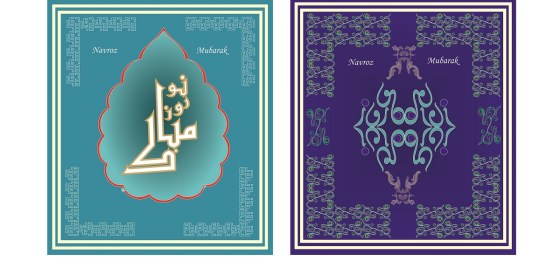
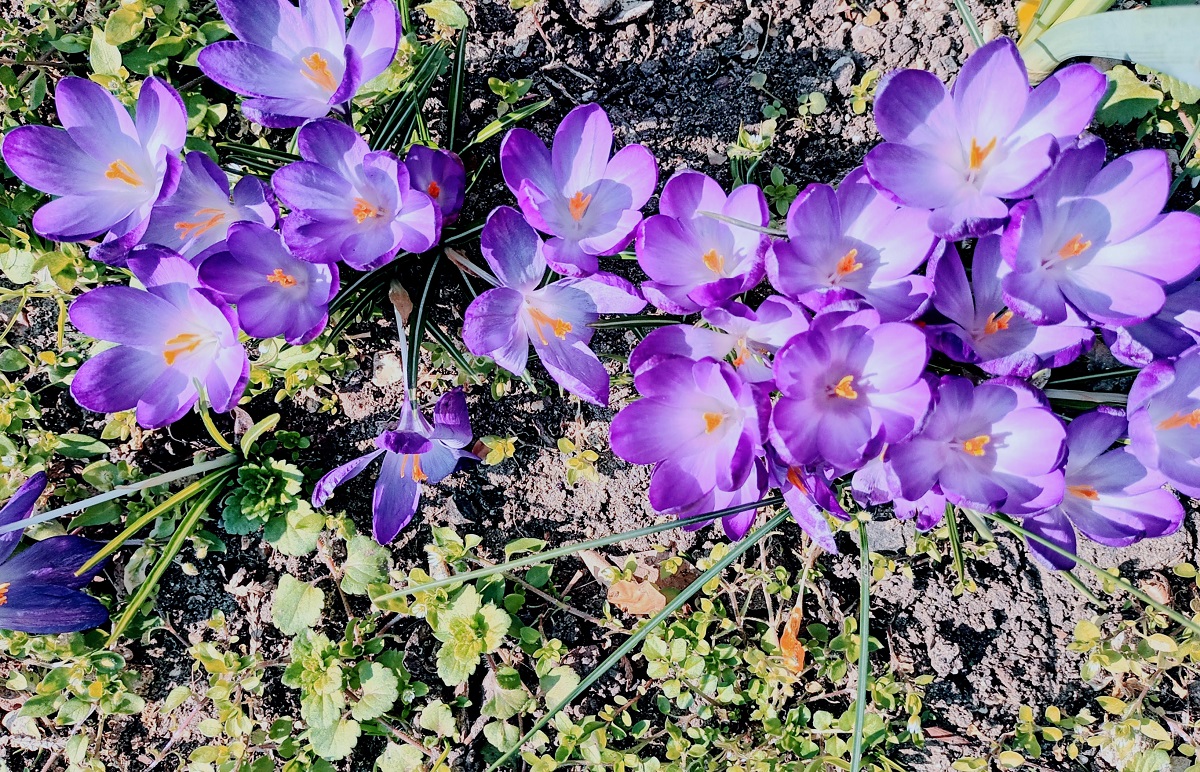
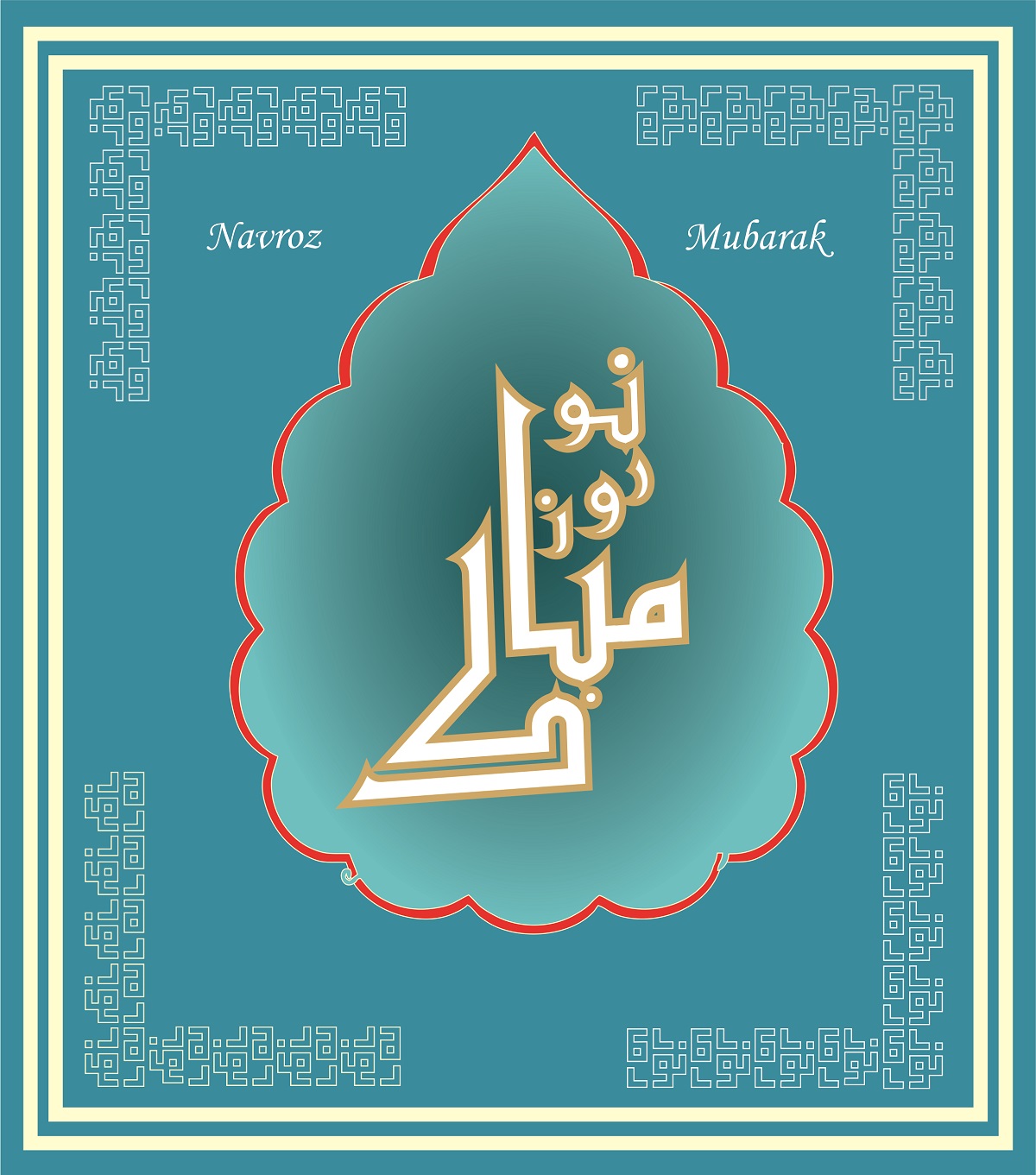
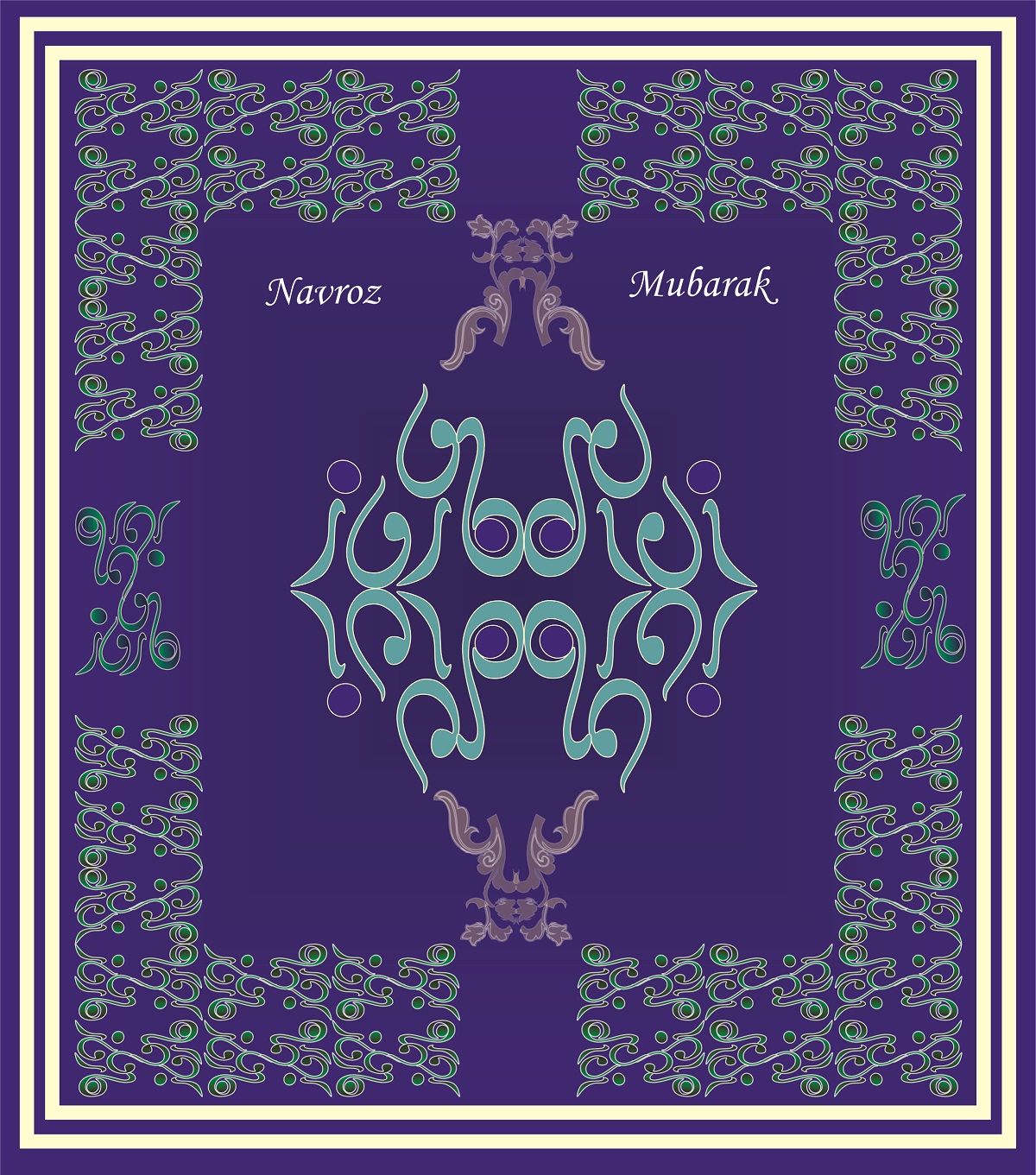
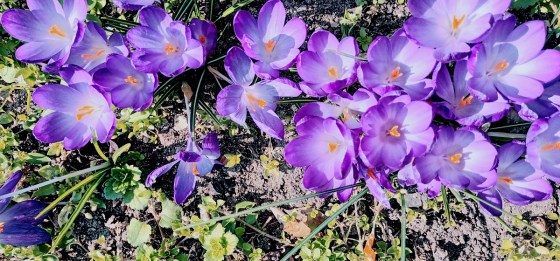
For this most auspicious occasion falling on March 21, 2023, we present below two beautiful calligraphies in Eastern Kufi and Diwani script prepared by Toronto based Ismaili artist Karim Ismail. We also present a special new article on Navroz by Mohez Nato of France, who submitted the following lovely photograph of Crocus sativus or saffron crocus growing in his garden.
FLOWERS AND CALLIGRAPHY
Please click on images for enlargement
Crocus sativus or saffron crocus in Mohez Nato’s garden at his home in Paris. Read his Navroz article HERE. Photograph: Mohez Nato.
~~~~~~~~~~~~~~
Calligraphy Navroz and Navroz Mubarak in square and eastern Kufi by Toronto’s Karim Ismail.
~~~~~~~~~~~~~~
Calligraphy Navroz in Diwani script by Toronto’s Karim Ismail.
Date posted: March 21, 2023. Last updated: March 22, 2023 (link to full Talika added, typos.)
_____________
Karim Ismail
Originally from Uganda, Karim Ismail lived in England before settling in Canada. By profession, he is a Pharmacist (retired). It was in England, in 1986, that he came across the artwork of a German Muslim, Karl Schlamminger (1935-2017), at the Ismaili Centre London. Karl’s artwork on calligraphy and geometrics, had a profound effect on Karim. He is frequently seen conducting calligraphy workshops for children at the Aga Khan Museum in Toronto. Karim is also active on the literature counter at the Ismaili Centre Toronto.
Before departing this website, please take a moment to review Simerg’s Table of Contents for links to hundreds of thought-provoking pieces on a vast array of subjects including faith and culture, history and philosophy, and arts and letters to name a few. Also visit Simerg’s sister websites Barakah, dedicated to His Highness the Aga Khan, and Simergphotos. The editor may be reached via email at mmerchant@simerg.com.
“Navroz, with the awakening of nature, is also a good opportunity to revitalize in us these landmarks — the fundamentals of the ethics of our faith, gratitude, humility, wisdom, compassion, tolerance, service, solidarity, and a frontierless brotherhood…. our reflections and resolutions should be focused on the meaning we want to give to our family life, which must remain more than ever united”
By MOHEZ NATO
Alhamdulillah and Shukran Mawla
First of all, let us give thanks to Allah for His Mercy and for blessing the Shia Imami Ismaili Muslims with guidance under the divine authority of the Imam-of-the-Time. We lovingly express our gratitude to our revered Mawlana Hazar Imam for his constant blessings and prayers for all his murids around the world for good health and happiness, spiritual progress, worldly success, strength of faith, unity, barakah and mushkil-ahsan. It is indeed gratifying that we are able share this happy day of Navroz (also Nawroz, Nowruz) with our family members, with those of the Jamat and with those who are cherished to us.
Navroz 2023 has a very special character for the Ismaili Jamats around the world. It is now almost 5 years since the memorable Diamond Jubilee, when more than 50,000 Ismailis gathered in Lisbon for a momentous Darbar and where we witnessed the installation of the Headquarters of the Imamat — the Divan — in Portugal. The precious Farmans that were delivered by Mawlana Hazar Imam during the Lisbon Darbar remain in our hearts, and we are glad that they accessible in printed format along with other Farmans that Mawlana Hazar Imam has made in the last two decades.
A Time of Renewal
Crocus sativus or saffron crocus in the author’s garden at his home in Paris. Photograph: Mohez Nato.
Navroz, with the awakening of nature, is also a good opportunity to revitalize ourselves in these landmarks: the fundamentals of the ethics of our faith of gratitude, humility, wisdom, compassion, tolerance, service, solidarity, and a frontierless brotherhood.
The current time is going through health crises, climatic, ecological, geopolitical and economic turbulence. And in this troubled world, so stressful and anxious, our reflections and resolutions should be focused on the meaning we want to give to our family life, which must remain more than ever united. We must also more than ever before express our Ismaili identity and our brotherhood without frontiers as a “One Jamat” in solidarity.
We have to reflect on the meaning and direction of our professional achievements, on how to remain faithful to our loyal commitments in the national civil society.
A clear vision of these goals will result in progress in our spiritual quest and in remaining true murids of Mawlana Haza Imam. We seriously have to reflect on his Farmans and aspirations for the Jamat.
With the faith of conviction and with Mawlana Hazar Imam guidance to us on the path of Siratal-Mustaqim, we will overcome our fears and face our difficulties.
Awareness
Navroz is also the occasion of an awareness, the adoption of firm resolutions for a high ideal, for the spiritual quest and the choice of a serene life, made of brotherhood, love and generosity.
And this awareness necessarily leads to a commitment for one’s family, for one’s community, for one’s country, and for those most in need, and must lead to greater service to fellow human beings, by putting aside our personal interests.
Mawlana Hazar Imam, in his speech at Columbia University on May 15, 2006, specifically called “for a concern for personal responsibilities in order to pursue common goals such as passion for justice, pursuit of equity, respect for tolerance, and dedication to human dignity.”
We must not compromise on the fundamentals of our ethics, and never forget to feel at all times grateful to Allah’s Mercy and place ourselves at all times under His Blessing and Protection.
Islam is an art of living! And part of this art and Islam’s ethic is to balance our material and spiritual lives. This fundamental balance must be explained to the younger generation and the youth of the Jamat. In our daily lives, in our social and professional relationships, we must be meritocratic, irreproachable and considered above all as values or models of example. And in religious matters, we must strive to add a spiritual dimension through constant prayers and remembrance of Allah.
Hectic Life
Our life, since the turn of the 21st century, seems to be marked by a great rush. We often feel as if we are running after our existence, with the feeling that it is slipping away from us more and more. And yet, in spite of the hectic pace, we must commit ourselves to taking care of our interiority. This raises the question of how to combine the ethics of our faith with our personal, professional and social life.
We need to manage our time in order to devote moments to our interior life, reinforced by a moral ethic, and thus give an increasingly richer meaning to all the moments of our life.
It is therefore inwardly, in our soul and in our spirit, that we must seek the meaning of our life, our commitment to a harmonious and fulfilled life so that the cause of our joy, of our fulfillment remains within us. Our sincere and humble endeavours in our spiritual quest through meditative silence will give us the presence of a Light, which escapes any explanation, but which is something subtle, a reality rich in spiritual happiness.
The day we decide to look for the essential in ourselves, we will be on the way to freedom, serenity, plenitude. We only need to silence the discordant voices of our egoistic instincts, of our proud passions, of our jealous thoughts and our dark, chaotic feelings.
The silence of Ibadat and Bandagi (early morning meditation) will have the power to project us in another time, in another space, where the divine knowledge inscribed in us from all eternity, will reveal itself little by little to our conscience. And we will feel fulfilled, filled with divine light. With sustained and selffless efforts, this quest for light will lead to living a faith of conviction.
The challenge is to unify our all aspects of our lives, which will give us an opportunity to live a time that is not accelerated. Let us not let ourselves be “devoured by time”. We have to let our mind wander to marvel at the beauty of creation, to be inward looking and take hold of the questions, “What is the meaning of our life?” and “How can we have a successful life?”
Prayers and Hopes for Navroz
Let’s take the courageous decision to cultivate our spiritual life and our interiority in a consumer society that invites scattering and produces an imbalance in our existence.
On this blessed day of Navroz, let us raise our prayers together:
– O Mawla Ali, O Hazar Imam, make us confident and serene murids living a solid faith of convictions;
– O Hazar Imam, please pour on the darkness of our intelligence some rays of your Noor, that will illuminate us, give us the key and the inspiration to face and solve all the options of the din and the duniya!
Navroz Mubarak!
Date posted: March 20, 2023.
_____________________
Born and raised in Madagascar, Mohez Nato went to France in the late 1960’s to pursue his university education. Political tensions in Madagascar prevented him from returning to his home country, where he had planned to teach and carry out research on medicinal plants. Instead, he remained in France and completed his PhD, following which he worked as a teacher-researcher in Plant Biotechnology at the University of Paris Sud XI from 1971 to 2011.
Now, in his retirement, Mohez does voluntary work giving courses in French-speaking Universities in countries like Burkina Faso, Lebanon, Benin, Algeria and Tunisia. He is also the president of a Humanitarian Association which has been active in Madagascar since 1993. Within the Ismaili community, Mohez was Secretary General of the Ismailia Association for France (with President Mohamad Peera) which organized Mawlana Hazar Imam His Highness the Aga Khan’s visit to Paris in 1980. Thereafter, he devoted time for the opening of a Jamatkhana in Antony in southern suburb of Paris, where he also held the position of Kamadia from 1981 to 1983. After the Golden Jubilee celebrations in 2007-08, Mohez was bestowed with the title of Alijah by Mawlana Hazar Imam. Mohez is married to Farida, with whom he has two daughters, Farahna and Rahima. We invite you to read his earlier piece Ode à l’Imam du Temps Présent / Ode to the Imam of the Present Time published in Barakah.
“I think we all recognize that nothing in our world is more necessary than the spirit of Navroz. When we see all the conflicts, the plights of migrants and refugees, when we see the rise of xenophobia and racism in so many parts of the world, it is clear that we all need the spirit of Navroz” — António Guterres, UN Secretary General, quote from film.
Simerg is pleased to present a special YouTube feature on Navroz entitled “The Spirit of Nowruz: Marking the Start of Spring” that was organized by the US Library of Congress (LOC). The entire LOC program with discussions and a Q&A session is almost 1 hour and 13 minutes long. The informative 45 minute film by award-winning documentary and educational film producer and director Farzin Rezaeian commences at the 15th minute mark of the program with remarks by UNSG António Guterres. The film provides viewers with an excellent overview of the history of Navroz and how the festival is celebrated today across different countries, cultures, traditions and faiths. Every aspect of Navroz is covered in this fine — and at times heart-warming — film that will raise our spirits as we commence the New Year on March 21, 2023, followed by the holy month of Ramadhan two days later, on March 23.
Film commences at around the 15th minute mark. NOTE: The YouTube presentation takes a few moments before it begins.
Date posted: March 18, 2023.
_____________
Before departing this website, please take a moment to review Simerg’s Table of Contents for links to hundreds of thought-provoking pieces on a vast array of subjects including faith and culture, history and philosophy, and arts and letters to name a few. Also visit Simerg’s sister websites Barakah, dedicated to His Highness the Aga Khan, and Simergphotos. The editor may be reached via email at mmerchant@simerg.com.
PRELUDE:Thirty years ago, Mbeya Town, situated in the Southern Highland region of Tanzania lost Raibanu Sikina Kanji Lalji. She and her husband Rai Kanji Lalji were one of the pioneers of Mbeya. She was a dedicated person not only to her Lalji Bharmal family by marriage but to all communities of the town. Being her grand nephew, I am humbled to write about her so that she is not forgotten and thus will belong to the pages of history of the Indian contribution in the development of East African countries.
It is a misconception that the people of Indian origin in East Africa are descendants of the labourers who built Kenya-Uganda railway. Almost 32,000 workers from Kutch and Punjab were involved in laying a railway line from Mombasa to Kampala. Between 1896 and 1901, 2,493 workers died and 6,454 became invalid while laying the tracks. After the completions, only about 7,000 workers chose to stay back; the rest of them returned to India.
History indicates that there were trade links between Kutch, Gujarat and African coast for centuries. Modern day migration of Indians (or Asians as they were called in East Africa) to East Africa started in early and middle part 19th century. It was estimated that the number of Indians living in Zanzibar in 1859 was around 2,000.
Before, during and after the completion of laying of railway tracks in East African countries, Indian traders, mostly in the beginning from Kutch and then Kathiawar, had migrated to establish trading posts, called “dukas” along the railway routes. There were however others who were brave enough to venture out and establish trading posts in unexplored and dangerous regions of these countries. This was to provide the needs of indigenous populations and also of German and British administrators, living in the towns where they had established administration centers called “Bomas”. One such part was Southern Highland region of German East Africa (Tanganyika) and one such family was of my great grandfather Lalji Bharmal Rana’s children and grandchildren.
Initially, the Indian settlers in East African countries were male Indians. These men came alone without their spouses, as either they felt that the move to East Africa would be temporary and short lived or would send for their wives later on, when financial means permitted. The other group was young single men.
Women, following their migration to East Africa, either to join their husbands or after becoming brides of young single men who had gone back to get married, have played a very major and important role in the success of Indian settlement in Africa in general and East Africa in particular. They not only minded their homes and looked after the children but they were pillars of support for Indian men. They helped their husbands in the “dukas”, looked after the extended family and also helped other women in the community they were living in.
Mbeya and Tukuyu regions of the Southern Highland Province of Tanganyika was blessed with arrival in the early part of 1923 — after her marriage to Wadabapa Kanji Lalji Bharmal — of a lady, who would play a major role not only in the settlement of Lalji Bharmal family and Indian community of various backgrounds and religion but also the betterment of the general population of Mbeya.
Her name was Sikinabai Kanji Lalji — our Wadima, The Grandma of Mbeya.
Wadima Raibanu Sikina Kanji Lalji. Photograph: Dr. Mohamed Manji collection.
Wadima Sikina was the daughter of Hirji Rajpar Kalyan from Nagalpur, Kutch. She was a sister of five brothers who all migrated to Tanganyika. The oldest brother, Jaffer, settled in Zanzibar and the rest, Mollo, Merali, Bandali and Suleman settled in Tukuyu. Wadabapa Kanji Lalji was the second son of Lalji Bharmal and being single, immigrated first in early second decade of 20th century. His older brother, Manji, was a family man and a breadwinner for the Lalji Bharmal family, farming on their small piece of land called “Kundhi Wadi”. Thus he was not able to go first to Tanganyika. Wadabapa Kanji Lalji after succeeding in his business, returned to Kutch in 1922 to get married.
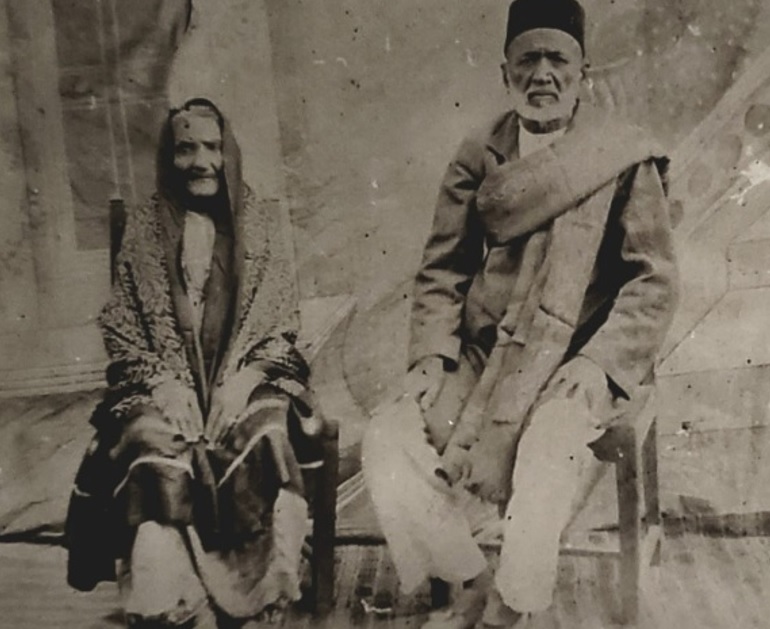
Wadima’s parents, Mr & Mrs Hirji Rajpar Kalyan. Photograph: Dr. Mohamed Manji collection.
The 48th Ismaili Imam, Mawlana Sir Sultan Mahomed Shah, His Highness the Aga Khan lll, had instructed the Kutch Kathiawar Ismaili Jamats to go to East Africa for economical betterment. So this newly married couple was given a big task to take some of Wadabapa’s brothers and nephews with them on their trip back to East Africa to settle them and help them to earn their living there. At a young age of seventeen and as a newly married bride, she took this responsibility with her husband and became the “mother” of the family.
The new home of Wadima, as Mrs Sikinabai Kanji Lalji, will be addressed from now on, was in New-Langenburg (presently known as Tukuyu), a small hillside town in the Southern Highland region of Tanganyika (now known as Tanzania).This was the place the German administration, before 1st World War, had established a center called “Boma”. Mr Kanji Lalji had moved to this place from a close by village of Masoko where he had initially settled in 1911.
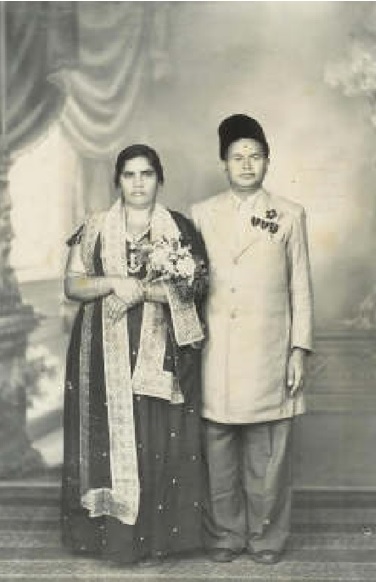
Mr & Mrs Kanji Lalji. Photograph: Dr. Mohamed Manji collection.
In those days, these small villages in East Africa did not have any hotels or restaurants. There were only few Indian families of different backgrounds, i.e. Hindus, Sunni Muslims and Khoja Muslims (mostly Ismailis).They thus had no choice but to look after each other in all ways of life. Any new arrival or visitor would just have to go to any “duka” of an Indian person and he and his family would be taken care of. They would be fed, housed and also would get help so to open their own “dukas” or find them employment, regardless of religious background. This was an old Sindhi, Kutchi and Khatiawadi tradition for generations, practised in India and outside India.
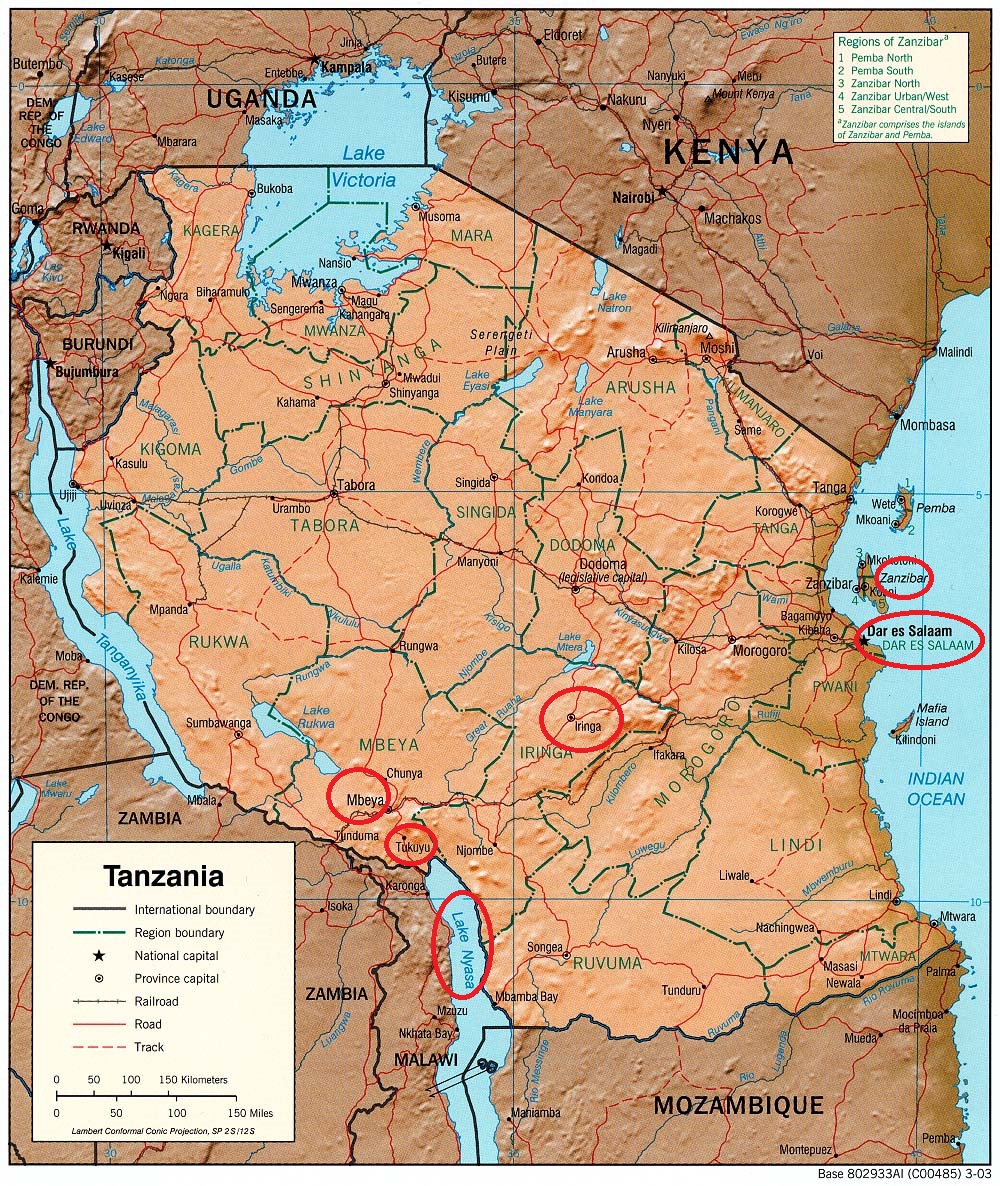
Click on map for enlargement
Shaded relief map of Tanzania. Perry-Castañeda Library Map Collection, University of Texas. This is an annotated version prepared by Simerg and locations mentioned in the article have been circled in red.
As very few of the Indian man-folk had wives, Wadimaa played major role in this aspect in Tukuyu, during that time. One such example was an arrival of a Sunni Muslim family of Haji Yusufmia in Tukuyu in late 1920’s or early 1930’s; they had arrived in Tukuyu after crossing Lake Nyassa (Malawi) in a small canoe from Nyasaland. They were on their way to Mbeya region to settle. They stayed with them and Haji Yusufmia made Wadimaa his blood sister. From then on that relationship between these two families continues to exist until the present day and has remained strong among their children and grandchildren. Haji Yusufmia became a prosperous businessman in Mbeya and a respected Muslim community leader in the Southern Highland region. He and his family were officially invited to attend the Diamond Jubilee celebration of Mawlana Sultan Mahomed Shah Aga Khan in 1946 in Dar es Salaam.
Wadima Sikinabai and Wadabapa Kanji Lalji were matriarch of the Lalji Bharmal family in the settlement of Wadabapa’s older brother Manji’s sons and daughters, his younger brothers Hussein and Karim Lalji. They helped them settle, marry and establish themselves in Tanganyika and some of them became quite successful economically.
In spite of being young, Wadima had an inborn mature quality and accepted a major role in the social aspect of the communities. She learned Swahili language and also local tribal language of Nyakyusa. As there were no doctors or official midwives, women helped each other during deliveries. She was one of the main women involved as a “midwife”. She was self-taught by observing and also from a midwifery medical book for women; she told me that she bought this book in Mumbai for 3 rupees during her first return visit to Kutch after her marriage. She also told me (being an MD myself) during our fireplace talks in her later years, while visiting Vancouver, that she still wanted to learn more. She wanted to know about new procedures involved during deliveries in the present modern day.
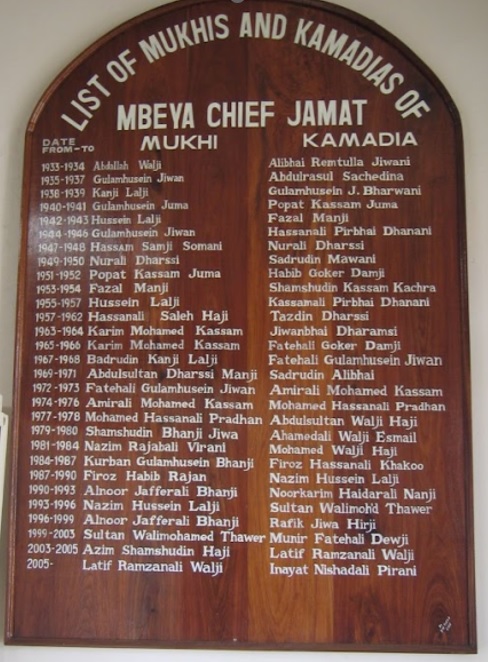
In 1935, Wadima and her family relocated to Mbeya. They became one of the pioneers of Mbeya. She continued her involvement in Mbeya community in the same way, and in some respect in more involved way. She was the main lady player in establishment of the Ismaili community of Mbeya. She, with her husband served as Mukhiani and Mukhi of Mbeya Ismaili Jamat in 1938. Their names are embedded on the plaque shown below. She also was instrumental in the establishment of other Ismaili majalis gatherings in Mbeya. In early 1950’s, as per Mawlana Sultan Mahomed Shah’s instructions, she was one of the first ladies in Mbeya, to adopt the simple western dress and gave up her Indian attire of “pacheri” and saris. She also was instrumental in getting other reluctant Ismaili ladies to do the same.
List of Mukhis and Kamadias of Mbeya Jamat Photograph: Dr. Mohamed Manji collection.
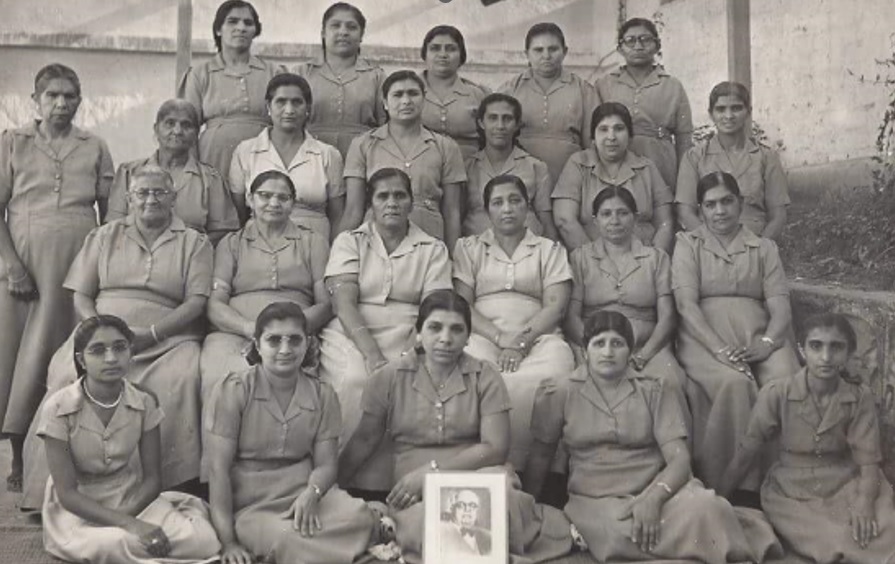
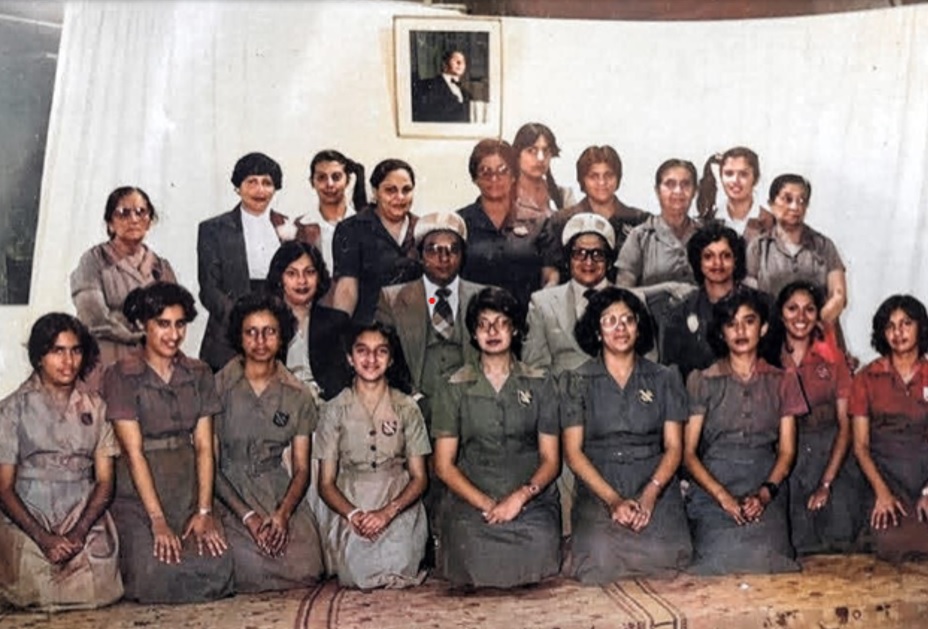
Wadima established the Ismaili Ladies Voluntary corps in Mbeya. The following pictures show her involvement over the decades. She also participated in preparing food during Ismaili functions as part of “Jaman” committee. In spite of her age, she also participated in one of the early Vancouver Partnership Walk during her visit to Vancouver, BC.
Mbeya Aga Khan Women’s Voluntary Corp early 1950s. Photograph: Dr Mohamed Manji collection.
Mbeya Aga Khan Women’s Voluntary Corp late 1950s. Photograph: Dr Mohamed Manji collection.
Mbeya Aga Khan Women’s Voluntary Corp late 1980s. Photograph: Dr Mohamed Manji collection.
Over the years, she earned the respect of all communities of Mbeya, whether they were of native African population or of Indian and European background and came to be known as WADIMA (Grandma). She had a persona of being confidant and in expressing authority. Families would get her involved in settlement of family, marital and financial issues of the community. After Tanganyika’s independence on December 9, 1961, local native political leader would come and greet her as she had known them since they were young. At any Indian wedding, she would be consulted and invited. I remember that my father did consult and inform her about weddings in our family.
In the late 1940’s and early 1950’s, members of the Lalji family in Mbeya would visit Wadima’s place once or twice a week after Jamatkhana, for chit-chat. I was very young and my young cousins and young uncles would gather around a “sigree” (charcoal heating utensil), as Mbeya at an altitude of 1,758 metres (5,500 ft) was quite a cold place. The rooms were lit by lanterns; in that period there was no electricity in Mbeya. We would listen to the elders talking about local news, news from Kutch and other family news. Wadima was a very good storyteller. The young ones would sit with her and she would tell to us about our ancestry, about Kutch and their early hard days they went through when she came to Tanganyika and other interesting stories. This was kind of passing on to all of us, our history and informing us, who we were and where we came from.
Her legacy is being remembered and talked about, up to now, by all Lalji Bharmal youngsters, who were sitting around the “sigree” in those early days and also the new Lalji Bharmal generations in the latter days. When we get together here in Canada and talk about Mbeya, we remember her by saying to each other that “Wadima was saying so”.
Wadima during one of her visit to Vancouver in early 1990’s fell sick. Her wish always was to be buried in the African soil. She returned to Mbeya, Tanzania, her “home”. She passed away in Mbeya, surrounded by family, at the age of 88 years, on February 8th, 1994, and she is buried in Mbeya, Tanzania — the place she was a part of in building.
As I reflect on her magnificent life, I pray for the peace of her soul as well as the souls of all the departed members of my family.
Acknowledgements: I would like to first acknowledge my late Wadima Raibanu Sikina Kanji Lalji herself. She over the years provided me her history, which enabled me to pen down the above write up. I would also like to acknowledge my father’s first cousin and Wadimaa’s son Mr Badrudin Kanji Lalji, his daughter Al-Shamsh (Shamshi) Ladha and Wadimaa’s blood bother’s son Haji Satarmia Haji Yusufmia for providing information for this write up.
Date posted: March 16, 2023. Last updated: March 18, 2023 (names, typo corrections.)
_______________
Dr. Mohamed Fazal Manji
Dr Mohamed Fazal Manji, a cancer special and recipient of the 2022 Royal College of Canada M. Andrew Padmos International Collaboration Award, is originally from Mbeya, Tanzania. He is a Consultant Radiation Oncologist at BC Cancer Agency of British Columbia, Canada, and Clinical Associate Professor, University of British Columbia.He graduated in medicine from Makerere University, Kampala, Uganda and immigrated to Canada in 1972. Dr. Manji specialised in radiation cancer treatments at Princess Margaret Hospital (Cancer Center as it is called now) in Toronto. He obtained the Canadian Fellowship (FRCPC) and American Board Specialist Certification (DABRT) in Radiation Oncology. He also undertook special courses in Nuclear Medicine and Endocrinology at Harvard Medical School, Boston USA. He became the first Canadian trained Ismaili Radiation Oncologist in Canada and probably in North America.
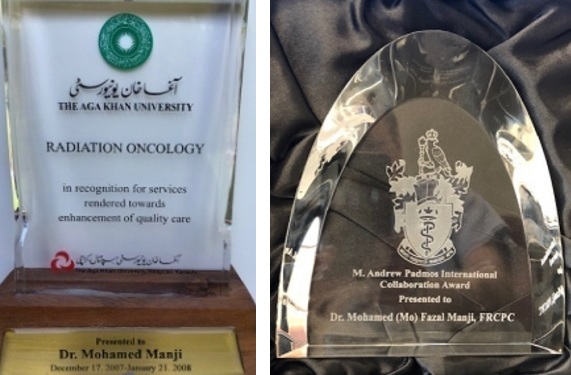
A plaque from Aga Khan University in appreciation of Dr. Manji’s services and at right Dr. Manji received the 2022 Royal College of Canada M. Andrew Padmos International Collaboration Award
He has been working at BC Cancer agency since 1977. He spent time abroad, working in Riyadh, Saudi Arabia, to help modernize the Radiation Department at King Faisal Specialist Hospital & Research Center. He spent 12 years at this tertiary hospital for cancer and other diseases. He was also involved in the planning and development of Radiation Oncology Departments at the Aga Khan University Hospitals in Karachi and Nairobi and spent some time working at both places. He has contributed to many peer review publications, abstracts, book chapters and also lecture presentations nationally and internationally. He is the son of Rai Fazal Manji of Mbeya Tanzania, who served as a member of Aga Khan Supreme Council of Tanganyika in 1950’s and Raibanu Rehmat Fazal Manji, daughter of Alijah Mohamed Hamir who, in early 1930’s, built an iconic Jamatkhana in Iringa, Tanzania, and donated it to Imam Sultan Mahomed Shah unconditionally. Dr Manji served as first Member for Health on the first Aga Khan Ismaili Regional Council of Ontario and Quebec in 1973. He has previously contributed an informative piece on Prince Amyn Aga Khan’s visit to Toronto in 1973 on Simerg’s sister website Barakah.
_____________
Before departing this website, please take a moment to review Simerg’s Table of Contents for links to hundreds of thought-provoking pieces on a vast array of subjects including faith and culture, history and philosophy, and arts and letters to name a few. Also visit Simerg’s sister websites Barakah, dedicated to His Highness the Aga Khan, and Simergphotos. The editor may be reached via email at mmerchant@simerg.com.
If you are in Alberta, and are waiting for warmer weather to see Banff National Park’s emerald coloured lakes, green forests and wildlife, make no mistake that the Park offers extraordinary scenery in winter. Its snow covered mountains and frozen lakes will baffle your eyes and, with the exception of bears who will be in hibernation for a few more weeks, you will also encounter an amazing variety of wildlife. Malik Merchant’s short excursion to Banff and Lake Louise offered him a rare opportunity to witness how Albertans, Canadians and people from all over the world come to Banff to enjoy its extraordinary mountains, ski resorts, sulphur springs, canyons and trails….as well as coffee shops, restaurants and art galleries! Please click HERE or on the photo below for Merchant’s story and photographs on Simergphotos.
A coyote off Banff’s Tunnel Mountain Road. Please click on image for story and more photos.
Featured photos at top of post: A CP freight train passes through Morant’s curve on the Bow Valley Parkway (Hwy 1A), 6 kms from Lake Louise. The lookout point is a very popular spot for visitors as it offers a stunning view of trains coming around the bend, with the Bow River flowing along the side and mountains in the background. It is a dream spot for train lovers! The frequency of the trains is unreliable, though.
Nurin Merchant pens down a photo essay to reflect on her summer visit to Alberta in 2022. With spring soon approaching and summer to follow, Nurin strongly recommends that Albertans and visitors to the province should consider visiting Waterton Lakes National Park and the Kananaskis country to experience their extraordinary natural beauty, the stunning Rocky Mountains and superb wildlife. Please click PHOTO ESSAY or on the photograph below to view a small collection of photographs from more than 1,200 that she took with her dad over a period of 6 days in Alberta.
Waterton Lake. Please click on image for photo essay.
Featured photo at top of post: Forget Me Not Pond, Kananaskis Country.
Date posted: February 26, 2023.
________________
Before departing this website, please take a moment to review Simerg’s Table of Contents for links to hundreds of thought-provoking pieces on a vast array of subjects including faith and culture, history and philosophy, and arts and letters to name a few. Also visit Simerg’s sister websites Barakah, dedicated to His Highness the Aga Khan, and Simergphotos. The editor may be reached via email at mmerchant@simerg.com.