Simerg is an independent initiative dedicated to Ismaili Muslims, the Aga Khan — their Hereditary Imam — and the Ismaili Imamat, and Islam in general through literary readings, photo essays and artistic expressions
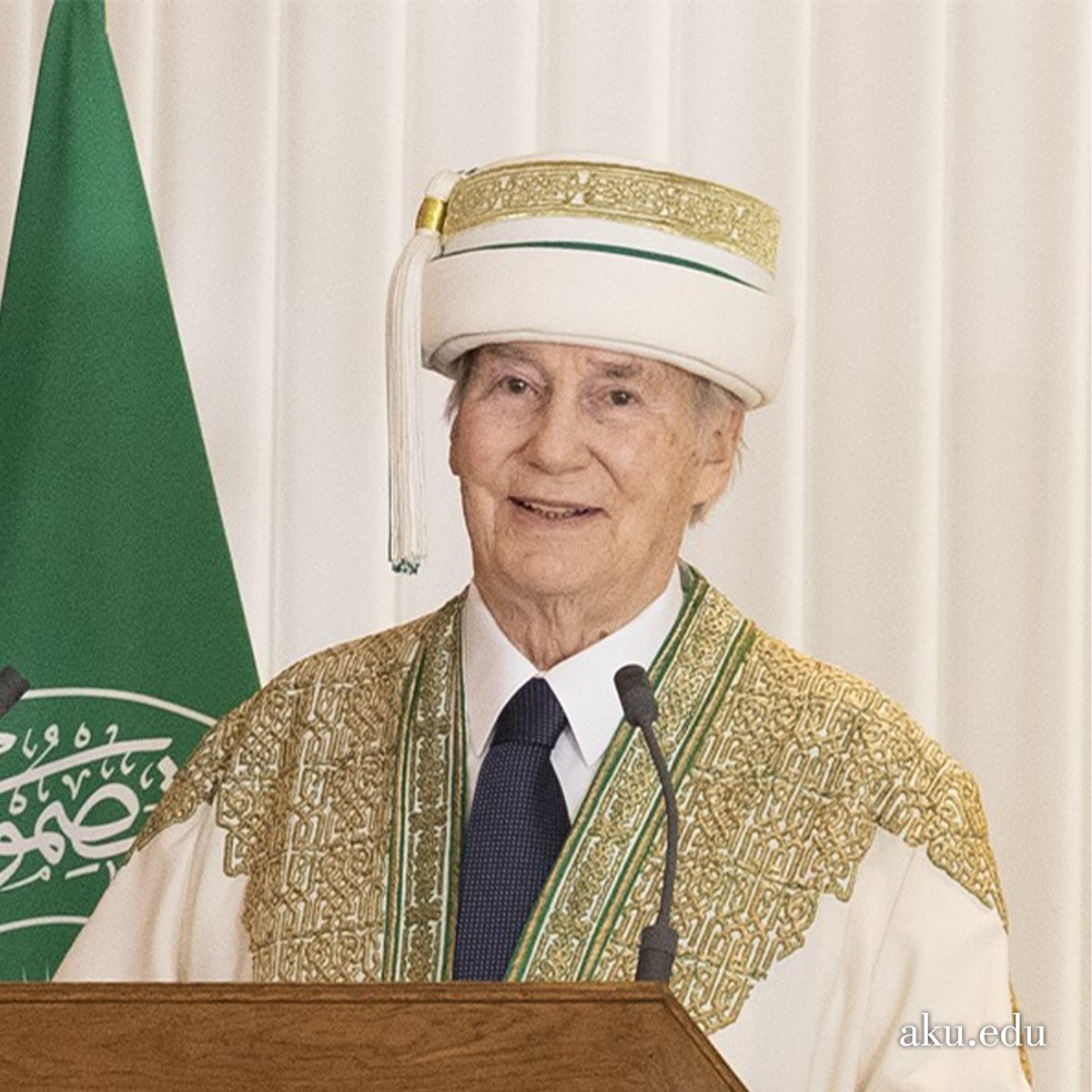
His Highness the Aga Khan addressing the 2020 Aga Khan University Convocation. His 64th Imamat Day will be celebrated on July 11, 2021. He became the 49th Imam of the Ismaili Muslims at the age of 20 when he was still a student at Harvard University. Please click on photo for article by acclaimed American writer Michael Hamilton Morgan.
“Believe it or not — hard work in the areas of education, scientific research, medicine, public works, charity, economic development and entrepreneurship — are the behavioral pillars of historical Muslim culture that made Muslim culture the single most progressive force in the world from about 650 to 1500 of the current era…..This ancient Muslim religious devotion to science, ideas, openness and empirical evidence has indeed been obscured in the mainstream….in the Muslim world, incomplete popular understanding of the faith of Islam has weakened understanding of the importance of logic and reason to the Islamic tradition.
“In this vast tapestry of the interaction of Muslims with each other, and with other cultures and faiths, there is one tradition that unfailingly continues the progressive heritage of classical Islam — profoundly intellectual, open, tolerant, pacific — and in particular one leader who has made it especially attuned to the many difficulties of the world today. That would be Ismailism and its revered Imam, the current Aga Khan IV”….. READ FULL ARTICLE.
Michael Morgan is an international speaker and author of Lost History: the Enduring Legacy of Muslim Scientists, Thinkers and Artists (National Geographic/Random House) which has reached thousands of readers around the world, and has been translated into several languages. Morgan received Egypt’s Presidential award for the Arts & Sciences in 2008. His insightful article on the Aga Khan is a must read!
Date posted: July 7, 2021.
_________________________
Before departing this website please take a moment to review Simerg’s Table of Contents for links to hundreds of thought provoking pieces on a vast array of subjects including faith and culture, history and philosophy, and arts and letters to name a few. Also visit Simerg’s sister websites Barakah, dedicated to His Highness the Aga Khan, and Simergphotos.
“They were out on Sunday…. going for a family walk on a beautiful spring evening near their quiet, safe London neighbourhood. Now four of them are gone. A nine-year-old boy is in hospital trying to recover from serious injuries while the rest of his entire life has been snuffed out in front of him by a black Dodge Ram pickup truck driven by someone apparently filled with hate…. I can’t understand how a young man, now charged, who would have been raised and schooled in a time when Canadian multiculturalism is more than a concept, but a reality, would be filled with so much anger toward a family he didn’t even know.” — PLEASE READ COMPLETE COLUMN BY JANE SIMS IN THE LONDON FREE PRESS
Please click on image for article in London Free Press
Prime Minister Justin Trudeau vowed to combat Islamophobia in the country following a “targeted attack” on a Muslim family in London, Ontario, which led to death of three adults and one teen. Trudeau expressed grief over the incident and condemned the “hateful and heinous” act. “I spoke on the phone this evening with @LdnOntMayor and @NTahir2015 about the hateful and heinous attack that took place in London, Ontario yesterday. I let them know we’ll continue to use every tool we have to combat Islamophobia — and we’ll be here for those who are grieving,” Trudeau tweeted.
In another tweet, the Prime Minister said:
I’m horrified by the news from London, Ontario. To the loved ones of those who were terrorized by yesterday’s act of hatred, we are here for you. We are also here for the child who remains in hospital – our hearts go out to you, and you will be in our thoughts as you recover.
The targeted attack on the Muslim family took place in London, Ontario on Sunday, June 6, when the family was out for an evening walk on a splendid spring day.
Simerg conveys its deepest condolences to the family, relatives and friends of the victims as well as to all Muslim and non-Muslim Canadians who are grieving from this horrible tragedy. We pray for the complete recovery of the child who is in the hospital. We pray that the souls of all the deceased victims may rest in eternal peace. Inna lillahi wa inna ilayhi raji’un (“Surely we belong to God and to Him we return” — Holy Qur’an, 2:156).
Date posted: June 8, 2021.
_____________________
Before departing this website please take a moment to review Simerg’s Table of Contents for links to hundreds of thought provoking pieces on a vast array of subjects including faith and culture, history and philosophy, and arts and letters to name a few. Also visit Simerg’s sister websites Barakah, dedicated to His Highness the Aga Khan, and Simergphotos.
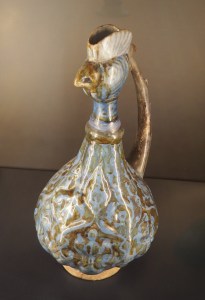
The Simurgh ceramic vase at the Aga Khan Museum, Bellerive Room.
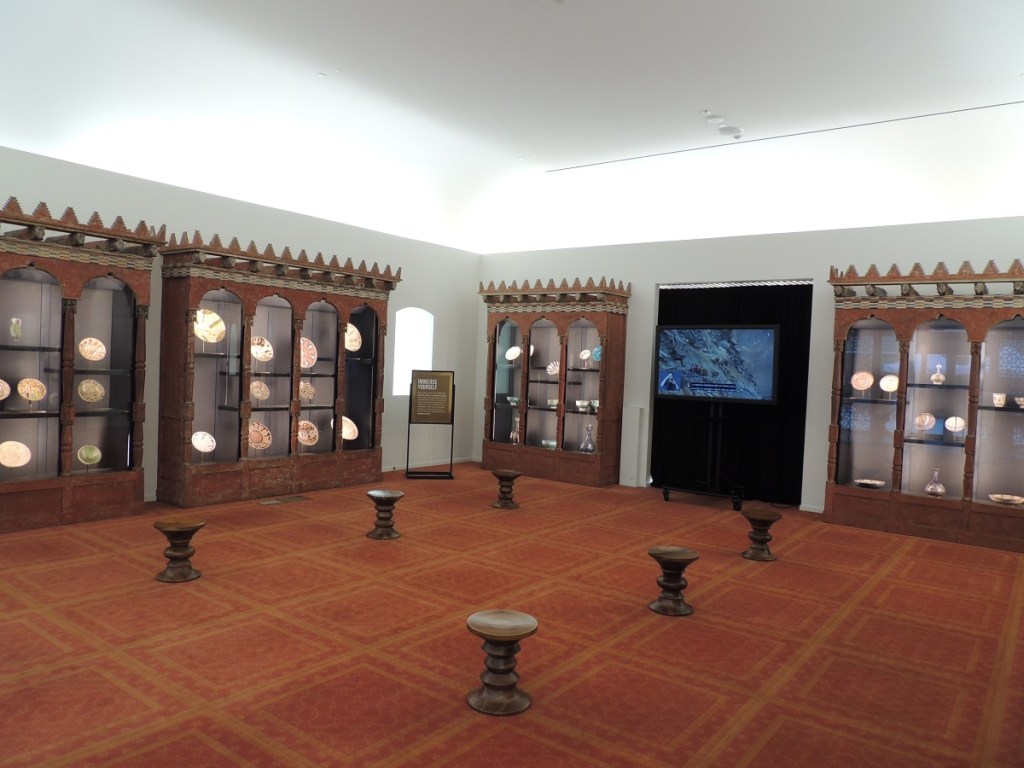
In our “Photo of the Day” feature published in Simergphotos on June 2, 2021, musician, author and artist Afraaz Mulji picked out the ceramic object Simurgh as his favourite piece among 60 other ceramic works of art that make up the beautiful Bellerive Room at Toronto’s Aga Khan Museum. The collection was gifted by Prince Sadruddin Aga Khan’s widow, Princess Catherine, to honour his memory. The Prince (d. 2003) was a consummate collector who formed one of the great collections of art from the Muslim world.
Bellerive Room, Aga Khan Museum, Toronto. Photo: Malik Merchant/Simerg.
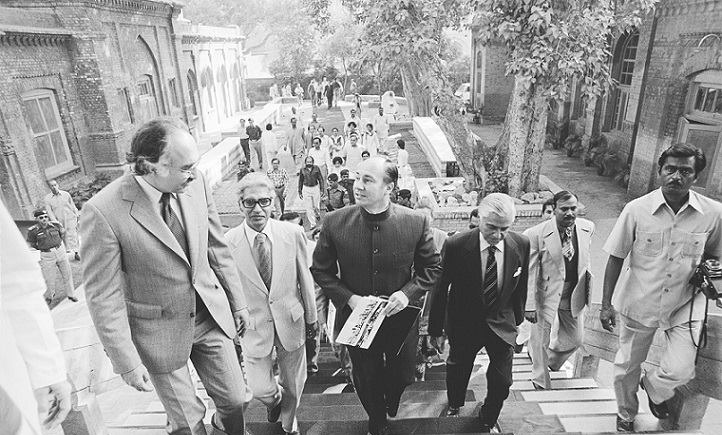
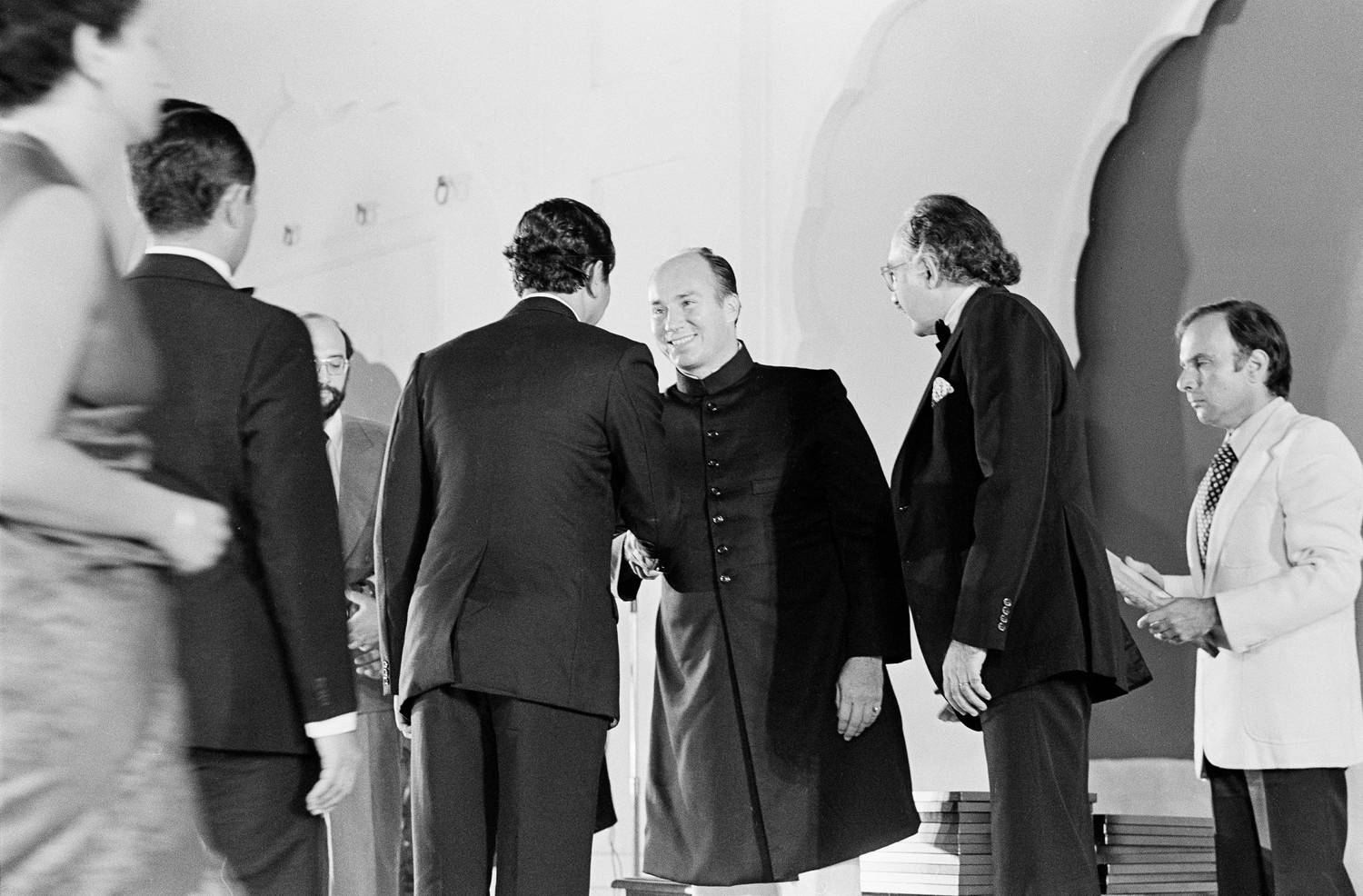
Looking through Mawlana Hazar Imam’s speeches, we noted that he had mentioned Simurgh in a dynamic and stirring address that he delivered at the inaugural ceremony of the Aga Khan Award for Architecture held in Lahore, Pakistan on October 23, 1980.
Article continues below
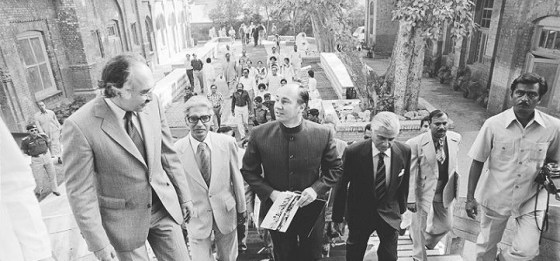
Mawlana Hazar Imam, His Highness the Aga Khan, arrives for the inaugural ceremony of the Aga Khan Award for Architecture held on October 23 1980, in Lahore, Pakistan. Photo: AKDN/Christopher Little.
Mawlana Hazar Imam, His Highness the Aga Khan, presents the Aga Khan Award for Architecture to representatives of the Kampung Improvement Programme (KIP) in Jakarta, Indonesia at the first award ceremony held on October 23. 1980, in Lahore, Pakistan. Photo: AKDN/Christopher Little.
Mawlana Hazar Imam said:
“…..as we celebrate the first Awards and open the way for the forthcoming ones, all these challenges (Please read Speech at AKDN) can help us in defining the attitudes we must develop in thinking of the future and the areas of discovery open to us. It is a task we must accomplish together, fully acknowledging our diversities, but knowing, as well, that there is a Straight Path which is that of our Faith.
“Let me close, therefore, by reminding you of Attar’s great poem, the Conference of the Birds, Mantiqat at-Tayr.
“The birds, you will recall, in huge quantities went in search of the Simurgh, the ideal and perfect king. After many tribulations, thirty of them do reach the end of the journey and come to the gate of the Supreme Majesty. The Chamberlain tests them and then opens the door and they sit on the masnad, the seat of the Majesty and Glory. And, as an inner glow came into them, they realised that it is they together who were the Simurgh and that the Simurgh was the thirty birds.
“Is this not what these Awards mean? From the travails and labours of thousands, humble masons or expensive experts, there have emerged those works made by us and for us which we can present as being, all together, as an aggregate, as a group, the statement of our hopes and of our expectations as much as of our achievements.”
________________
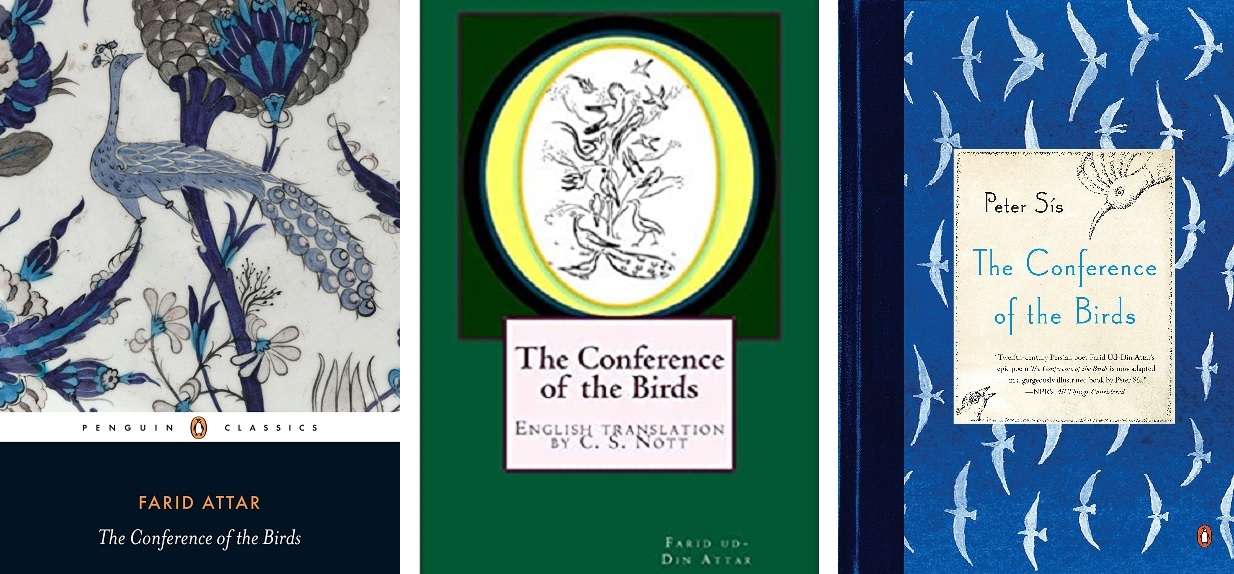
The Conference of the Birds: Selected Works in English
From left: Front covers of The Conference of the Birds by Davis, Nott, and Sis. Click on links below for pricing and availability. May we note that there are translation by other writers.
1. Attar’s Conference of the Birds by C.S. Nott has been available for more than 60 years in English, with a newer paperback released in 2016. Please check out C.S. Nott Conference of the Birds on Amazon.
3. More recently Peter Sis, an award winning children’s book writer and illustrator, has offered a beautiful and uplifting adaptation of Attar’s poem which is available in both hardback and paperback formats. See Peter Sis Conference of the Birds on Amazon. See also its availability at Bookoutlet.
Date posted: June 3, 2021.
_______________________
We welcome feedback from our readers. Please complete the LEAVE A REPLY form below or click Leave a comment. Your letter may be edited for length and brevity, and is subject to moderation.
Before departing this website please take a moment to review Simerg’s Table of Contents for links to hundreds of thought provoking pieces on a vast array of subjects including faith and culture, history and philosophy, and arts and letters to name a few. Also visit Simerg’s sister websites Barakah, dedicated to His Highness the Aga Khan, and Simergphotos.
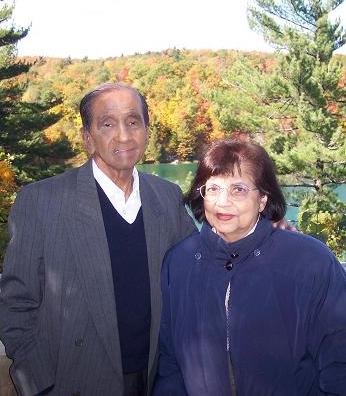
Alwaez Jehangir and Alwaeza Maleksultan Merchant pictured at Gatineau Park during their visit to Ottawa in 2007.
Thursday May 27, 2021, will be the 3rd anniversary of the passing of Jehangir Merchant (December 13, 1928 – May 27, 2018), father of Malik (publisher and editor of this website), Fahar and his wife Nina, Alnoor and his fiance Shellina; grandchildren Naim and Nurin; and sister Banu. Our mother and grandmother, Maleksultan (popularly known as Mrs. Merchant), who was our dad’s partner of 66 years, was then still alive; she passed earlier this year on January 21, 2021. This website was launched twelve years ago in the spring of 2009 with their encouragement, guidance and support. The first piece published in Simerg was entitled The Mystery of the Missing Mount Nasir Khushraw.
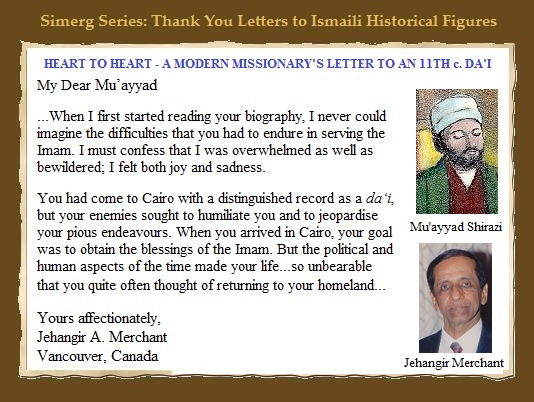
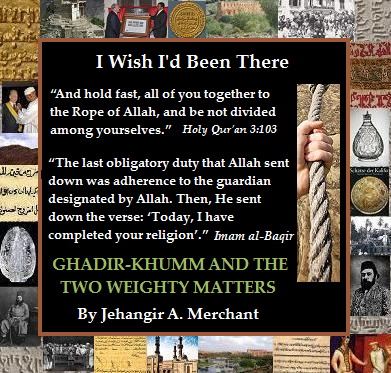
Among several articles by my dad that were published on Simerg, two original contributions that absolutely stand out and are a must read are (1) a letter of gratitude to his greatest hero in Ismaili history, the Fatimid missionary Muayyad din Shirazi and; (2) Ghadir Khumm and the Two Weighty Matters for the acclaimed series I Wish I’d Been There. Please read the two pieces by clicking on the hyperlinks I have provided in the preceding sentence or on the two images shown below.
Please click on image to read Jehangir A. Merchant’s thank you letter to Fatimid missionary Al-Mu’ayyad al-Shirazi
*******
Please click on image to read Jehangir A. Merchant’s “Ghadir-Khumm and the Two Weighty Matters”
We fondly remember our parents and grandparents, and pray for the eternal peace of their souls. Ameen.
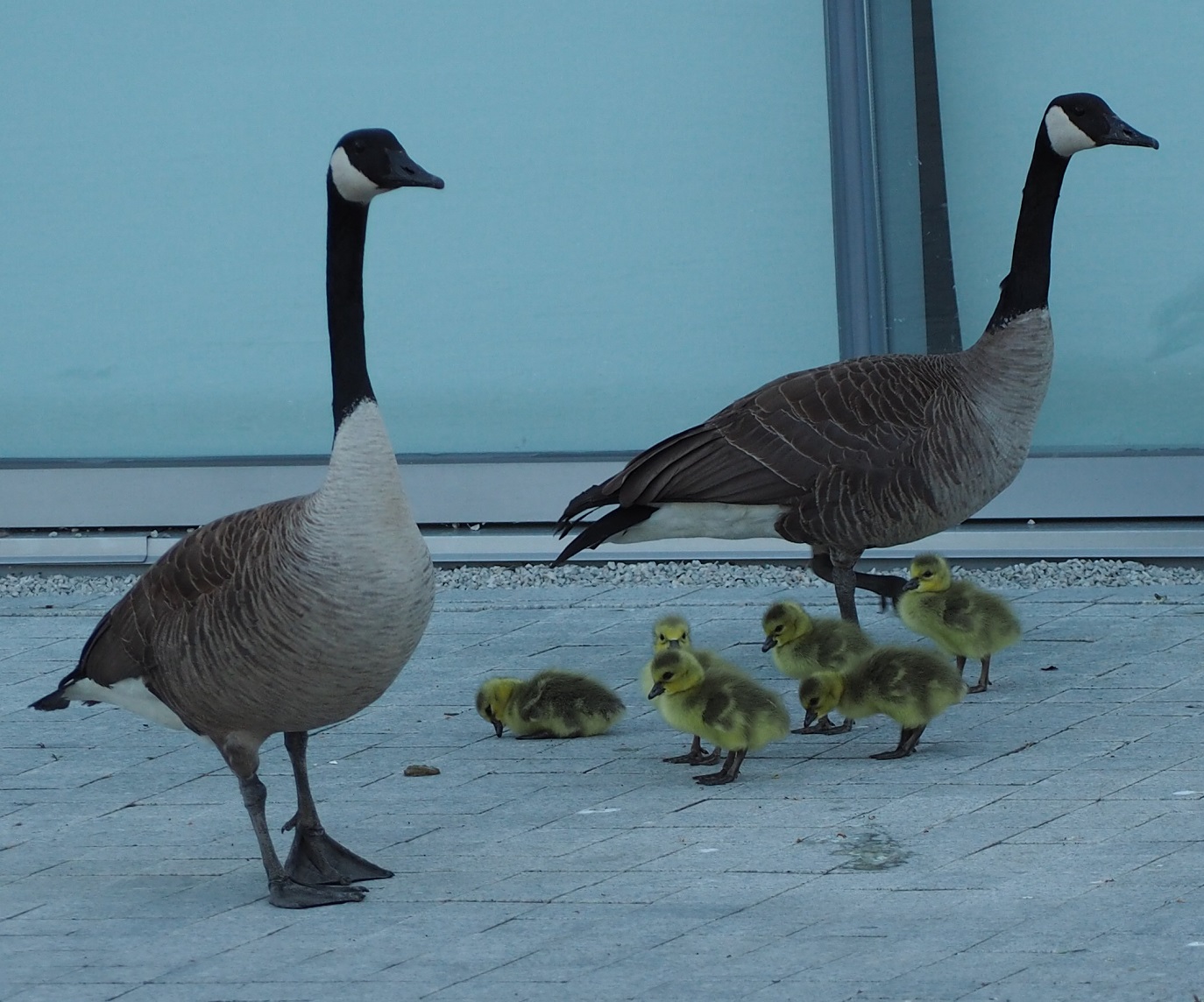
The female goose I had photographed so many times in the weeks before I travelled to Vancouver lay on her eggs for around 28 days. No food, no drinks, no wandering around!
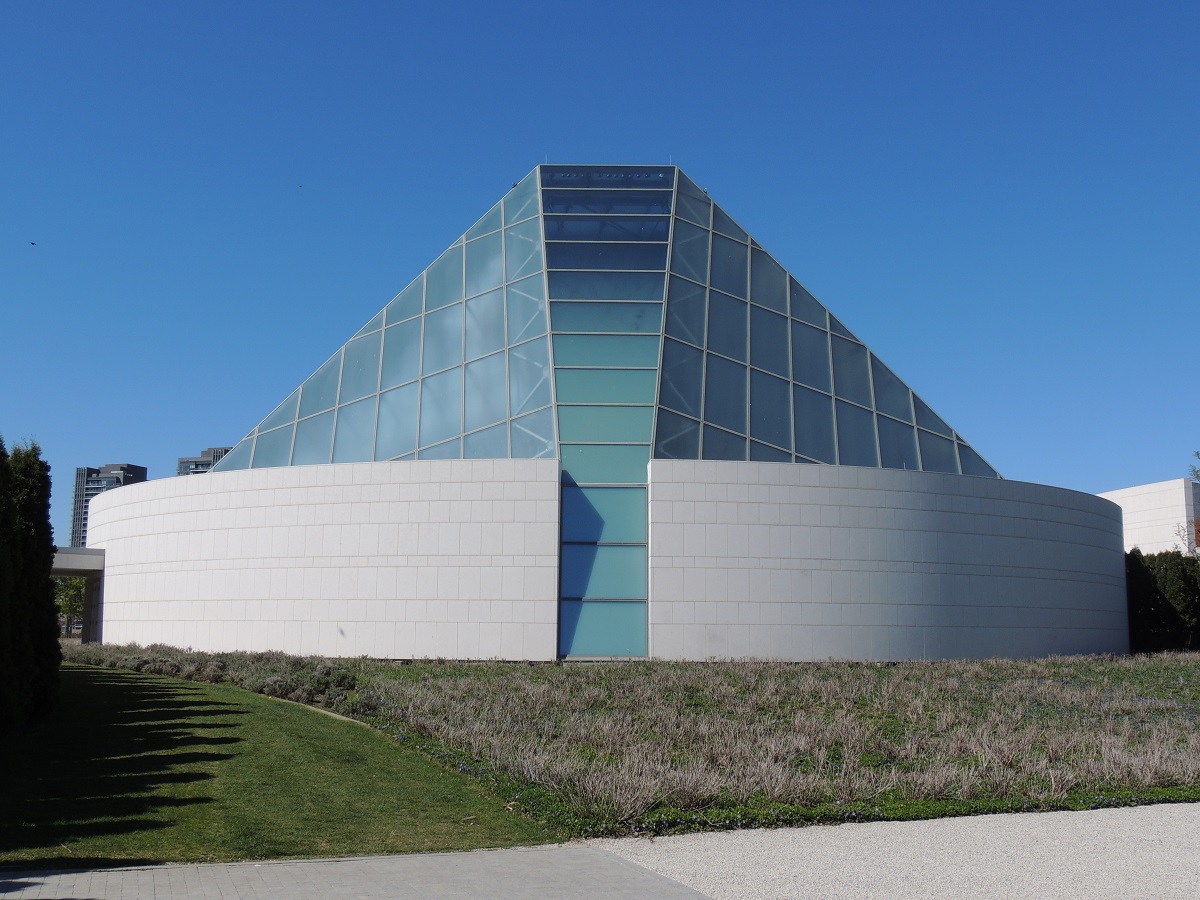
She had to find a perfect spot to protect her nest from animals and human interference, and that she did at a shrub just outside the South East wall of the Ismaili Centre. What a strategy — uncomplicated and safe!
The eggs hatched on the morning of Wednesday May 12, as per the security guard who was present at the nesting site when I met him. My plan was to actually go to Edward Gardens for a long walk but instead of travelling straight on Wynford Drive to reach Don Mills Road, I “lost my senses” and ended in the parking lot of the Aga Khan Museum. I couldn’t have been happier, with what I saw and came away with.
I would call it “A Miracle of Life” and it took place at the end of Ramadhan, and on the day of the sighting of the new moon that Ismaili Muslims celebrate as Chandraat as per the wishes of their 48th Imam, Mawlana Sultan Mahomed Shah, His Highness the Aga Khan (1877-1957). He bestowed the night on the Ismailis for the inner peace and happiness it would bring. For me seeing this phenomenon of birth, and looking at the tiny goslings was an incredible and joyous event. I consider it as the most appropriate gift of Eid ul-Fitr. Enjoy the photographs.
To my fellow brothers and sisters in the Ismaili community, I share with you the following message that Mawlana Hazar Imam, His Highness the Aga Khan, conveyed to us a year ago on the occasion of Eid ul-Fitr:
“It is my wish that my Jamat should look to the future with hope and courage, in keeping with its age-old tradition of unity, generosity and mutual support which has at all times enabled it to move forward to a position of enhanced strength and resilience, from generation to generation.
“My spiritual children should always remain mindful that it is the principles of our faith that will bring peace and solace in these times of uncertainty. I am with my Jamat at all times, and each of you, individually, is always in my heart, in my thoughts and in my prayers.
“I send my most affectionate paternal, maternal loving blessings to all my Jamat – for happiness, good health, confidence and security in your lives ahead, and for mushkil-asan.”
My daughter Nurin joins me in conveying all readers of Simerg, Barakah and Simergphotos Eid Mubarak with best wishes and prayers for good health; long lives and success in all walks of life.
Date posted: May 13, 2021. Last updated: May 14, 2021 (link to updated version of post, click HERE)
________________________
Before departing this website please take a moment to review Simerg’s Table of Contents for links to hundreds of thought provoking pieces on a vast array of subjects including faith and culture, history and philosophy, and arts and letters to name a few. Also visit Simerg’s sister websites Barakah, dedicated to His Highness the Aga Khan, and Simergphotos.
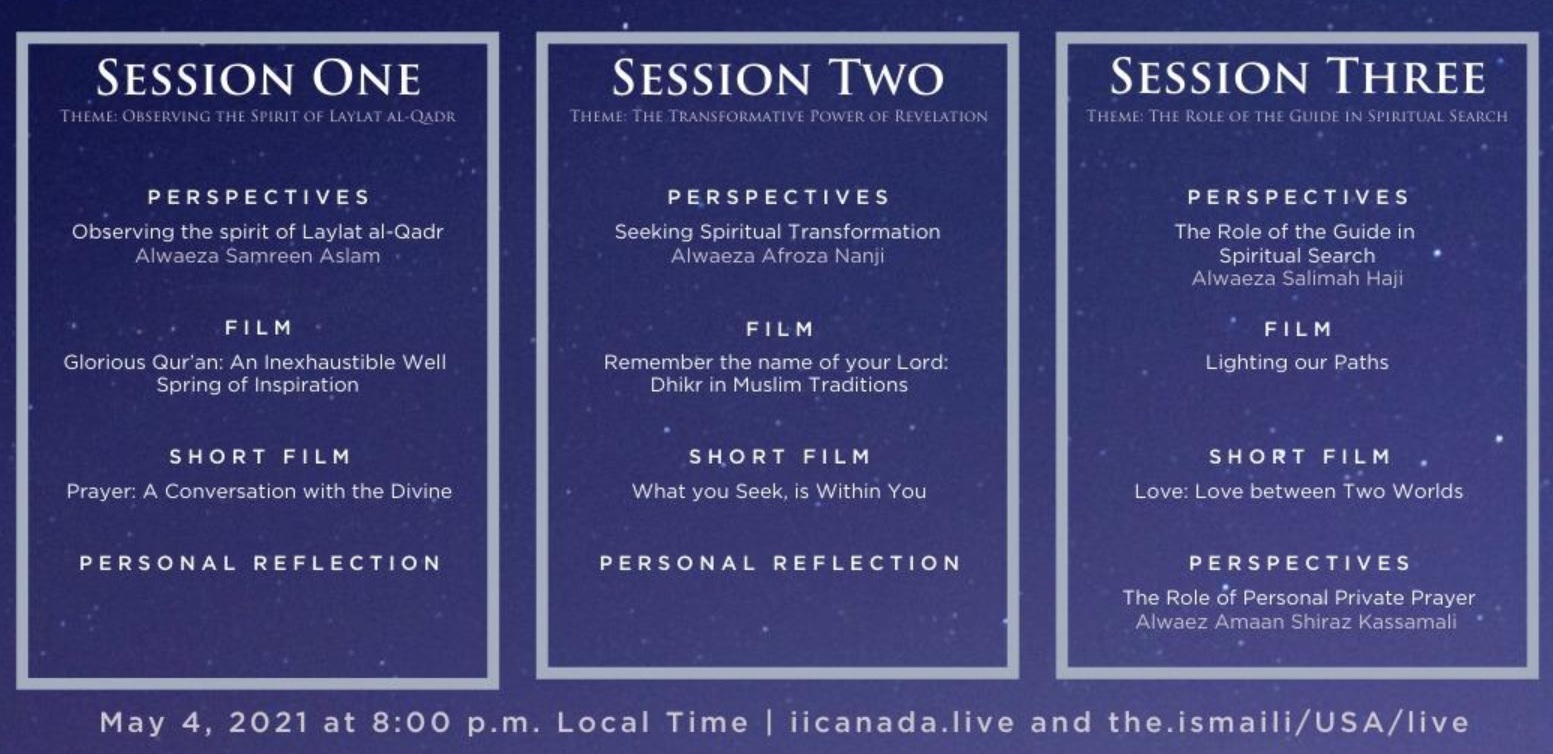
Ismaili Muslims observe Laylat al-Qadr on the 23rd night of Ramadhan, which falls on Tuesday, May 4, in 2021. Jamati members across North America are cordially invited to participate in a special Laylat al-Qadr program that will be held in three sessions as highlighted in the poster below (click on image for enlargement).
Please also click HERE for the institutional events page, and click on Laylat al-Qadr to read Simerg’s piece on the Night of the First Revelation of the Holy Qur’an.
Verses from the Holy Qur’an on the Immaculate Conception of Jesus Christ
19:17 Then We sent unto her Our Spirit and it assumed for her the likeness of a perfect man.
19:18 She said: Lo! I seek refuge in the Beneficent One from thee, if thou art God-fearing.
19:19 He said: I am only a messenger of thy Lord, that I may bestow on thee a faultless son.
19:20 She said: How can I have a son when no mortal hath touched me, neither have I been unchaste?
19:21 He said: So (it will be). Thy Lord saith: It is easy for Me. And (it will be) that We may make of him a revelation for mankind and a mercy from Us, and it is a thing ordained.
19:22 And she conceived him, and she withdrew with him to a far place.
19:23 And the pangs of childbirth drove her unto the trunk of the palm-tree. She said: Oh, would that I had died ere this and had become a thing of naught, forgotten!
[Mary complains to a palm tree about the pains of childbirth. The tree tells her to shake its trunk and ripe dates will fall.]
19:24 Then (one) cried unto her from below her, saying: Grieve not! Thy Lord hath placed a rivulet beneath thee,
19:25 And shake the trunk of the palm-tree toward thee, thou wilt cause ripe dates to fall upon thee.
19:26 So eat and drink and be consoled. And if thou meetest any mortal, say: Lo! I have vowed a fast unto the Beneficent, and may not speak this day to any mortal.
19:27 Then she brought him to her own folk, carrying him. They said: O Mary! Thou hast come with an amazing thing……CLICK TO READ FULL ARTICLE
Date posted: December 25, 2020.
Before departing this website please take a moment to review Simerg’s Table of Contents for links to hundreds of thought provoking pieces on a vast array of subjects including faith and culture, history and philosophy, and arts and letters to name a few.
(Editor’s note: As of November 20, 2020, Jamatkhanas in the Canadian province of British Columbia (BC) are once again temporarily closed due to orders issued by the provincial government that impact all places of worship. The BC Jamatkhanas had re-opened at the beginning of August with limited attendance capacity both in the evenings and mornings. Zaher Ahamed’s excellent piece is an attempt to convey his joyful experience of attending a Jamatkhana in Canada in the midst of Covid-19. On new developments about Jamatkhana openings and closures in Canada, please subscribe to the official Al-Akhbar electronic bulletins distributed by Ismaili institutions in Canada).
“Maybe….because of this pandemic, I have experienced the true nature of our faith and gained a new insight into one of our central religious practices of our tariqah: the remembrance of Him in His house during the hour of Baitul Khayal” — Zaher Ahamed
By ZAHER MEGHJI AHAMED
Headquarters Jamatkhana Vancouver. Photo: FNDA.
It was our first journey to the re-opened Headquarters Jamatkhana in Vancouver during a pandemic: it was for the early morning contemplation and prayers or Baitul Khayal during the earlier part of August, and it turned out to be a total ethereal, peaceful and powerful experience, the closest I have ever felt to the presence of the Nur (Light) of Imam in a what had become a truly perfect sacred spiritual space.
There was pin drop silence! The pandemic protocol put in place, after going through a painless computerized registration system as you entered, did not permit for social chit-chat, small talk and worldly conversations over a cup of chai before entering the sacred space.
We were swept with only the thought of Him silently with dignity into the Jamatkhana prayer hall. We were in a peaceful dignified space, where there was not a word between the murids, each masked, each enclosed in his or her own socially distanced bubble. The conversation was only with Him, just as it was meant to be. We felt ourselves immersed in the cosmic quiet and stillness, focusing now only on seeking out moments of happiness through the Divine Word, knowing that, with the Imam’s presence in this space, He was with us blessings us on our own individual journey to seek to come nearer to Allah through the Nur of Hazrat Ali.
With a silent and reflective utterance of “Haizanda” (He is ever living) we stepped into this sacred space and right into his presence! With closed eyes, a quiet mind and an open heart we slipped into the rhythm of silently uttering the Divine Word, first with our lips and then in our hearts, feeling it flow through, ever so slowly, into the depth of our soul, awakening it: and over a period of time, the word now deeply embedded released moments of energy, awareness, joy and happiness…. all in a timeless moment, the soul wanting to stay for ever and then…. the hour was over in what seemed like a second…. with the promise of another day to be again in His presence in this sacred space.
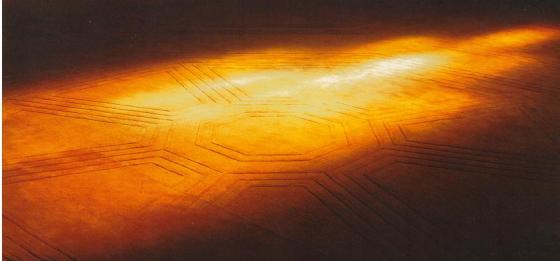
“Sacred Space” – the Jamatkhana prayer hall, Ismaili Centre Vancouver. Photo: Bruno Freschi Collection, 1985.
This is what the house of the Lord was meant to be like!
Then, without a word with anyone, we stepped straight outside into our car, carrying the peace that was in our hearts. And on our way home, we saw the light of the waning moon with Venus ablaze shining on us, leaving us speechless in the cosmic balance of His creation.
The calmness that we had felt in the Jamatkhana continued on our journey home. It was then that I remembered Hunza, where I had felt that same pin drop silence with no words in calm and quiet in a Jamatkhana with a dimly lit hall, “a sacred space,” in Karimabad. And now, I had once again experienced that in my own Jamatkhana in Vancouver — and that too in a global pandemic or maybe because of a global pandemic!
Maybe, ironically, because of this pandemic, I have experienced the true nature of our faith and gained a new insight into one of our central religious practices of our tariqah: the remembrance of Him in His house during the hour of Baitul Khayal.
Going for Ibadat in the morning, in its truest sense, should be an act filled with a simplicity and a reverence of the highest kind for this sacred space devoid of any refreshments, hanging around the chai table and having meaningless conversations that last until almost 5 a.m!
Spaces created in Jamatkhanas for prayer are sacred spaces!
It was truly a unique experience and in terms of the logistics, the whole process of going to the Jamatkhana, from the time of arrival until departure, was very well organized, with an army of well trained volunteers directing your every move: Your car on arrival is directed into a pre-planned space; if you have not brought your mask one is provided to you; next you confirm your spot and answer standard Covid-19 protocol questions and have your temperature taken; you then get directed into the shoe/coat area, have your hands sanitized and then are led finally into your own space.
When the limited rites and ceremonies, tailored to keep murids safe, are completed, you are led out to your car in an orderly manner. Fifty pre-allocated murids who have come to the Jamatkhana for the morning Ibadat and prayers each, I believe, leaves with a unique experience.
What else are we witnessing during the pandemic?
I believe, we are seeing the birth of a “global Ismaili renaissance” showcased and driven by a digital platform of webinars, zoom sessions and the Ismaili TV. We are seeing the fruition of the coming together of Ismaili talent in all its forms: academic scholars and waezins, health care professionals, dancers, musicians, singers, consultants, counselors, journalists, Aga Khan Development Network (AKDN) executives and staff, and Jamati leaders, all the result of our Imam’s extraordinary vision and its execution over the last 60 years.
It is like seeing a period of our rich Fatimid heritage in a digital mirror!
Seniors are zooming… the youth are dancing, men are cooking… women are leading and “dadimas” (grandmothers) are “face timing… and all this within just the last 7 months.
Learning, Mawlana Hazar Imam has often said, should continue throughout our lives. Age should not be a constraint, and this is precisely what we are witnessing. We are exploring with full confidence, and thousands of voices from around the world and from our global Jamat are now being heard directly. This is the commencement of a new digital communications era, and the challenge now will be to stay truly connected and to manage this era carefully with awareness and sensitivity so that it does not stifle in its own success.
As for me and my family, this pandemic has brought us even closer and it feels good to be in the centre of “This Ismaili Renaissance”.… a truly humbling experience!
Date posted: November 20, 2020.
________________________
Zaher Ahamed
Zaher Ahamed is an internationally recognized expert in Strategic Marketing, Multicultural Communications, Diversity & Human Resources Development, Strategic Planning, Design & Project Management. His over 40 years of Business & Consulting experience includes working with Expo 86, the Royal Bank of Canada, Life Care International, Terry Fox Foundation, WIOMSA (Zanzibar), Governments of Canada & British Columbia as well as holding teaching positions with the University of Stockholm, Red Deer University and BCIT in Europe and in Canada.
He has had extensive experience working for corporate and not-for-profit organizations in the Middle East and Africa. In Nairobi, Kenya, he worked with the Aga Khan University Hospital, as a project manager for the establishment of turnkey state-of-the-art digitally connected Pilot Primary Health care and diagnostic Aga Khan Medical centres in East Africa. His volunteer experience includes working in Syria, Zanzibar, East Africa, Sweden. USA and Canada. He is multilingual and has a deep interest in Ismaili history and Ginanic and Sufi traditions. Now retired in Vancouver, BC, Canada, Zaher continues to perform voluntary work with Ismaili and non-Ismaili institutions around the world.
________________________
We welcome feedback from our readers. Please complete the LEAVE A REPLY form below or, if you don’t see the box, please click Leave a comment. Your letter may be edited for length and brevity, and is subject to moderation.
Before departing this website please take a moment to review Simerg’s Table of Contents for links to hundreds of thought provoking pieces on a vast array of subjects including faith and culture, history and philosophy, and arts and letters to name a few.
“I would take my students on a field trip to Toronto to see this miracle of miniature painting, one that continues to fascinate when greatly magnified. It features extraordinary details of flora and fauna, as well as a rainbow coalition of human beings from every continent and culture, much as one sees on the streets of Toronto.” — Gary Tinterow, Museum of Fine Arts, Houston, on the Shahnameh Folio ‘Court of Gayumars’ at the Aga Khan Museum
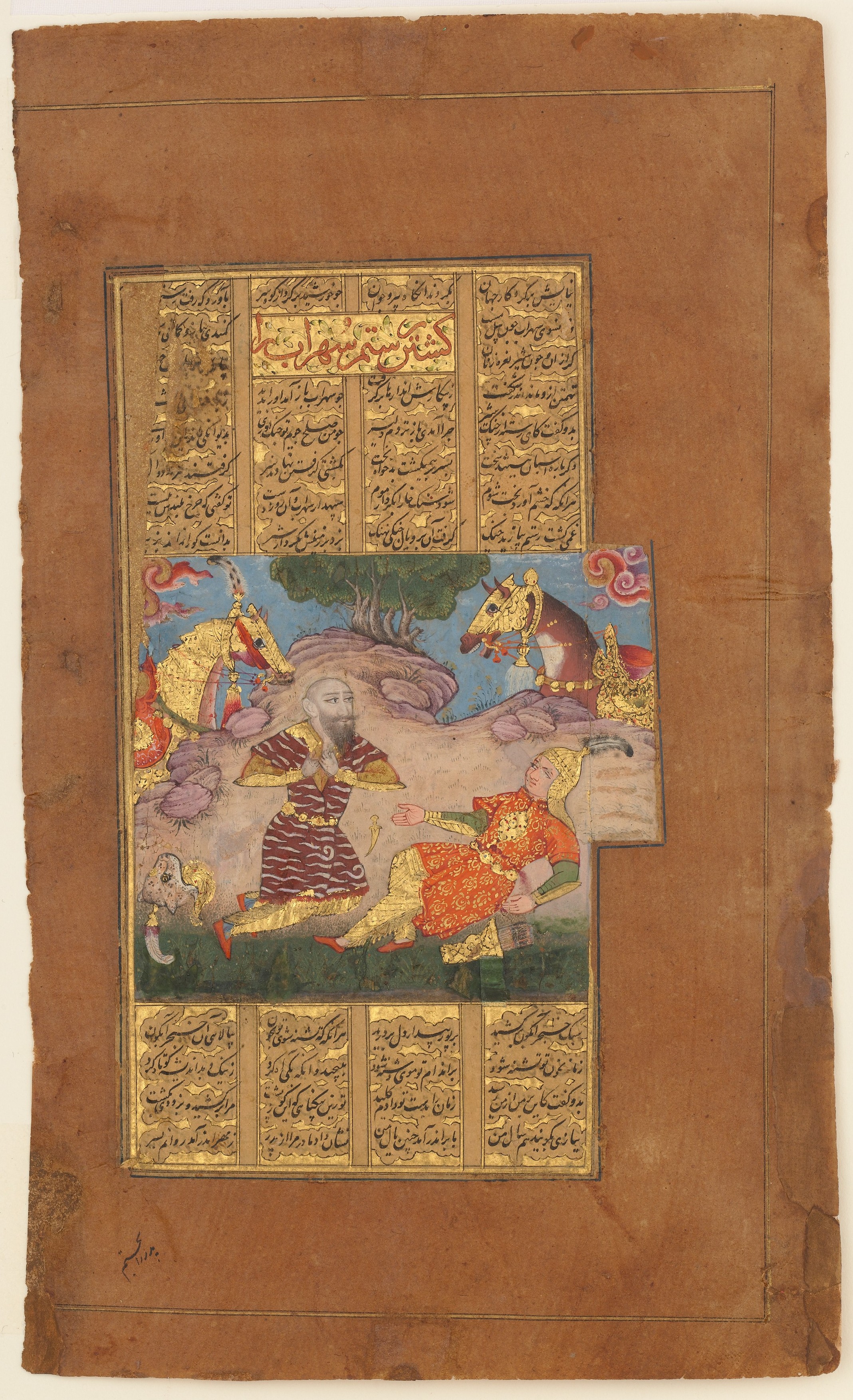
When I first started learning English upon my arrival in the early 1960’s in Dar es Salaam from Lourenco Marques (now Maputo), Mozambique, where I had received instructions in Portuguese at my primary school, in Gujarati at today’s equivalent of Baitul Ilm classes, and spoke Hindi at home, my dad presented me with a hardback version of the story of Rustum (or Rustam) and Sohrab (Suhrab). It was a large print book with beautiful illustrations. However, it was also story of tragedy. Rustum had been separated from his princess (Tahmina) for a long time, and did not know that he had a son named Sohrab from her. Several years later, the father and his son met on one to one combat on opposing sides, where Rustum wrestled Sohrab to the ground and fatally injured him. Rustum, to his horror, realised the truth when he saw his own arm bracelet on Sohrab, which he had given to Tahmina many years before and which she had in turn given to Sohrab before the battle, in the hope that it might protect him.
Little did I know then, that this was a story from Shahnameh, The Book of Kings, written by Ferdowsi, now some 1030 years ago.
The hero Rustam was unaware that he had a son, Suhrab, by Princess Tahmina. It came to pass that the two met in battle, fighting on opposing sides. They struggled in single combat until Rustum stabbed Suhrab fatally. Rustum realized that he had slain his own son when he saw Suhrab’s arm bracelet, which he himself had given to Tahmina many years before. Tahmina had given it to Suhrab before the battle, hoping it would protect him. Photo: Wikipedia, CCO 1.0 Public Domain.
The illustration from the book, which my beloved late father Jehangir Merchant had given me, of a father standing above his son, whom he has just mistakenly killed in a combat, is one of the most powerful and saddest images I have seen in storytelling. The folio of the father and son in tragic combat that is shown above is from the collection of New York’s Metropolitan Museum of Art.
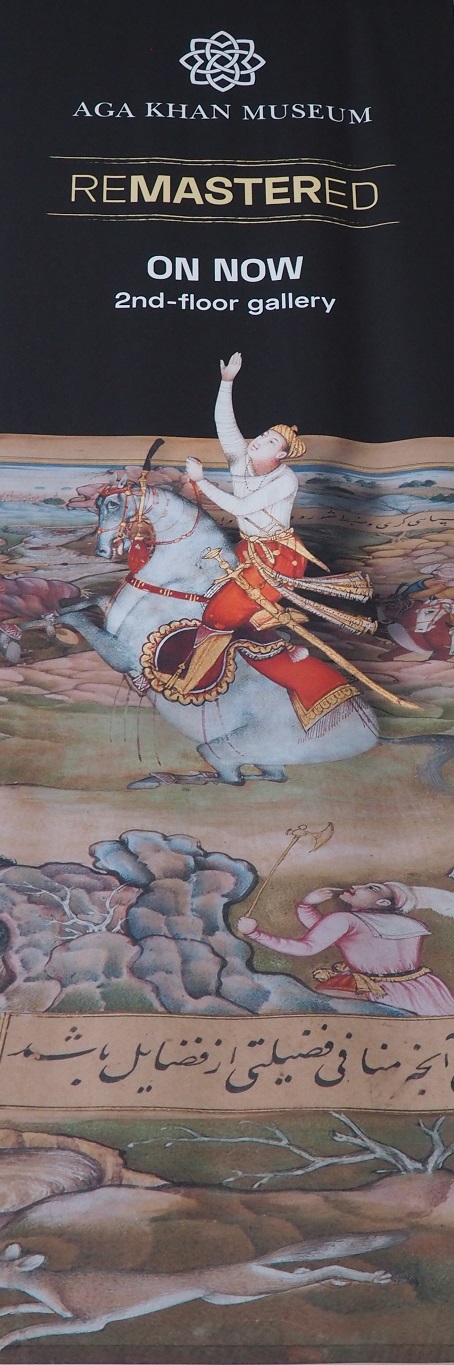
Remastered at Aga Khan Museum until March 21, 2021. Photo: Malik Merchant /Simerg
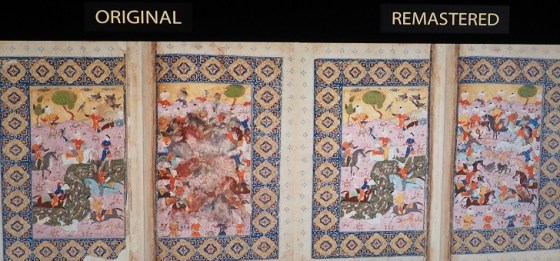
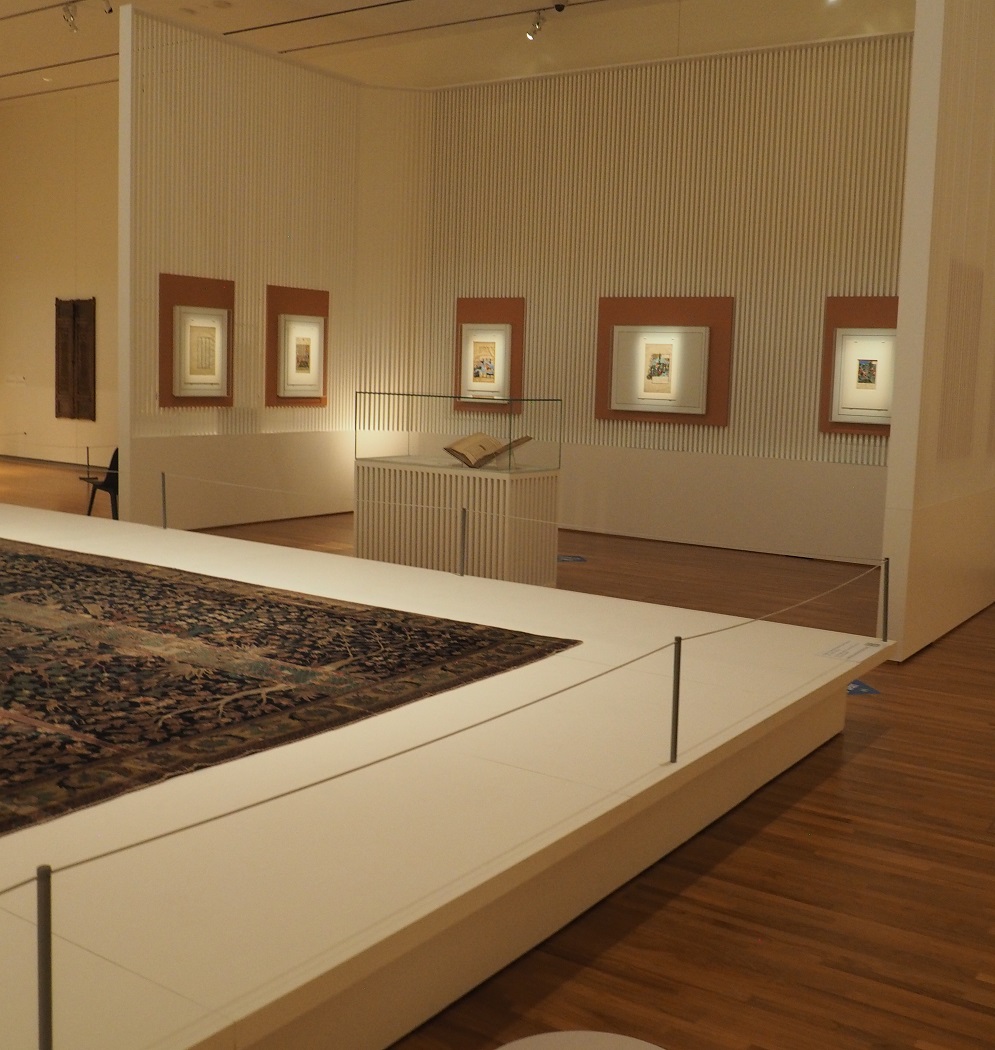
The Aga Khan Museum does not have any folios from the Shahnameh depicting this specific battle scene, but some other outstanding loose folios from the Shahnameh form part of a new exhibition under the theme REMASTERED in the museum’s upper gallery (running until March 21, 2021). In addition, the permanent collection on the main floor of the museum contains other magnificent folios from a number of illustrated manuscripts of the Shahnameh that were produced during the 13th-16th centuries. These folios are located just at the right of the Wagner carpet exhibit.
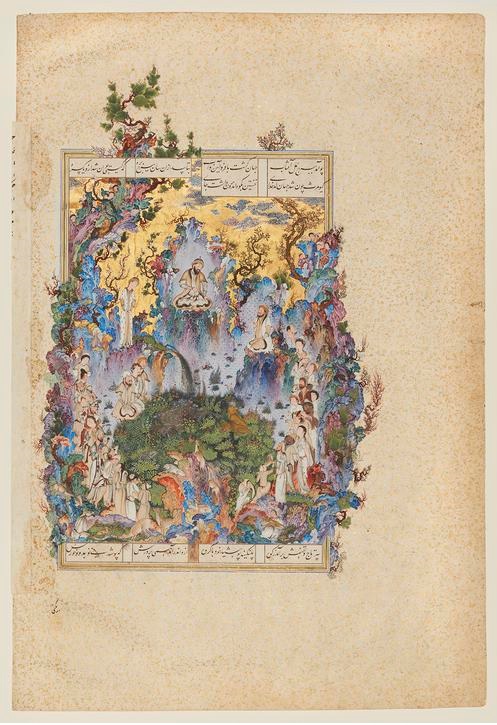
Missing from display, at the moment, is what is considered to be one of the finest folios from the Shahnameh, called The Court of Gayumars. Apollo Magazine, in its issue dated August 29, 2018 recommended the Gayumars as “one of the pieces that every school kid in the USA needs to see.” Writing for the issue, Gary Tinterow, Director of the Museum of Fine Arts, Houston, stated:
“I would take my students on a field trip to Toronto to see this miracle of miniature painting, one that continues to fascinate when greatly magnified. It features extraordinary details of flora and fauna, as well as a rainbow coalition of human beings from every continent and culture, much as one sees on the streets of Toronto.” He has also recommended that when the folio is exhibited, it should contain a little bit of commentary.
And speaking of the new REMASTERED exhibition itself, Ulrike al-Khamis, the acting Director and CEO of the Aga Khan Museum, in a recent press release stated: “We have created one of the most innovative showcases of Islamic manuscript paintings ever to have been assembled. Remastered invites viewers to immerse themselves in the beauty of some of the most impressive masterpieces in the Islamic tradition and find new meaning in centuries-old stories of heroism, love and principled living.”
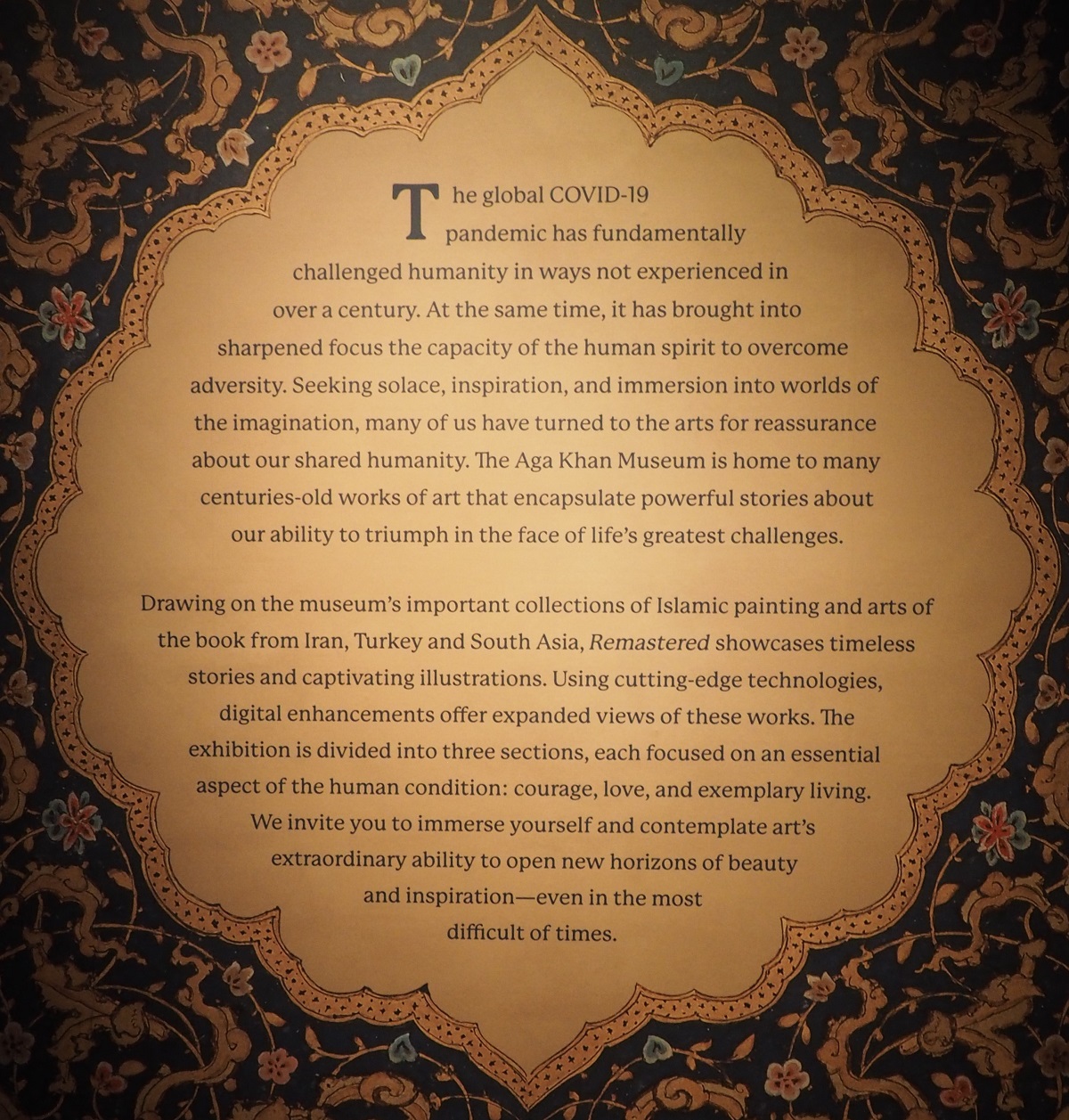
Aga Khan Museum’s introduction to the new Remastered Exhibition, on until March 21, 2021. Photo: Malik Merchant / Simerg.
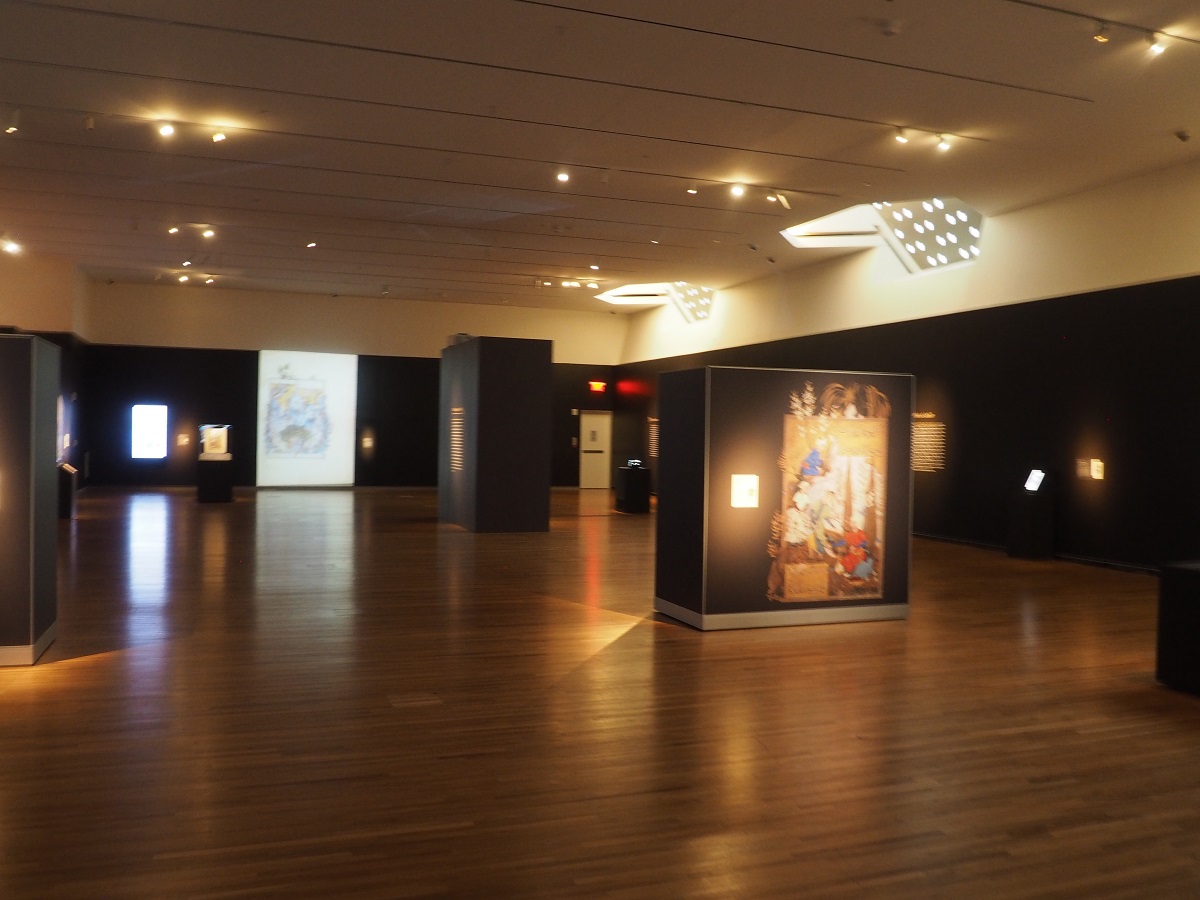
A view of the Remastered Exhibition that runs on the second floor of the Aga Khan Museum in Toronto until March 21, 2021. Photo: Malik Merchant / Simerg.
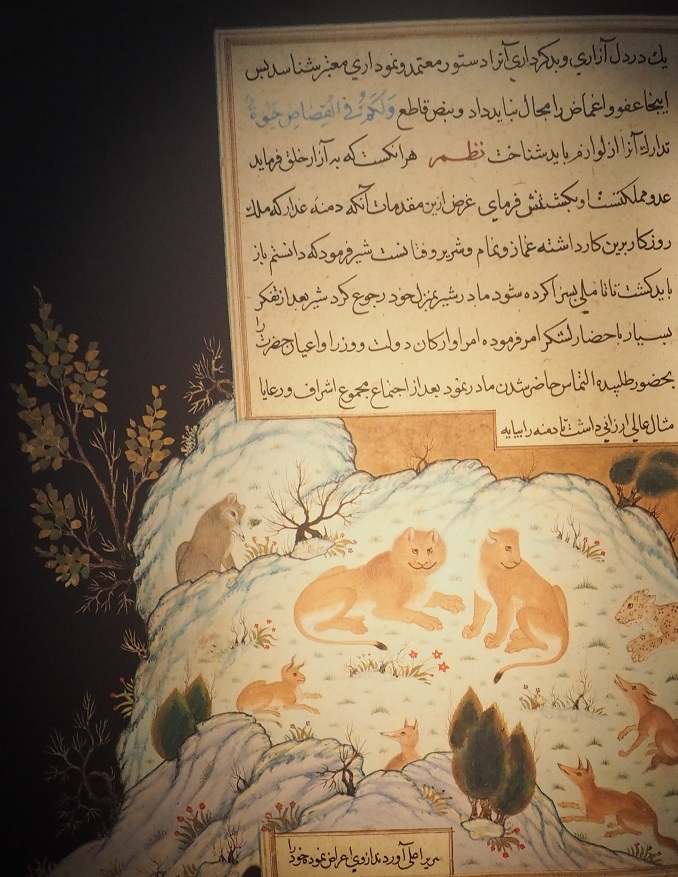
A display at the Remastered exhibition which was launched recently at the Aga Khan Museum, and continues to March 21, 2021. Here the jackal Dimneh is brought before the Lion-King and his mother. Illustration from a manuscript of Anvar-i Suhaili, Iran 1593. Photo: Malik Merchant / Simerg.
Over the coming weeks, we plan to publish special features on the folios in the Remastered exhibition that powerfully present tales of courage, stories of the heart, and exemplary living or model life, along with their corresponding digitally engaging panels prepared by Ryerson University library that offer new ways of understanding the manuscripts.
“Ferdowsi is everything we expect of a great poet…, for he teaches us both what people are and what they should become” — Federico Mayor
The focus of this post is on the Shahnameh, which forms an integral and important component of Remastered. What is the Shahnameh and who was Ferdowsi? Of course, readers will find many resources on the internet but I have come across a fantastic address delivered by UNESCOS’s former Director General,Federico Mayor in 1990 on the 1000th anniversary of the completion of the Book of Kings. His piece, below, is a must read.
Ferdowsi’s Shahnameh: The Book of Kings
An image of folio Court of Gayumarfrom Firdawsi’s Book of Kings. This page is considered as one of the most exquisite pieces in the Aga Khan Museum collection, and has been recommended as one that every student must be taken to see. Photo: The Aga Khan Museum.
“The ‘intellect’, which Ferdowsi calls Kherad, demands more than ‘intelligence’ in the common meaning of the term: it includes the ability to perceive good, a deep-seated and generous wisdom and a serenity that comes from balance and self-control. The concept of Kherad runs through the entire book, being at one and the same time its dominant theme, the spirit that animates it and the good it extols” — Federico Mayor
By FEDERICO MAYOR
The following article has been adapted from an address delivered in Tehran on December 22, 1990 by Mr Federico Mayor, to mark the celebration of the 1000th anniversary of the completion of the manuscript of the Book of Kings (the Shanameh by Firdausi). At the time, Mr. Mayor was the Director-General of the United Nations Educational, Scientific and Cultural Organization (UNESCO). Mr. Mayor’s complete address can be read at the organization’s website HERE.
‘Be Name Khodavande Jano Kherad’ (‘In the name of the Lord of the soul and of wisdom’). These majestic words open the Shahnameh, The Book of Kings, that monument of universal literature. And as I read on I discover, immediately after the glorification of the Creator, a passage on this second page that forces me to stop, taken aback with amazement, wonder and near disbelief: the words before me sing the praises of intelligence!
Can it really be that a thousand years ago, an Iranian poet was exalting above all else the process of thought based on knowledge? And he did it with such conviction and felicitous expression that he cannot fail to convince:
‘The intellect is the greatest of all the gifts of God…It is the source of your joys and your sorrows, of ‘your profits and your losses…It is the guardian of the soul, and to it is thanksgiving due’. “
At that instant, I knew I had come across a work and a man of exceptional qualities. This ‘intellect’, which Ferdowsi calls Kherad, demands more than ‘intelligence’ in the common meaning of the term: it includes the ability to perceive good, a deep-seated and generous wisdom and a serenity that comes from balance and self-control. The concept of Kherad runs through the entire book, being at one and the same time its dominant theme, the spirit that animates it and the good it extols.
“Can it really be that a thousand years ago, an Iranian poet was exalting above all else the process of thought based on knowledge? And he did it with such conviction and felicitous expression that he cannot fail to convince” — Federico Mayor
There are few books in the world and in history that have become, like The Book of Kings, an expression of national identity. Ferdowsi’s poem is both the reflection and the leaven of a culture that is in many respects reconciled with itself.
In terms of language, it forms a reservoir, an encyclopaedia of inexhaustible wealth. In terms of historical perspective, it reconciles past and present. In terms of historical perspective, reconciles past and present, integrating in a unified culture the pre-Islamic tradition and the contributions of Islam; that is an achievement whose importance is not perhaps sufficiently appreciated, for the resulting fusion, with its creative repercussions, was to prove most prolific.
Lastly, in terms of literary genre, it is an epic that blends in a single creation the true and the legendary, the observable and the imaginary. Ferdowsi reconciles history and myth, resembling at one moment Herodotus and at the next Homer. As a historian, he relates an episode with the same fervour and magical inspiration as if it were a tale; as a mythologist, he describes an adventure with the same precision and concern for details as if it were drawn from real life.
Ferdowsi thus bequeathed to his country a heritage that has been transmitted from one generation to the next in all its vitality. There are few civilizations in which a poetic work has become so ‘popular’, that is to say both widely known and deeply loved.
Let me say how much I regret that my ignorance of your language prevents me from savouring in full the subtlety of these lines, their majesty and their secret music.
“The 1000th anniversary of the completion of the manuscript continues a long-standing tradition whereby, ever since the death of the poet, scholars have attempted to make amends for the ingratitude of the Sultan to whom Ferdowsi offered this treasure and who failed to appreciate its true value” — Federico Mayor
But even when translated Ferdowsi’s poetry preserves an inimitable charm. The Book of Kings, which was translated into Arabic in the 12th century of the Christian Era, has been avidly read, studied and commented on. Historians, linguists, poets, writers, painters and miniaturists have used it as the source material for the work of several lifetimes. Jules Mohl translated it in its entirety into French in the 19th century, and thanks should be rendered to him for devoting 30 years of his life to the translation of the 60,000 verses that Ferdowsi had spent 30 years perfecting 800 years before.
The task was so tremendous that not all the volumes were published until two years after the translator’s death. Mohl has been the benefactor of countless scholars in Western Europe — he has enabled them to discover one of the summits of world literature.
0n 11 February 1850 the French writer, Sainte-Beuve, in one of his Causeries du lundi (Monday conversations), urged the resumption of publication by the Imprimerie rationale (national publishing house) of what he called ‘the magnificent book’. Stressing the popularity of the work in Iran, he enthusiastically presented the author, his themes and a few episodes, based on his reading of Jules Mohl. His enthusiasm proved to be contagious: the English poet, critic and essayist, Matthew Arnold, became immersed in all the available historical and geographical works on Persia, reread the Iliad, and in 1853 published a splendid poem entitled Sohrab and Rustum, relating the tragic episode of the hero’s killing of his son on the field of battle. A complete translation into English of The Book of Kings was published in 1925; the translation was an enormous task that had been carried out by two brothers, Arthur and Edmund Warner.
A view of the Aga Khan Museum’s folios from manuscripts of Shahnameh, The Books of Kings, that were produced between 13th-16h centuries. At the near end is the famous Wagner Carpet depicting “Islamic Garden of Eternal Bliss.” Photo: Malik Merchant / Simerg.
In Germany, the great lyrical poet and orientalist Friedrich Rückert translated the tragedy of Rustum and Sohrab, at the beginning of the 19th century. Another German poet, Schack, translated the entire epic part of the work, the translation being published in 1853. Complete translations of The Book of Kings exist today in all the widely spoken languages, and numerous translations of extracts exist in some 40 languages.
The 1000th anniversary of the completion of the manuscript continues a long-standing tradition whereby, ever since the death of the poet, scholars have attempted to make amends for the ingratitude of the Sultan to whom Ferdowsi offered this treasure and who failed to appreciate its true value.
And today here, in this hall that bears the poet’s name, we ourselves have now come together from the four corners of the world, to carry on and give new impetus to that tradition. But what is it in The Book of Kings that draws us together, captivates our hearts and enables its author to triumph over both time and place?
0f many outstanding passages in the work, one might mention the meeting of the hero Rustum and his son Sohrab, a beautiful and poignant story of two beings related by blood and brought by destiny to a fatal confrontation. Following in the footsteps of Sophocles, who gave voice to the sufferings experienced by Oedipus when he had murdered his father and then married his mother, Ferdowsi paints the picture of Rustum discovering that he has just killed his own son. This is a perfect example of what Aristotle meant by ‘tragedy’: it is a story that arouses in us feelings of both pity and horror, for Rustum, during the three days of the duel between them, has come to admire the qualities of his adversary — agility, intelligence in combat, nobility and chivalry.
On several occasions, father and son are on the point of recognizing one another; their speeches are tinged with admiration and tenderness, but Fate will not be cheated. When Sohrab dies under Rustum’s blows and Rustum discovers the identity of his victim all Ferdowsi’s readers shudder; all are fathers who have just killed their sons. We can see why this great tragic theme has attracted the attention of poets of all periods and civilizations: the feelings to which it gives rise are common to all times and all countries.
In celebration of the millennium of Ferdowsi’s birth a solemn tribute was paid to him at the Sorbonne, where French poets emphasized the lesson of wisdom he dispensed:
‘This poet is not only an enchanter: he is a scholar; he is not only a scholar: he is a sage. While our heads are still humming with all the wonders he has filled them with our spirits retain the lessons he has given us. Even when the enchantment of his tale fades and we fall back into the normal world from the fairyland into which he had carried us we are not disoriented: on the contrary, the poet deposits us on a well-marked road with a sturdy staff in our hand. Ferdowsi is everything we expect of a great poet…, for he teaches us both what people are and what they should become’.
The Book of Kings is indeed studded with precepts, and it is not uncommon for an episode to be accompanied, in the same enchanting style, by a moral for the reader’s edification.
“the characteristic of Ferdowsi by which he appears eminently modern to us is without doubt, first of all, his faith in the ability of people to rise above hostility, contempt, suspicion and hatred by an impulse of fellow feeling and compassion” — Federico Mayor
Statue of Ferdowsi in Tus, Iran. Photo: Wikipidea / CC by 4.0.
Princes, for example, are exhorted to be humble, in a concept of power in which the notion of ‘service’ predominates. ‘When you become a sovereign,’ says Ferdowsi, ‘behave as a humble servant’. Addressing the mighty, the poet reminds them of the ephemeral nature of all things, like the slave who, in ancient Rome, had to accompany the victor on his triumphal chariot and whisper to him from time to time: Memento quia pulvis es(‘Remember that thou art but dust’). Nevertheless, the characteristic of Ferdowsi by which he appears eminently modern to us is without doubt, first of all, his faith in the ability of people to rise above hostility, contempt, suspicion and hatred by an impulse of fellow feeling and compassion. The French poet Lamartine, moved by the moral qualities with which Ferdowsi endows his heroes, wrote of them: ‘They are more than kings, for kings reign only for a time — and these heroes reign over the future’.
In The Book of Kings there are many colourful battle scenes, but they never glorify vanity nor the thirst for violence. On the contrary, Ferdowsi depicts in them the absurdity of conflict and struggle. We have seen the pain in which the duel between Rustum and Sohrab ends. Elsewhere, Alexander the Great goes to the bedside of his mortally wounded enemy, Darius III. Moved by compassion, he swears to the dying man that he will re-establish peace between the Persians and the Greeks, and when Darius is dead, he organizes his funeral with great ceremonial. In another scene Isfendyar, mortally wounded by Rustum, sees in a flash that his killer is only the instrument of fate and is not truly responsible for his death. Before dying therefore, he entrusts to him the education of his son, Bahman.
Ferdowsi shows his respect for and appreciation of others, with their different religious, ethnic and social backgrounds. Would it not be worth while to relay and amplify this message Asia has passed on to the world down the centuries?
Another view of the Shahnameh folios on the main floor of the Aga Khan Museum. Photo: Malik Merchant / Simerg.
I personally think that The Book of Kings should be distributed as widely as possible. This work is not only part of the human heritage but can also help men and women of the 20th century — what am I saying, the 21st century — to improve and to live in greater peace with themselves and with others. I would in particular want to see it brought to the knowledge of young people throughout the world. By exposing young people to the humanism of Ferdowsi we sow the seeds of wisdom in the minds of those who will forge the future.
‘It is through peace that men achieve happiness’, said Ferdowsi, ‘may those who preach war vanish from our midst’.
Peace, not violence. Temperance, not excess. Mercy, not cruelty. Remember the passage in which the young Iredj sets out in a spirit of peace and wisdom to find his brothers, whose evil designs are known to him. When one of them hits him in anger and is about to kill him Iredj says to him gently ‘Have you no fear of God or pity for our father?…What? You are alive and you want to take the life of another? How can you reconcile these two things? Harm not an ant that is dragging a grain of wheat, for it is alive, and life is sweet and good’ .
This love of life is love of one’s fellow, of all others. Ferdawsi, the Persian national poet, is not a chauvinistic poet. This is why the Arabs, the Turks and the Indians have adopted Ferdawsi, translating him into their languages. He is becoming universal, he belongs to everyone. That is what makes Ferdowsi an inspired forerunner of today’s world, in which the spirit of war may be vanquished only by the spirit of tolerance and in which it is UNESCO’s task to ensure that peoples achieve a better understanding of each other through an ever-deeper knowledge of their respective cultures, which represent their most precious heritage.
Indeed, it was with lines by Ferdowsi that Mr Golan Ali Raadi, the then Chairman of the Executive Board, welcomed the ceremonial inauguration of UNESCO Headquarters on 3 November, 1958:
‘The best-constructed buildings crumble under the action of the rain and burning sun, But neither wind nor rain shall have any hold on the monument my verse has built.’
Just as Ferdowsi’s words are in striking accord with the intention of UNESCO’s founders, so I hope that the Organization will pursue its action in accordance with the ideals that inspired the poet: a sense of honour and human dignity, a demand for justice in the exercise of power, tolerance, compassion for the weak and the vanquished, serenity and wisdom — in a word, Kherad.
Date posted: November 15, 2020.
______________________________
Federico Mayor. Wikipedia CC BY 2.0
Federico Mayor Zaragoza (born 27 January 1934 in Barcelona) is a Spanish scientist, scholar, politician, diplomat, and poet. He served as director-general of UNESCO from 1987 to 1999. He is currently the chairman of the Foundation for a Culture of Peace and member of the Honorary Board of the International Decade for the Promotion of a Culture of Peace and Non-Violence for the Children of the World as well as the honorary chairman of the Académie de la Paix. According to 1995 issue of the Ismaili magazine, during his tenure as UNESCO’s Director General, Mawlana Hazar Imam, His Highness the Aga Khan, was invited to address a full session of its Executive Board, which met at UNESCO headquarters in Paris. Mr. Mayor paid tribute to the Aga Khan Development Network’s success in building capacity and empowering people — especially women — to manage their own development according to local models that respect the diversity of needs and resources. (Profile excerpted from Wikipedia and the Ismaili, 1995).
Please click on Toronto.com and Toronto Star to read reviews of Aga Khan Museum’s new exhibition Remastered (on until March 21, 2021).Please also visit the Aga Khan Museum website for the latest information and details about visiting the museum — it is open Thursday-Sunday, with a pay as you wish entrance.
Before departing this website please take a moment to review Simerg’s Table of Contents for links to hundreds of thought provoking pieces on a vast array of subjects including faith and culture, history and philosophy, and arts and letters to name a few.
We welcome feedback from our readers. Please complete the LEAVE A REPLY form below or, if you don’t see the box, please click Leave a comment. Your letter may be edited for length and brevity, and is subject to moderation.
November 2, 2020 marks the 143rd birth anniversary of Mawlana Sultan Mahomed Shah, the 48th hereditary Imam of Shia Imami Ismaili Muslims. We invite you to download our marvellous publication “The Imam of the Socio-Economic Revolution” which is bundled with plenty of inspiring and informative stories, articles and unique points of view. Please click HERE to download the book, and listen to the following presentation of a small piece from the book.
Audio Reading: The Face of Imamat
A short reading on Imam Sultan Mahomed Shah, His Highness the Aga Khan
For the full version of this post, including a transcript of the audio, please click on Barakah.
Date posted: November 2, 2020.
_________________________
Before departing this website please take a moment to review Simerg’s Table of Contents for links to hundreds of thought provoking pieces on a vast array of subjects including faith and culture, history and philosophy, and arts and letters to name a few.
We welcome feedback from our readers. Please complete the LEAVE A REPLY form below or, if you don’t see the box, please click Leave a comment. Your letter may be edited for length and brevity, and is subject to moderation.