Passings: Izzat Muneyb remembered through her poetic reflections on Prophet Muhammad, the Prophet’s Mosque in Madinah and the London Ismaili Centre

Izzat Muneyb (d. May 20, 2017)

By Abdulmalik Merchant

(NOTE: You may submit a condolence by clicking the COMMENTS box shown above left, beside the title — thank you, ed.).

It is with great sadness that we announce the passing of Izzat Muneyb on May 20th, 2017 in London, England, at the age of 75. Izzat was buried at the Ismaili cemetery at Brookwood in Surrey immediately following a funeral ceremony held at the West London Jamatkhana on Saturday, May 27th at 10:45 a.m.

We convey our heartfelt condolences to Izzat’s surviving sisters Zarin and Gulzar and their families, as well as all who knew her in the U.K. and many other parts of the world. We pray for the eternal peace and rest of Izzat’s soul.

Izzat Muneyb was raised in Mombasa, Kenya, and then pursued her further studies in the UK where she obtained an Honours degree in English from Birmingham University, a Post-Graduate Certificate in Education from Kings College, London and a Masters in Curriculum Studies from London University, England. She had a varied career, working in the fields of education, health, commerce and public order. She served on various Ismaili community institutions, including the Shia Imami Ismaili Tariqah Board, Mombasa, His Highness the Aga Khan Provincial Tribunal and His Highness Aga Khan Education Board in Nairobi. As an Education Board member, she originated the concept of, and edited, the Commemorative Issue 1977-78, to celebrate sixty years of Ismaili education in Kenya. From 1983–1994, she worked at the Institute of Ismaili Studies in London as a Member of the Education Unit and contributed to the Ta’lim Curriculum which is used throughout the Ismaili world to impart religious education  Over the last few years, she focused on her own creative writing in London.

Izzat contributed numerous pieces for this website, and we are pleased to re-publish her thoughtful reflections on the Prophet Muhammad (s.a.s.), the Prophet’s mosque in Madinah and the first purpose built Ismaili Centre and Jamatkhana in the Western World that is located in London.

WE  WELCOME READERS’ TRIBUTES IN MEMORY OF IZZAT MUNEYB

We invite your tributes and messages of condolences in memory of Izzat Muneyb. You may do that by clicking on LEAVE A COMMENT (that is also shown at left of the title of this post, at top). Should you run into issues while submitting your comment, then please send it via email to simerg@aol.com, Subject: Izzat Muneyb.

~~~~~~~~

1. In Praise of Prophet Muhammad
(May Peace Be Upon Him)

BY IZZAT MUNEYB

Author’s note: This song introduces us to some of the titles by which Prophet Muhammad came to be known. They are: ‘Ahmad’, ‘Mustafa’, ‘Rahmatan li’l-‘aalameen and ‘King of law laak’. The words ‘law laak’ in Arabic mean, “Were it not for…” There is a Hadith of Prophet Muhammad, where Allah speaking to His prophet, says, “Were it not for you, I would not have created the universe – law laaka lamaa khalaqtu’l-aflaaka.” [1]

N.B: The lines marked * are sung twice.

Muhammad, Muhammad,
How shall we praise you, Muhammad?*

Shall we call you Ahmad?*
He who is praised in heaven
Shall be praised here on earth.

Muhammad, Muhammad,
How shall we praise you, Muhammad?*

Shall we call you Mustafa?*
The Chosen of God on earth,
You have brought us the Qur’an.

Muhammad, Muhammad,
How shall we praise you, Muhammad?*

Shall we call you Rahmatan li’l-‘aalameen?*
God sent you as a Mercy
To the whole of creation.

Muhammad, Muhammad,
How shall we praise you, Muhammad?*

Shall we call you the ‘King of law laak’?*
Even God says He created
The universe for you.

Muhammad, Muhammad,
How shall we praise you, Muhammad?*

© Copyright: Izzat Muneyb.

____________

Notes:

[1] Source: Sukheel Sharif, The Jawziyyah Institute, 2006

~~~~~~~~~~~

2. Building the Prophet’s Mosque — Masjeedun Nabee — in Madinah

An Islamic miniature from Siyer-i Nebi (16th century, Turkey), depicting Bilal giving the call to prayer. Photo: Wikipedia.

BY IZZAT MUNEYB

Author’s Note: This ballad tells the story of how the first mosque in Islam, the Prophet’s Mosque in Madinah, Masjeedun-Nabee, was built and how the first Muslims were called to prayer, with Bilal, a black Muslim, reciting the first adhaan. [1] The Prophet (Peace be upon Him) let his she-camel, Qaswaa’, who was “under the command of God”, choose the site. This allowed him to not have to accept land from, and thus show partiality to, any of the influential clans in Madinah.

N.B: The first line of each verse is sung twice. The ballad should ideally be sung to the accompaniment of a guitar.

Qaswaa’ the camel has chosen the ground,
Dig here, O Muslims and level the ground.        Qaswaa’.…….1

Muhammad has said, “O, here will I stay,
Here build my mosque and here shall I die”.         ..…….………2

Cut down the trees and make the pillars,
Lay down the bricks and cement with mortar.      ……………….3

The Muhaajiroon [2] and the Ansaar [3]
Work with a will in the spirit of Islam.                   ……………….4

Aly then asks how to ‘complete’ the mosque,
“How shall we call the believers to prayer?”          ..…………….5

The Muslims think hard, “O shall we use bells [4]
If not a Jewish horn, then a trumpet perhaps.”     ………………6

Then, humble and meek, Abdallah did speak,
“I dreamt, Ya Rasool, a human voice, I pray.”       ..…………….7

Muhammad then said: “O my faithful Bilal,
It is you who must say the very first Adhaan.”      ..………….…8

And so did Bilal God’s praises sing
And his powerful voice in Madinah did ring.          ..……………9

Here endeth my tale of Masjeedun-Nabee,
It still stands today in Madinah city.                       …………….10

© Copyright: Izzat Muneyb
____________
[1] Adhaan is the Muslim call to prayer. Bilal climbed up a palm tree, to recite the first adhaan, because he wanted his voice to carry far and wide. Minarets appeared around eighty years after the Prophet’s death, to call the faithful to prayer.
[2] Muhaajiroon– The Emigrants, Muslims who made the hijrah or migrated from Makkah to Madinah, because of the persecution of the Makkan Quraysh. The Prophet finally made the hijrah during September 622 A.C., after all the Muslims, except Imam Ali, had left Makkah.
[3] Ansaar – The Helpers, Madinan Muslims, who helped the Makkan Muslims settle in Madinah.
[4] Ringing church bells is a Christian practice – the Muslim call to prayer had to be unique to Islam.

~~~~~~~~~~~

3. At the Ismaili Centre

Ismaili centre bismillah Entrance

The Entrance Hall of the London Ismaili Centre.

BY IZZAT MUNEYB

As soon as I enter the Ismaili Centre,
What do I see in Arabic calligraphy?

Bismi’llaahir-Rahmaanir-Raheem
Is what I see. ”In the name of Allah
Most Kind, Most Merciful.”

In the name of Allah I begin all things,
In the name of Allah I conceive all thoughts;
In the name of Allah I complete all deeds.

As soon as I enter the Ismaili Centre,
What do I see in shining marble
And white plaster?

I see a star-shaped fountain, pouring out water.

The fountain is so clear,
And the water so pure…

We too must be pure in body and soul
And polish the mirror of our hearts!

Why is the fountain seven-sided?
What does it mean?

Seven is the number of perfection
And seven times seven gives us
Our forty-ninth Imam.

The guidance of the Imam of the time –
And his portrait in mosaic, crafted from lapis,
Glowing with gentle radiance reminds us –
Helps us to grow closer to Allah.

But, have you seen the grey interlace design
Around the fountain?

Yes, it is a flower of beauty.

Al-kathratu fi’l wahdati,
Wa’l wahdatu fi’l kathrati
Is what it means.

The One has originated
The multiplicity of creation;
Now, from that multiplicity we move
Towards the Unity of the One.

And as I climb the stairs of the Ismaili Centre,
What do I see hanging from the ceiling?

I see lamps luminous and gleaming,
Full of light and full of meaning.

By the light of the lamp
We read the Qur’an.
With the light of the Lamp
We begin to know.
The light of the Lamp
Leads us to the Light of God

As I climb to the next level,
What do I see?

I see a painting, vibrant,
Swirling in colour.

It tells of the Verse of Light,
The Aayat’un Noor,
It hints at the mystery of
Noorun ‘alaa Noor.

As I enter the prayer hall
What do I see on the qiblah wall
In dark columns tall?

Carved in wood and written in space,
The panels say, Allah, Muhammad and Ali,
Allah, Muhammad and Ali.

These Beautiful Names invite me
To take my place with the Jamat,
They become my rosary.

As I sit down, as I close my eyes,
What do I do? What do I say?

I remember Allah.
I say,“Ya Muhammad”, “Ya Ali”,
I say, Salawaatu’llaahi alayhumaa
Salawaatu’llaahi alayhumaa.

The Grace of God fills the hall,
The Light of God bathes us all.

Cleansed in thought and spirit,
I feel the presence of God
And am filled with His peace.

© Copyright: Izzat Muneyb.

Date posted: May 27, 2017.
Last updated: May 30, 2017 (formatting and new comments).

_______________

Editorial Note: The poem was first published in July 1987 in Ilm, Volume 11, No. 2, p. 39-41. It was originally written for the younger members of the Jamat, to be recited either by an individual, or as a choric or part poem. Readers might find the movement of the poem interesting. As the individual climbs higher through the various levels of the London Ismaili Centre to the Jamatkhana hall, so also the poem marks an inner journey from a physical to a devotional and then to a spiritual plane of being.

_______________

Your tribute to Izzat Muneyb

We invite your tributes and messages of condolences in memory of Izzat Muneyb whose funeral took place on Saturday, May 27, 2017 in London, England. Readers may do so by clicking on LEAVE A COMMENT. If you encounter problems in submitting your comment, then please send it to simerg@aol.com, Subject Izzat Muneyb.

Short readings to build your knowledge on Ismaili theology, esoterics and history

“THE ISMAILI IMAMAT REPRESENTS THE SUCCESSION OF IMAMS SINCE THE PROPHET MUHAMMAD” — HIS HIGHNESS THE AGA KHAN, 2014

Aga Khan Golden Jubilee Visit to Canada Vancouver

INTRODUCTION TO THE SERIES

Mawlana Hazar Imam Shah Karim al Hussaini, His Highness the Aga Khan (pictured above), in direct lineal descent from the Holy Prophet Muhammad (s.a.s.) through Hazrat Ali (a.s.) and Hazrat Bibi Fatima (a.s), is the 49th Imam of the Ismaili Muslims. From the time of the first Imam Ali, who was designated and appointed as such by the Holy Prophet, the Imams of the Ismaili Muslims have ruled over territories and peoples in various areas of the world at different periods of history in accordance with the Islamic precepts and ethics of unity, brotherhood, justice, tolerance and goodwill. The Ismaili Imam is therefore not only concerned with the material advancement and the improvement of the quality of life of his Ismaili followers, but also that of other Muslim communities and societies at large in which they live.

In accordance with historical and theological works and the teachings of their Imams, the Ismailis believe that each Imam is the bearer of the Light of Imamat (or Nur). This (spiritual) Light is with the Ahl al-bayt (i.e. the Imams from the Prophet Muhammad’s family). This Nur was with the first Shia Imam Ali and, for Shia Ismailis, is now with their present 49th Imam. Every Imam guides his followers during his time through the Nur of Imamat.

The Nur of Imamat is always there to guide through the physical presence of the Imam. The Imam holds his followers hands and leads and protects them in both difficult and good times. He shows them how they should live in a particular time and place. Just as the water of a river continues to flow, the Hereditary line of Imamat from Hazrat Ali never stops. That is, the Imam is always physically present and manifest on this earth. According to Shia tradition, the Imam is the threshold through which God and the creatures communicate. He is thus a cosmic necessity, the key and the center of the universal economy of the sacred: “The earth cannot be devoid of an Imam; without him, it could not last an hour. If there were only two men left in the world, one of them would be the Imam.”

One of the goals of each Ismaili is to strive to come closer to the spiritual light of the Imam. One can do so by fulfilling one’s material and spiritual responsibilities to the best of one’s ability. Praying regularly, living by the ethics of Islam, following the Imam’s guidance strengthens the Ismailis’ spiritual bond with their Imam, and through his Light, brings them closer to Allah.

In the coming days, weeks and months Simerg will endeavour to provide different perspectives on the Imamat and Ismaili contributions to Islamic culture and thought from various literary works on Ismaili philosophy, theology and history.

Beatific Vision of the Imam

The [Imam’s] beatific vision is of two kinds: one a physical meeting with the Imam and the other a spiritual recognition of his essence [Nur], through which God is recognized.

Speaking of the second of these, Pir Sadr al-Din, in his ginan [religious hymn] “Sakhi māhā pad keri vāt koek jānere”, writes:

Friend! None but a few know of the exalted station. Indeed, they alone recognize it who have found the true guide.

Friend! Within the heart, at the confluence of the three spiritual rivers, there is an imperishable light. There – a shimmering effulgence, pearls are showered.

Friend! I completely lost consciousness of my physical self when my meditation mounted the empyrean, bursting forth.

Friend! I beheld the place of the lofty throne, I saw the seven islands, the nine continents.

Friend! The religious scriptures and books cannot fathom this, for there is neither day there, nor night, neither sun, nor shade.

Friend! My Lord is not such that He can be spoken of. He is to be seen – for He is indescribable, and nameless.

Friend! How sweet is that Lord, indescribable, nameless. Says Pir Sadr al-Din, truly, with my own eyes, I have seen Him!

~~~~~~

Dazzled by the Light of Imamat

When Ismaili missionary al-Mu’ayyad-din Shirazi had left Shiraz in Persia for Fatimid Egypt, he was very hopeful that he would get the opportunity to see the Imam-Caliph Mustansir-bi-Allah, but at the same time he had also feared the intrigues of the ministers who did not permit any man of learning to see the Imam personally, unless he complied with their dictates and acknowledged their superiority.

On reaching Egypt he experienced all that he had feared. He was lodged in a small house and his visits to the court were short and limited to prevent him from seeing the Imam.

Disappointed, he finally decided to leave Egypt and wrote as follows to Tastari, one of the most powerful persons in the Fatimid State:

“I have not come to Egypt to seek wealth or gain any position. The promptings of my faith have brought me here. I have come to visit the Imam and not the Vaziers and their officials. Unfortunately, these people stop me from having a look at my Imam and now I am returning disappointed.”

The sudden death of Tastari gave al-Mu’ayyad another opportunity to renew his efforts to get some time to be in the holy presence of the Imam and with some help was finally able to pay respects to the Imam. Describing his experience, he writes:

I was taken near the place where from I saw the bright Light of the Prophethood. My eyes were dazzled by the Light. I shed tears of joy and felt as if I was looking at the face of the Prophet of Allah and of the Commander of the Faithful, Hazrat Ali. I prostrated myself before the one who is the fittest person to bow to. I wanted to say something, but I was awe-struck.

I tried to speak but my tongue refused to move. People asked me to say what I wished to say. I could say nothing. The Imam said, ‘Leave him. Let his fear and awe subside’.

After this, I rose. I took the holy hand of the Imam, placed it on my eyes and on my chest and then kissed it. I left the place with immense joy.

~~~~~~

Imam Mu’izz’s Arrival in Cairo

In 969 CE, Imam al-Mu‘izz, “an excellent planner, an efficient organiser and a statesman amply talented in diplomacy,” with the help of his general Jawhar Siqilli, acquired Egypt peacefully.

During this time the building of the new city of Cairo began and in 970 CE the foundation for the al-Azhar mosque was laid. The Imam himself arrived in Cairo in 973 CE in a very touching ceremony. His sons, brothers and uncles, and other descendants of Imam al-Mahdi, the first Fatimid caliph, made their entrance with him. Imam Mu’izz brought with him the coffins of his ancestors Imams al-Mahdi, al-Qa‘im and al-Mansur.

Stanley Lane-Poole’s description of Imam al-Mu‘izz may aid one to understand his successful reign:

He was a born statesman, able to grasp the conditions of success and to take advantage of every point in his favour. He was also highly educated, and not only wrote Arabic poetry and delighted in its literature, but studied Greek, mastered Berber and Sudani dialects, and is even said to have taught himself Salvonic … His eloquence was such as to move his audience to tears. To prudent statesmanship he added a large generosity, and his love of justice was among his noble qualities.

Cairo’s location between Africa and the Mediterranean ensured that it became a large, thriving commercial centre.

The greatness of the Fatimid Capital is described in the following words by Al-Muqaddassi, a notable medieval Arab geographer who lived in the tenth century.

Know that Baghdad was great in the past, but is now falling in ruins. It is full of troubles, and its glory is gone. I neither approve it nor admire it, and if I praise it, it is a mere convention. Fustat (today, part of old Cairo) is today where Baghdad was in the past, and I do not know of any greater city in all of Islam.

~~~~~~~

Imams are our Spiritual Parents

In the Shia tradition, the teaching of the Imam (also referred to as the Ta’lim of the Imam) lights his follower’s path to spiritual enlightenment and vision.

The spiritual enlightenment or the elevation of the soul gained by following the Imam’s guidance is described in many works by Shia theologians, and is particularly evident in the Ginans, Qasidas and narrative accounts written by Ismaili Pirs and missionaries.

The following excerpt is from a work by the Ismaili missionary, Muayyad-din-Shirazi:

Look at the trouble your parents have taken from the days of your childhood in the growth of your bodies and in the improvement of your physical life on earth. But for the interest they took in you, you would not have been what you are.

Your souls are thousand times more important than your bodies. The Imams are your spiritual parents.

Avail yourselves of a few days of life which are at your disposal here and look after your spiritual elevation under the care of your spiritual parents.

Once you miss this opportunity, you will repent forever. You will not be given a second chance to set things right.

~~~~~

Imam’s Favours Cannot be Counted

From a work by renowned Fatimid scholar and jurist, Qadi Numan. 

Let us make a short survey of their favours on us. We were ignorant of everything and were spiritually dead. They brought us back to life and showed us the path of wisdom. We were blind, they gave us the eyes to see for ourselves what is right and what is wrong.

We were groping in the dark, they showed us the light. We had lost the track, they showed us the way to salvation. We were lacking in knowledge, they gave us knowledge. We were falling in hell-fire, they picked us up and put us in the middle of righteous.

In short, they have done us the favours which we cannot count.

They have given us all that is good in this world and the world to come.  

Date posted: May 1, 2017.

________________________

The material for this post was compiled and adapted from the following sources:

  1.  Preamble Of  the Ismaili Constitution;
  2. The Ismailis in the Middle Ages: A History of Survival, a Search for Salvation by Shafique N. Virani, Hardcover – May 3, 2007;
  3. Life and Lectures of Al Muayyad fid-din al Shirazi, edited by late Jawad Muscati and A.M. Moulvi, Ismailia Assocciation for Pakistan, 1950;
  4. The Divine Guide in Early Shi’ism by Mohamad Ali Amir-Moezzi, published by the State University of New York;
  5. Code of Conduct for the Followers of Imam by Qazi Noaman, translated by Prof. Jawad Muscati; and
  6. Ta’lim curriculum prepared for Ismaili children, published by Islamic Publications, London.

Note: Simerg has launched a sister website totally dedicated to His Highness the Aga Khan. Please visit Barakah: “His Highness the Aga Khan A Visual and Textual Celebration”. Facebook page facebook.com/1000fold.

His Highness the Aga Khan’s 80th Birthday: What Jamats Can Give to their Oldest Serving Imam On this Singularly Important Occasion to Make Him Happy

SALGIRAH MUBARAK TO ISMAILIS AROUND THE WORLD

A portrait of His Highness the Aga Khan taken by Jean-Marc Carisse a few years ago. Copyright: Jean-Marc Carisse.

A portrait of His Highness the Aga Khan. Photo: Jean-Marc Carisse. Copyright.

Introduced by Abdulmalik Merchant
(Editor: Simerg, Simergphotos and barakah)

Spread in various countries around the world, the Shia Imami Ismailis have their own innumerable ways for celebrating important religious occasions according to their various cultural, social and religious traditions and backgrounds. One very important occasion in the annual calendar of the Ismailis is the Salgirah, or the birthday of their Imam. His Highness the Aga Khan is their present Imam, and Ismailis around the world are  marking his 80th Salgirah on December 13, 2016.

His 80th birthday makes Mawlana Hazar Imam’s lifespan the longest in the chain of forty-nine Imams who have succeeded as hereditary Imams after Prophet Muhammad (s.a.s.). The previous Imam, His Highness the Aga Khan III, Mawlana Sultan Mahomed Shah (November 2, 1877 – July 11, 1957), lived almost 80 years! Combined, the reigns of the successive 48th and 49th Imams have lasted and incredible 131 years! Mawlana Sultan Mahomed Shah became Imam at the age of 7, and reigned for 72 years while Mawlana Shah Karim al-Hussaini became Imam on July 11, 1957 at the age of 20, and has already reigned for 59 years. Simerg has dedicated a special website, http://www.barakah.com, to celebrate his Diamond Jubilee, and extensive material will be added to barakah during the next several months leading to the Diamond Jubilee next July.

For this historical and singularly auspicious Salgirah, we extend our heartiest congratulation to Mawlana Hazar Imam and the Noorani family as well as to all Ismailis around the world. We join with all our readers to offer prayers for Mawlana Hazar Imam’s long life and good health and pray that every Ismaili may have barakah and spiritual peace through his blessings. We also pray for jamati members who are facing hardships and difficulties in many parts of the world, such as in Syria, with hope that peace and security may return to their homelands.

The following excerpts from Mawlana Hazar Imam’s farmans and articles will enhance the readers’ understanding about the occasion as well as the special relationship that binds the Imam of the Time with his spiritual children.

Hazar Imam’s Profound Birthday Wish

“I would like my Jamat to think what is the meaning of a birthday in an individual’s life and what is is the meaning of a birthday in Imam’s life. What can a jamat give to Imam on his birthday and what would really make him happy, and, after all, this, in an individual’s life and in Imam’s life, should and must be a day of happiness.

“Jamat can give me one happiness; that is that they should be united, that they should be regular in all jamat work and that they should live in the best tradition of my spiritual children.  My East Pakistan [now Bangladesh – ed.] jamats have given me this gift for nine days and I want you to know that today is not only a symbolic birthday but it is a real birthday, it is a day of real happiness for me.”

“….My jamat should accept in all matters nothing but the best; this means that you should seek to improve your worldly conditions by every means possible so long as you remain within our faith. Spiritually this means that you have to be regular in prayer, regular in service, regular in attendance in jamatkhana.” — Mawlana Hazar Imam, His Highness the Aga Khan, Farman Mubarak, Dacca, December 9, 1964. [1]

Imam’s Guidance and Love Through Noor (Light) of Imamat Guides His Community to Worldly and Spiritual Satisfaction

“You have gathered here today to wish me a happy birthday and to reaffirm your loyalty and love to your Imam. My happiness at being with you on this occasion is deep and pure; all my thoughts, all my hopes and all my prayers are for you.

“Since the 11th of July 1957, all my aims and ambitions have been devoted to help and guide my spiritual children in spiritual and worldly matters. The happiness which I have gained from my work, the encouragement to carry more and more responsibility and undertake more and more projects, the continuous search for truth in all matters, all this has been due to you.

“For hundreds of years, my spiritual children have been guided by the rope of Imamat; you have looked to the Imam of the Age for advice and help in all matters and through your Imam’s immense love and affection for his spiritual children, his Noor has indicated to you where and in which direction you must turn, so as to obtain spiritual and worldly satisfaction.” Mawlana Hazar Imam, His Highness the Aga Khan, Farman Mubarak, Karachi, December 13, 1964 [2]

Faith and Spiritual Humility in a Rapidly Advancing Material World

“During the next generations, you will be living in a world of increasing material plenty, of voluminous material activity, and where a large part of man’s intelligence and thought will be devoted to providing material benefits to you.

“In the minds of some, there may be one day, some confusion as to the meaning and necessity for faith and if my spiritual children were ever to manage their lives in such a way as to come to believe that their minds create rather than having been created and that their material comfort is such that spiritual humility is  no longer warranted, I can tell you now that the true and real happiness, which I pray it should be your blessing to experience will never touch your hearts.

“Any rapid change in your material surroundings will impose upon you immense unhappiness, immense worry and frustration. You will fall to understand that the material benefits will have produced in your hearts only dissatisfaction and disillusionment, when in fact you have in front of you every day from sunrise to sunset, from this world to all the others, from the smallest material particle to the creation of life itself, a visual and intellectual proof that as yet man has succeeded only in a minute manner to influence the world in which he lives and that this influence has been exercised only on what some misguided believe to be the significant aspect of human life on earth and that is the material one. Our concept has always maintained worldly matters where they belong and I am convinced that as a whole my jamat is a great deal happier than many others who have unlimited material wealth but who know not from where this wealth comes, what is its value, and why it is, even in practical terms, tending to become more and more of a burden rather than a blessing.” Mawlana Hazar Imam, His Highness the Aga Khan, Farman Mubarak, Karachi, December 13, 1964. [2]

Blessings

“On this happy day I rejoice in being with my spiritual children and in the knowledge that their spiritual and moral strength is such as to allow them to benefit from many more worldly goods without forsaking the remembrance of, and the submission to, ‘He from whom we have come and to whom we will return’.

“I give on this occasion to each and every spiritual child here and every spiritual child today living in this world, my most affectionate paternal maternal loving blessings: Khanavadan, Khanavadan.” Mawlana Hazar Imam, His Highness the Aga Khan, Farman Mubarak, Karachi, December 13, 1964. [2]

________________

References:

[1]. Hikmat, His Highness Prince Aga Khan Shia Imami Ismailia Association for Canada [now Ismaili Tariqah and Religious Education Board, ed.], Salgirah issue, December 13, 1986, Vol. II, No. VIII, p. 3.
[2]. Ismaili Mirror, Pak Ismailia Publication, Garden Jamatkhana, 13 December 1974, Karachi, Pakistan, p. 5. Also see Hikmat, Vol II, No. VI, February/March 1986, p. 1.

~~~~~~~

READINGS ON THE SIGNIFICANCE OF SALGIRAH

Mawlana Hazar Imam’s Salgirah and the Depth of His Love for the Jamat

The term Salgirah is of Persian origin. Sal means anniversary and girah means knot and hence Salgirah literally means ‘an anniversary knot added on to a string kept for the purpose’. This article approaches the subject of Mawlana Hazar Imam’s birthday in terms of the Imam’s love for his murids and the love and devotion of the murids for their Imam.

In Salgirah Ginan Pir Sadr al-Din Asks Mu’mins to Act Righteously and Gain Spiritual Recognition of Imam-e-Zaman

+ Listen to ginan at Ginan Central

Eji Dhan Dhan Aajano has attained a very special status because it is primarily recited during the festivities marking the birthday of Mawlana Hazar Imam. The appropriateness of reciting the ginan during Salgirah will become apparent as we try to understand the ginan and its underlying spiritual teachings. To listen to various renditions of Eji Dhan Dhan (#160),  as well as over 760 other ginans please click http://ginans.usask.ca/recitals/ginans.php?id=0.

The Preamble Of “The Constitution of the Shia Imami Ismaili Muslims”

The new Ismaili Constitution was ordained, signed and sealed by His Highness the Aga Khan on December 13th, 1986, his 50th birthday. His Highness did this with the belief that the Constitution would provide a strong institutional and organizational framework for his Ismaili community to contribute meaningfully to the societies among whom they live.

His Highness the Aga Khan and the Ismailis

.

.

On the occasion of His Highness the Aga Khan’s 75th birthday on December 13, 2011, Simerg published a three-part photo essay tribute to the 49th Ismaili Imam. For those who may have missed, the series has been consolidated into a captivating one piece photo essay, which can be read by clicking on the above link.

Date posted: December 12, 2016.

___________________

Feedback? Please click Leave a comment.

Archives: Please click Table of Contents for links to all articles published on this blog since March 2009. Subscribe to this Website via the box near the top right of this page.

In 2016, His Highness the Aga Khan’s 80th Birthday and the Commemoration of the Milad of the Prophet Muhammad (s.a.s.) are Only Hours Apart

Papa Jan Photo: His Highness the Aga Khan Hunza Visit

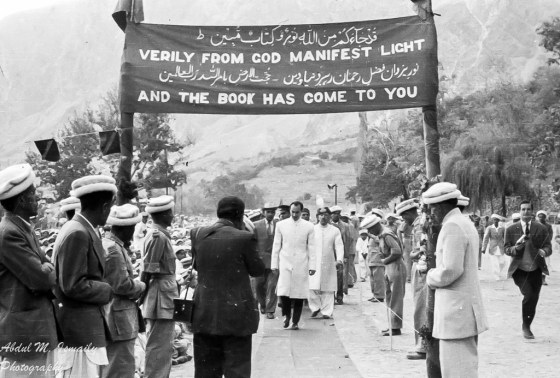
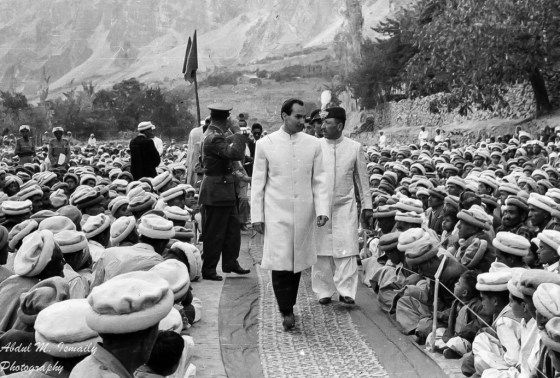
The Jamat of Hunza accept the gracious deedar (glimpse) of Mawlana Hazar Imam, His Highness the Aga Khan, as he visits the Princely State in the Northern Areas of Pakistan in 1960. Hunza was then governed by the Mir of Hunza, who is seen following Hazar Imam. Photo: Abdul M. Ismaily. Copyright.

INTRODUCED BY ABDULMALIK MERCHANT
Editor/Publisher, http://www.simerg.com

For the first time in recent Ismaili history since the accession on July 11, 1957 of Mawlana Hazar Imam, Highness the Aga Khan, to the throne of Imamat, millions of Shia Imami Ismailis around the world will be celebrating his 80th birthday or salgirah on December 13, 2016, just after the commemoration of the milad or birthday of Prophet Muhammad (s.a.s) which falls on the 12th day of the Islamic month of Rabi al-Awwal. These two important festivals haven’t been as close to each other as now in the Ismaili calendar, based on information we have gathered.

In India December 13th, 2016, has been designated as a gazetted holiday for the celebration of the milad, while in numerous other Muslim countries and Western countries, the commemoration of the birthday of  the Prophet falls anywhere between December 11th and December 14th. The Ismaili community in Canada will be observing the milad on Sunday, December 11, 2016.

To mark these two very happy and inspiring days that raise our consciousness about the accomplishments of Prophet Muhammad and Mawlana Hazar Imam, we shall be featuring special pieces on this literary website as well as on Simerg’s two sister websites, http://www.simergphotos.com and http://www.barakah.com. It may be noted that barakah has been dedicated for the Diamond Jubilee of Mawlana Hazar Imam.

We begin with a piece from Ismaili ginanic sources on the Divine Institution of Nabuwwat (or Prophethood), which was precursor to the Divine Institution of Imamat.

It is Shia Muslim belief that Prophet Muhammad (s.a.s) designated his cousin and son-in-law Hazrat Ali to be the first Imam (Ghadir-Khumm and the Two Weighty Matters) . Thereafter, the Imamat has continued by heredity through Imam Ali (a.s.) and his wife and Prophet’s daughter, Hazrat Bibi Fatimat-az-Zahra, Khātun-i-Jannat (a.s). Today, the Ismailis are the only Shia community in this hereditary lineage led by a living Imam, His Highness the Aga Khan. The forefathers of His Highness ruled in North Africa and Egypt as the Fatimid Caliphs, and were founders of Cairo and the Al-Azhar University.

~~~~~~~~~~~~

Prophet Muhammad in Ismaili Ginans

BY HAKIM VALI MOHAMMAD SURANI
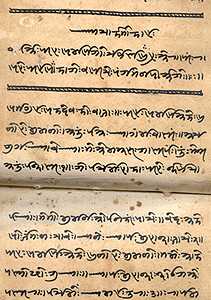
A folio from a manuscript of Ginan Vaek Moto of Pir Shams. Ms. KM 125, 463 folios, 200 x 160 mm; Copied in 1897 Samvat/1841 by Dahio Surijiani. Credit: The Institute of Ismaili Studies, London, http://www.iis.ac.uk

Introduction

The ginanic literature of the Ismailis emerged when Ismaili Pirs (missionaries) came to India to spread the teachings of Islam and the Shia Ismaili Tariqah. The task which lay before the Pirs was to introduce the teachings of their faith in a form which would not be completely alien to the people to whom they were preaching. The ginans were therefore composed on a ‘synthetic pattern’ of the prevalent religious poetry. The Pirs took the local religious terms as conceptual tools to introduce Ismaili and Islamic teachings to the masses and, in so doing, they achieved good results. The method they adopted was most logical and quite in the spirit of the universal nature of Islam. The Holy Qur’an says:

“Call unto the Way of your Lord with wisdom and fair preaching; and reason with them in ways that are best.” — Holy Qur’an, 16:125

Thus the Ismaili Pirs brought the Hindu mind to a logical understanding of the fundamental concepts of Islam. Professor Ivanow makes the following observation on the approach taken by the Ismaili Pirs:

“Either by intuition, or sound and clever reasoning, the Nizari Ismaili missionaries devised some methods which helped them to overcome such local obstacles…One was their bold tactics in separating the meaning and spirit of Islam from its hard Arab shell…They explained the high ideals of Islam in the familiar terms of ancestral religion, Hinduism….They brought the matter a step further by proclaiming Islam the crowning phase of the whole development of Hinduism. According to them, the Qur’an (together with the ta’wil system) was the last and final Ved, completing the earlier revelations. Thus, from a purely Islamic view point, the method of bridging the difference between Islam and Hinduism adopted by Ismaili missionaries was perfectly correct, in no way conflicting with orthodox ideas.” — Excerpts from Ismaili Da’wa in India, by W. Ivanow, Ilm, Volume 4, Number 2.

In this brief article, we will present only a few of the several verses that reference Prophet Muhammad (s.a.s.) in the ginanic literature of the Ismailis.

Nubuwwah

Among the concepts presented by Ismaili Pirs in the ginans was the concept of Nubuwwah (Prophethood).

In the Holy Qur’an this concept is explained with reference to the last Prophet, Hazrat Muhammad Mustafa (may peace be upon him). By giving an analogy of Sirajum-Munira to the Nabi (Prophet) as in the following verse, the Holy Qur’an relates the concept of Nubuwwah with the symbol of Noor (light):

“And as one who invites unto Allah by His permission, and as a lamp that gives light (Sirajum-Munira).” — Holy Qur’an, 33:46.

While the Holy Qur’an describes the Nabi as ‘Bright Lamp’, the ginans use the symbol of ‘Chandni’ (Moon Light) for the Prophet. Both in the Holy Qur’an and the ginans, the Prophet is seen as a Rahemat (Mercy) to mankind. The Qur’an says:

“And We have not sent you but as a mercy to all the nations.” — Holy Qur’an, 21:107.

Obedience to the Prophet is obedience to God and it is also made a necessary condition for the love for God. Those who disobey the Prophet are called the ignorant ones. The ginans also speak in the same vein. The similarities show that the teachings of Ismaili Pirs had their foundations in the Holy Qur’an.

Mercy to Mankind

“An Apostle who rehearses to you the Signs of God containing clear explanations, that he may lead forth those who believe and do good works from darkness unto light.” — Holy Qur’an, 65:11

In the verse quoted above, the Prophet is the source of guidance for mankind. He shows them the right path, removes the veil of ignorance and brings them to Light. In the ginan Satveni Moti, Syed Imam Shah says:

“Nabi Muhammad iis joog mahe aviyaa, tis-thi chand-roona marag paya”

Translation:

“Prophet Muhammad has come in this period, and through this moon-like Light, the Way has been made bright.”

The Pir says that the Institution of Nubuwwah, through the last of the Prophets, is like a moon which expels darkness and shows the way to the travellers. It determines a way of action for salvation, because we are liable to errors and may go astray in this world of many complexities.

The Prophet’s manifestation as God’s Bounty and Mercy is shown by the following verse of the ginan Alaf Nirale Khalaq Raja by Pir Sadr al-Din:

“Bujo-re bhai chhatra kon tana, Chhatra Nabi Muhammad Mustafa tana”

Translation:

“Through whom is the care and protection? Know, O Brothers! The care and protection is through Nabi Muhammad Mustafa (the Chosen).”

This clearly resonates with the Qur’anic verse:

“Allah verily has shown grace to the believers by sending unto them a messenger of their own who recites unto them His revelations, and causes them to grow, and teaches them the Scripture and wisdom.” — Holy Qur’an, 3:164

And Pir Hasan Kabiruddin in his monumental composition, Anant Akhado, says:

“Ashaji Nabi chale Nooraj warsey, Rikhisar ne sir chhai(n)-ji”

Translation:

“There are showers of Noor where Nabi walks and the believers have his protection over them.”

Thus the ginans describe the Prophet’s care and protection as chhatra and chhai(n) respectively. His guidance is Noor (Light), which helps to dispel darkness and makes visible the path leading to reunion with God.

Redeemer

“And those whom they invoke besides God have no power of intercession save he who bears witness to the Truth and they know (him).” — Holy Qur’an, 43:86

“O Muhammad! Raise your head and speak, and you shall be granted your desire, and intercede and your intercession shall be accepted.” — Hadith, Bukhari, 81:51

Since the Institution of Nubuwwah is a Blessing given by Allah, believers will have the intercession of the Prophet on the Day of Judgement. This (intercession) will bring them spiritual bounties in the life hereafter. In the Ginan Yara Shafayat Muhammad Karshe , Pir Sadr al-Din says:

“Yara shafayat Muhammad karsey, Mu’min bahest lahenga.”

Translation:

“O friends! Muhammad will intercede (on the Day of Judgement), and the mu’min (believer) will earn the abode in heaven.”

In Buj Niranjan, the Pir says:

“Jo Nabi Muhammad karey shafayat, Ja(n)ko hai ummat ki riayat” — verse 6, lines 9-10

Translation:

“If Prophet Muhammad intercedes then his followers will find ease (on the Day of Judgement).”

However, a pre-condition of earning the intercession of the Prophet Muhammad is for one to accept his Prophetic role and to follow his guidance. This is beautifully explained in Kalma Kahore Momano by Pir Satgur Noor:

“Eji Nam Nabi-ka mitha hai, jaisa sakar dudh, Kalma kaho dil saach soo(n), to bando shafayat mool”

Translation:

“O mumin! the name of our Nabi is as sweet as sugar and milk. Recite the Kalma with a true and sincere heart. This, indeed, will provide for you the intercession of the Prophet.”

and,

“Eji Nabi to jeevo(n) ka datar hai, Jene Kalma sunaya sar; Je momin manshe to beheshti howenga, Baki gafil bhula gemar”

Translation:

“Nabi is the redeemer of all the souls and he has taught the kalma to you. A mumin who declares his faith in the kalma will earn the heavenly abode but the rest, who ignore the kalma, will be lost and, indeed, they are the foolish ones.”

The consequences of not obeying the Prophet Muhammad to those who have paid allegiance to Islam is provided in the following verse of Syed Imam Shah:

“Nabi Muhammad kahya jeene na kiya, dozakh-ma(n) darwaza une liya”

Translation:

“He who does not obey the teachings of Prophet Muhammad has taken for himself the path towards the gates of hell.”

And, in this vein, the Qur’an declares:

“Establish worship and pay the poor-due and obey the messenger, that you may find mercy. Think not that the unbelievers, are going to frustrate (God’s plan) on earth. Fire will be their home – and it is indeed an evil refuge.” — Holy Qur’an, 24: 56-57.
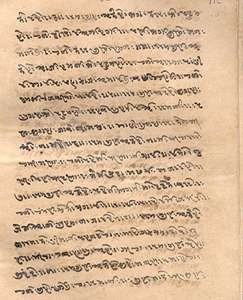
Folio of Pir Sadr al-Din’s Ginan, Saloko Nano. 492 pages, 200 x 160 mm. Copied between 1924 Samvat/1867 and 1942 Samvat/1885 by various scribes including Khoaja Jafar Khiate Dhalani. Credit: http://www.iis.ac.uk

Pre-Islamic Prophets

(a) Earlier Revelations

“Say (O Muslims): We believe in Allah and that which has been revealed to us and in that which was revealed to Abraham and Ishmael and Issac and Jacob and the tribes, and in what that which was given to Moses and Jesus, and in that which was given to the Prophets from their Lord; we do not make any distinction between any of them, and unto Him we have surrendered.” — Holy Qur’an, 2:136

Belief in Prophet Muhammad as the last of Allah’s Messenger renders it necessary for a believer to accept all the earlier prophets, as shown in the above verse. This essential principle as well as some of the references that the Qur’an makes about the earlier prophets is also found in ginans as shown in the following compositions:

In the Ginan Virabhai Saheb Kero Bhed Na Bujere Koi, Pir Sadr al-Din observes:

“Eji ek lakh-ne chovis hazaar-mahe paigumbar sardar”

Translation:

“Amongst the 124,000 (Prophets), the Prophet (Hazrat Nabi Muhammad Mustafa) is the chief.”

This is in accordance with a well known tradition of the Prophet Muhammad which states that there were 124,000 prophets; the Holy Qur’an mentions only about twenty-five prophets.

(b) Hazrat Adam (a.s.)

“They (Adam and his wife) said: ‘Our Lord! We have wronged ourselves. If Thou forgive us not and have not mercy on us, surely we are of the lost’.” — Holy Qur’an, 7: 23

A corresponding verse is found in Pir Hasan Kabiruddin’s Eji Sarve Jivu-na Lekha Leshey:

“Eji Dada Adam mota barvant kahiye, Tap mota tena kahiye.”

Translation:

“Hazrat Adam was indeed very strong (spiritually), and his penance was complete.”

(c) Hazrat Musa (a.s.)

“And when Moses came to Our appointed tryst and his Lord had spoken unto him, he said: ‘My Lord! Show me (Thyself) that I may gaze upon Thee.” — Holy Qur’an, 7:143

Pir Hasan Kabiruddin, speaking about Hazrat Musa, says:

“Eji Musa Nabi Shah-ku bahot pyara, Niti nit darshan karna”

Translation:

“Prophet Musa was the beloved of the Lord. He always sought and prayed for the vision of Allah.”

(d) Hazrat Ibrahim (a.s.)

“Say: Allah speaketh truth. So follow the religion of Abraham, the upright.” — Holy Qur’an, 3:95

And about Hazrat Ibrahim, Pir Hasan Kabiruddin says:

“Eji Ibrahim Nabiji-ki bataj suniye, Karna aiysa kaam”

Translation:

“Listen to the story of Prophet Ibrahim and do such deeds as he did.”

Nubuwwah to Imamat

“Behold, your Lord said to the angels: ‘I will create a Vicegerent on earth’.” — Holy Qur’an, 2:30

“O mankind! Verily there has come to you a convincing proof from your Lord: for We have sent unto you a light that is manifest.” — Holy Qur’an, 4:174

“He whose Mawla I am, Ali is his Mawla.” — Hadith

Finally, it would be appropriate to add a few ginanic verses which speak about the continuity of the Divine Guidance through the Institution of Imamat after the demise of Allah’s last Prophet, Hazrat Nabi Muhammad Mustafa (may peace be upon him). True, there would be no Prophet after Prophet Muhammad, but God’s guidance for mankind had to continue, or else how could God’s Infinite Mercy and Absolute Justice be explained?

The continuous and perpetual guidance mentioned in the Qur’anic verse:

“O mankind! Verily there has come to you a convincing proof from your Lord: for we have sent you a light that is manifest” — Holy Qur’an, 4:74

is stated by Pir Hasan Kabiruddin as follows:

“Noore-Khalifa iis joog-ma(n)hey awiya, Ta(n)ki amar jyot likhai ji”

Translation:

“Vicegerent of God (Imam) has come in this period and His Light is Eternal.”

However, the belief in and the recognition of Prophet Muhammad is a pre-requisite for a belief in the Imamat and this is reinforced in Pir Hasan Kabiruddin’s Allah Ek Khasam Sabuka:

“Nabi Muhammad bujo bhai, to tamey pamo Imam.”

Translation:

“O brothers! know Nabi Muhammad, i.e. know the teachings of Nabi Muhammad, for it is then that you will gain the recognition of the Imam of the time.”

Date posted: Friday, December 2, 2016.

_______________

This ginanic reading has been adapted from Hakim Vali Mohammad Surani’s piece Prophet Muhammad (s.a.s) in the Light of Ginans, which was originally published in Ilm, March 1980, Volume 5, Number 4, by the Ismailia Association for the United Kingdom, now known as the Ismaili Tariqah and Religious Education Board (ITREB). References to all the ginans quoted in this reading are provided in the original Ilm article.

http://ginans.usask.ca/ is an outstanding research resource for ginans and includes recitations of hundreds of ginans by multiple reciters from around the world.

New Video: An Inspiring Moment that Will Never Be Forgotten as Mawlana Hazar Imam, His Highness the Aga Khan, Blesses Murids in Kyrgyzstan

“I wish you all success, good health, happiness, everything you wish, everything you wish for, Best Blessings.” – Mawlana Hazar Imam, His Highness the Aga Khan. Please see one minute video footage from October 19, 2016, below.

LETTER FROM PUBLISHER

By Abdulmalik Merchant

Mawlana Hazar Imam pictured at the Olympia Hall, London, during his weeklong visit to the United Kingdom Jamat in September 1979. Seated next to him on the stage are Mukhi Noordin Jivraj and Kamadia Nizar Dhanani. Photo: Jehangir Merchant Collection.

Mawlana Hazar Imam, His Highness the Aga Khan, pictured at the Olympia Hall, London, during his weeklong visit to the United Kingdom Jamat in September 1979. Seated next to him on the stage are Mukhi Noordin Jivraj and Kamadia Nizar Dhanani. Photo: Jehangir Merchant Collection.

Some 37 years ago, my dad (Alwaez Rai Jehangir Merchant) wrote a piece for Ilm magazine on Mawlana Hazar Imam’s memorable week long visit to the United Kingdom jamats held at the beginning of September 1979. He mentioned about the unbounded joy originating from the souls of the members of the UK Ismailis when the visit was announced with a talika read in Jamatkhanas on July 7th, 1979. Then, describing the last few moments of Mawlana Hazar Imam’s final day of his seven day memorable stay in England, my dad wrote:

“In his infinite mercy and grace, Mawlana Hazar Imam then blessed the jamat for happiness, good health, unity, success in spiritual happiness, success in worldly happiness and for remaining on the Straight Path. What more would the mu’mins wish? Their Imam, their beloved Mawla had blessed them munificently. Tears were streaming from their eyes in reverence and devotion for their beloved Mawla for the immense love he had shown towards them….Very slowly and graciously, Mawla walked all around the [Olympia] hall to be as near to his spiritual children as possible for the last time during this visit. When he arrived at the exit of the hall, he majestically turned towards his spiritual children, stood there in all his glory for one brief moment, showered his Noor on the whole assembly of souls and then moved away from the sight of his beloved spiritual children who had all made him so very very happy.”

I mention this anecdote because something remarkable and inspiring happened a few days ago on October 19, 2016 in Kyrgyzstan as Mawlana Hazar Imam visited the new Naryn campus of the University of Central Asia. An amateur video footage that we have received captures the excitement, uncontrollable joy, happiness and emotion from a group of Ismaili murids as Mawlana Hazar Imam most graciously walks over to them, and from a very close distance, with hands stretched out, graciously and lovingly blesses them with the following words:

“I wish you all success, good health, happiness, everything you wish, everything you wish for, Best Blessings.”

The voices that we hear in the footage as Mawlana Hazar Imam steps in the direction of his followers (“Ya Hazar Imam”), and when he leaves them after fulfilling their dreams and filling their hearts, minds and souls with peace and unbounded spiritual happiness is a testament to the faith and love that each and every Ismaili around the world holds for his or her beloved Imam.

WATCH FOOTAGE OF MAWLANA HAZAR IMAM BLESSING MURIDS IN KYRGYZSTAN ON OCTOBER 19, 2016

Inshallah, the jamats all over the world will be blessed with the Imam’s Holy Deedar during the forthcoming Diamond Jubilee Celebration as we commemorate 60 years of his glorious and magnificent reign as our 49th Imam on July 11, 2017.

It is not in vain that Ismaili Pirs and missionaries wrote how fortunate the Ismaili people are to attain the recognition of the Imam of the Time, who is the direct descendant of the Prophet Muhammad (s.a.s.). Pir Sadardin wrote:

Eji Anand anand kariyo rikhisaro,
Awwal Shah tamey paya

Rejoice! O you who are on the True Path, rejoice!
For you have the Supreme Master.

On that note, we convey our heartiest felicitations and mubaraki to everyone who was present in Naryn to gain the Imam’s blessings, and wish to express our heartful thanks to the individual who has shared this video with us for the benefit of all our readers.

Date posted: October 21, 2016.

________________

We welcome your feedback. Please click Leave a comment.

An Exploration of Eight Ismaili Ginans on Science, Spirituality and Pluralism

ARTICLES BY SHIRAZ PRADHAN

Mawlana Hazar Imam on Ginans

SPIRITUALITY

Many Ismaili ginans relate the spiritual experiences of Ismaili Pirs and describe the meditative techniques used as an aid in the spiritual journey, and also the important milestones and inner cosmology corresponding to the different stages (maqamat). However, the Pirs emphatically have stated that the experiences of higher spiritual stations are not describable in rational language to people who are not initiated in the tariqa (path) and who have not experienced the different stations themselves. Pradhan uses two ginans by Pir Shams and Pir Sadardin to develop this theme.

PLEASE CLICK: The Inward Odyssey in Two Key Ismaili Ginans, “Brahma Prakash” and “Sakhi Mahapada”

~~~~~~~~~~~

Imam Sultan Mahomed Shah, His Highness the Aga Khan (1877-1957), had once said that “In your heart is a heap of fireworks, if you do not light it, how will you get Light (Roshni) in your heart?” The theme of the re-orientation of the soul and its migration towards the “Country of the Beloved” is captured beautifully in “Ek Shabda suno mere bhai….”

PLEASE CLICK: Ismaili Spirituality in Pir Shams Shabzwari’s Ginan “Ek Shabada Suno Mere Bhai”, accompanied with recitation

~~~~~~~~~~~

Continuing on the theme of spirituality and self-understanding in Ismaili Ginans, Pradhan  uses a parable from a Ginan of a young lion cub who grows up in the flock of sheep, and starts behaving like a sheep until it sees its own reflection in a pool to know its true identity.

PLEASE CLICK: An Explanation of the Ismaili Ginan “Kesri Sinha Sarup Bhulayo”

~~~~~~~~~~~

COSMOLOGY AND SCIENCE

Are the answers to secrets that Hadron Collider will reveal already in the Ginans? Pradhan’s study focuses on a granth composed by Syad Imam Shah around 1400 CE that he regards as one of the most scientifically advanced and compact ancient document, besides the Ikhwa-al safa.

PLEASE CLICK: Cutting-Edge Science in Syad Imam Shah’s Naklanki Geeta — Are the answers to secrets that Hadron Collider will reveal already in the Ginan?

~~~~~~~~~~~

Based on the acceptance by modern science of the Big Bang origin of our universe, Pradhan proceeds to analyse two Ismaili Ginans that have striking parallels of modern cosmology and astrophysics in them.

PLEASE CLICK: Concepts of Modern Cosmology and Astrophysics in Two Ismaili Ginans, Choghadia and Mul Gayatri

~~~~~~~~~~~

PLURALISM AND UNITY OF MANKIND

Our happiness and satisfaction must be anchored on pluralism and the underlying unity of faiths of mankind. Pradhan explores two different old traditions which echo these messages. One is from the Shia Ismaili Ginanic tradition and the other is from the Hindu Gujarati tradition.

PLEASE CLICK: Ideas of One Humanity, Love and Peace in World Religions: Comparative Study of Ginan “Hum dil Khalak Allah Sohi Vase” with a Hindu Bhajan

Date posted: August 15, 2016.
Date updated: August 28, 2016.

_________________

Poems “Anand” and “Intezaar” in Joyous Anticipation of the Diamond Jubilee of Mawlana Hazar Imam, His Highness the Aga Khan, on July 11, 2017

Anand

The Imam Blessing with Hand on Shoulder

BY SHARIFFA KESHAVJEE

Oft I sing Anand Anand
Lip service alone stirs
Not the heart to joy
Enshrined in us all
Is the primordial joy
Who will awaken it ?

Come ye Gardner of
The soul awaken in me
Open the door of joy
Lift the veil so I may see
The joy of perfection
In each cell the miracle

I am not so worthy
I need not strive
I live in the perfection
Of your creation
For you have laid
Your hand upon
My shoulder bowed

This Jubilee I await
To feel at depth
That resonance
That symphony
Come together in
Perfect harmony
Sat chit Anand

~~~~~~

Jubilee Intezaar

A prayer left my lip

Being asked
Is your heart jumping with joy?
My heart in reflective pause
Shed a tear of inquiry
Nay! where is joy I asked
It is in your visage?
A prayer left my lip

I asked
Is joy a heart searching seed
Is it locked in the bud of the rose
In the first ray of sunlight
In the rising companion star
Counting hues of green in nature
A prayer left my lip

I asked
Will it grow for me?
Experience a petal of the rose
The hint of morning light
A naked sight the first star
In ever surrounding verdure
A prayer left my lip

The answer came
There it ever is
In the heart of man
In every sinew and pore
In every breath
In every smiling blink

The prayer left my lip
Travelling heavenward
Ricocheting resounding
Hymnal songs of yore
It came back
To settle in my heart
Poured forth in song

In joy is enshrined
A dance of creation
A harmonious rhythm
A fine tuned fork
A Resonating universe
Is my Gods love
Is in my prayer

Life no Ponderous task
For in its joy of being
The incredible lightness
Leads moment to moment
To the Sirat of sat chit anand
The prayer left my lip
The answer is yout Jubilee

Date posted: December 15, 2015.

Copyright: Farida Keshavjee/Simerg.

__________

Sat – Truth; pure and eternal that never changes.
Chit –
Vision, knowledge.
Anand – Ecstasy, bliss, happiness.

Shariffa KeshavjeeEditor’s note:  Shariffa Keshavjee of Kenya, a regular contributor to Simerg, recently heard a tape of Mawlana Hazar Imam’s Golden Jubilee Farman that was made in Kenya in which he asked “Are your hearts jumping with joy?” Tears flowed and the intezaar of the coming Diamond Jubilee came to her mind, inspiring Shariffa to pen the two poems. The Diamond Jubilee of His Highness the Aga Khan, inshallah, will be celebrated on July 11, 2017, when he will complete 60 years as the 49th hereditary Imam of the Shia Imami Ismaili Muslims, in direct lineal descent of the Prophet Muhammad (s.a.s.) and Mawlana Ali (a.s.), the first Imam. Co-incidentally, on July 1, 2017, Canadians will begin celebrating the 150th anniversary of their country with major events, festivities and programs around the country.

Simerg welcome’s your feedback. Please click Leave a comment.

A Spiritual Father’s Love for His Community: The 79th Salgirah (Birthday) of Mawlana Hazar Imam, His Highness the Aga Khan

“When I leave this evening I would like that you should remember two things. One, that I will take with me in my heart the remembrance of each and everyone of you, the face of each and everyone of you. Secondly, that my love for my Jamat is a lot stronger than yours can ever be for me and I would like you to remember this…you must remember that Imam loves you more, much more than you can ever love him and you must be strong in this knowledge.” — Mawlana Hazar Imam, Karachi, December 26, 1964.

Photo_AKDN_Anya Campbell

Mawlana Hazar Imam, His Highness the Aga Khan, 49th hereditary Imam of Shia Ismaili Muslims directly descended from the Holy Prophet Muhammad (s.a.s.). Photo: AKDN/Anya Campbell. Copyright.

Spread in various countries around the world, the Shia Imami Ismailis have their own innumerable ways for celebrating important religious occasions according to their various cultural, social and religious traditions and backgrounds. One very important occasion in the annual calendar of the Ismailis is the Salgirah, or the birthday of their spiritual leader (Imam). His Highness the Aga Khan is their present Imam, and Ismailis around the world will be marking his 79th Salgirah on December 13, 2015. The following readings will enhance the readers’ understanding about the occasion as well as the special relationship that binds the Imam of the Time with his spiritual children.

Mawlana Hazar Imam’s Salgirah and the Depth of His Love for the Jamat

The term Salgirah is of Persian origin. Sal means anniversary and girah means knot and hence Salgirah literally means ‘an anniversary knot added on to a string kept for the purpose’. This article approaches the subject of Mawlana Hazar Imam’s birthday in terms of the Imam’s love for his murids and the love and devotion of the murids for their Imam.

In Salgirah Ginan Pir Sadr al-Din Asks Mu’mins to Act Righteously and Gain Spiritual Recognition of Imam-e-Zaman

+ Listen to ginan at Ginan Central

Eji Dhan Dhan Aajano has attained a very special status because it is primarily recited during the festivities marking the birthday of Mawlana Hazar Imam. The appropriateness of reciting the ginan during Salgirah will become apparent as we try to understand the ginan and its underlying spiritual teachings. To listen to various renditions of Eji Dhan Dhan (#160),  as well as over 760 other ginans please click http://ginans.usask.ca/recitals/ginans.php?id=0.

The Preamble Of “The Constitution of the Shia Imami Ismaili Muslims”

The new Ismaili Constitution was ordained, signed and sealed by His Highness the Aga Khan on December 13th, 1986, his 50th birthday. His Highness did this with the belief that the Constitution would provide a strong institutional and organizational framework for his Ismaili community to contribute meaningfully to the societies among whom they live.


His Highness the Aga Khan and the Ismailis

.

.

On the occasion of His Highness the Aga Khan’s 75th birthday on December 13, 2011, Simerg published a three-part photo essay tribute to the 49th Ismaili Imam. For those who may have missed, the series has been consolidated into a captivating one piece photo essay, which can be read by clicking on the above link.

Date posted: November 28, 2015.

___________________

Feedback? Please click Leave a comment.

Archives: Please click Table of Contents for links to all articles published on this blog since March 2009. Subscribe to this Website via the box near the top right of this page.

Special Series: Ismaili Expressions on the Imamat — (II) The Beatific Vision of the Imam of the Time

INTRODUCED BY ABDULMALIK MERCHANT

A very happy moment in my life when I visited Brown University in 1996. I snapped this picture of my beloved 49th Imam, His Highness the Aga Khan, and only realized that he was looking straight at my disposable nine dollar camera after I got the film processed in Philadelphia.  Photo by Abdulmalik Merchant

A very happy moment in my life when I travelled to Brown University from Philadelphia in 1996. I snapped this picture of my beloved 49th Imam, His Highness the Aga Khan, and only realized that he was looking straight at my camera after I got the film processed in Philadelphia a couple of days later. Photo by Abdulmalik Merchant

Every Ismaili yearns to see the Imam of the Time. It’s a dream of a lifetime. Throughout history, past and present, Ismailis have travelled far and wide to earn this special moment of grace and barakah (happiness) in their lives. Since the advent of the 20th century, the 48th Imam, Mawlana Sultan Mahomed Shah, and the current 49th Imam, Mawlana Shah Karim (His Highness the Aga Khan), have graciously travelled to lands around the world to give their beloved murids (followers) this blessed opportunity. Scientific and technological advancements have speeded up and shortened the time-gap between visits of Mawlana Hazar Imam with his jamats, though even in these situations, some jamats  such as those living in Central Asia, did not have the opportunity of a meeting with the present Imam and his predecessors for decades and centuries. What sustained their faith, sometimes under extremely difficult and extra ordinary circumstances, was their spiritual bond with the Imam of the Time.  

His Highness the Aga Khan pictured amongst his followers in Badakhshan in May 1995.

His Highness the Aga Khan pictured amongst his followers in Badakhshan in May 1995.

A cornerstone of Ismaili doctrines has been the principle of the Unity of Imamat, that is the  Ismaili belief and understanding that each Imam, being the bearer of the Noor (Light) of Imamat, is the same irrespective of his own age or the time he lives in. Thus in Ismaili writings, in addition to the importance of the physical didar (or glimpse) of the Imam, a strong emphasis has been laid on the followers to seek to attain the Beatific Vision of the Imam of the Time through special prayers, in addition to the ritual prayers. This idea is also conveyed in the sixth article of the Preamble of the Constitution of the Ismailis, which states:

“Historically and in accordance with Ismaili tradition, the Imam of the time is concerned with spiritual advancement as well as improvement of the quality of life of his murids. The imam’s ta‘lim lights the murid’s path to spiritual enlightenment and vision…”

The following collection  of writings from Ismaili history articulates the importance of both the  physical as well as the spiritual glimpse of the Imam of the Time. Our next reading in this short four-part series to commemorate Mawlana Hazar Imam’s 58th Imamat Day will consist of excerpts from the writings of Ismaili Imams on the subject of Imamat. This will be followed by contemporary voices on Imamat by members of the jamat.

1. An Inspiring Anecdote: Da’i Al-Mu’ayyad al-Shirazi ‘s Mulaqat  with  the 18th Ismaili Imam (or 8th Fatimid Caliph), Imam al-Mustansir Billah

A folio from the manuscript of al-Shirazi's Sirat. Credit: The Institute of Ismaili Studies.

A folio from the manuscript of al-Shirazi’s Sirat. Credit: The Institute of Ismaili Studies.

“I was taken near the place where from I saw the bright Light of the Prophethood.  My eyes were dazzled by the Light. I shed tears of joy and felt as if I was looking at the face of the Prophet of Allah and of the Commander of the Faithful, Hazrat Ali. I prostrated myself before the one who is the fittest person to bow to. I wanted to say something, but I was awe-struck.

“I tried to speak but my tongue refused to move. People asked me to say what I wished to say. I could say nothing. The Imam said, ‘Leave him. Let his fear and awe subside’.

“After this, I rose. I took the holy hand of the Imam, placed it on my eyes and on my chest and then kissed it. I left the place with immense joy.”

The same dai,  in the following entreaty to Imam Mustansir, typifies an Ismaili’s impatience to behold the face of the Imam of one’s time, and the urgency of this beyond any possible worldly consideration. He states: 

“I swear, were you to crown me, and were you to grant me dominion over the world entire and say to me ‘Let our meeting be postponed but an hour’, I would reply: ‘O my Mawla, let us meet instead!  For your delay of but an hour has turned my hair gray’.”

2. A Pilgrim’s Experience

During the reign of the 34th Ismaili Imam Gharib Mirza, a pilgrim tracked his way to Anjudan to see the Imam on behalf of the jamats in Khurasan. The identity of the pilgrim is not very clear due to the poor quality of the manuscript but the ode to the Imam reads as follows:

“Greetings! O Emperor of the Realm of Faith and World; I come from Khurasan to behold your face. All I have is a soul imperfect, sins and transgressions galore.

“Despite such worthless goods, I long for your grace, hoping that through me you may forgive the trespasses of your servants-one and all.

“As you are the sovereign and governor of all creation, this being testified to by the Qur’an itself, your proper name has been made manifest to all the faithful.

“You are Shah Gharib and Mustansir, the inheritor of Shah Salam!”

3. Pir Sadr al-Din on the True Guide, the Beatific Vision of the Imam, and the Alchemy of Transformation from Contact with the Imam

Folio of Pir Sadr al-Din's Saloko Nano at the Institute of Ismaili Studies.

Folio of Pir Sadr al-Din’s Saloko Nano at the Institute of Ismaili Studies.

The following is a translation of Pir Sadr al-Din’s ginanic compositiom “Sakhi māhā pad keri vāt koek jānere.”

“Friend! None but a few know of the exalted station. Indeed, they alone recognize it who have found the true guide.

“Friend! Within the heart, at the confluence of the three spiritual rivers, there is an imperishable light. There – a shimmering effulgence, pearls are showered.

“Friend! I completely lost consciousness of my physical self when my meditation mounted the empyrean, bursting forth.

“Friend! I beheld the place of the lofty throne, I saw the seven islands, the nine continents.

“Friend! The religious scriptures and books cannot fathom this, for there is neither day there, nor night, neither sun, nor shade.

“Friend! My Lord is not such that He can be spoken of. He is to be seen – for He is indescribable, and nameless.

“Friend! How sweet is that Lord, indescribable, nameless. Says Pir Sadr al-Din, truly, with my own eyes, I have seen Him!”

~~~~~~

And the following is a translation of a verse from Sab Ghat Sami Maaro Bharpur Betha on spiritual transformation:

“O Brother, The True Preceptor is like the philosopher’s stone and the followers are like copper.

“When the copper comes in contact with the philosopher’s stone it becomes gold.

“The followers gain spiritual enlightenment from the contact of the Imam. He is the only Glorious, O brother.”

4. Nizar Quhistani on the Imam of the Time As the Source of Salvation, and on the Continuity of Imamat

“Salvation is to be found in the Imam of the Time.

“Ever since I found the Imamate, permanently in human form, I have known no other guide than the living, everlasting Imam.

“For in his command, I have found peace in both the worlds.

“My lover appears in different forms,

“Because for each period there comes a new guidance;

“One after the other, there  follows another Qaim  Imam Ali.

“I have given up everything except that contained in the Qur’anic verse ‘offspring, one of the other’.”

Date posted: July 8, 2015.

_______________

Readings adapted from The Life and Lectures of the Grand Missionary al-Muayyad-fid-Din al-Shirazi and The Ismailis in the Middle Ages: A History of Survival, a Search for Salvation by Shafique N. Virani, Hardcover, May 3, 2007.

Feedback welcome, please click Leave a comment.

Special Series: Ismaili Expressions on the Imamat and Imam of the Time — (I) The Preamble of the Constitution of the Shia Imami Ismaili Muslims

LETTER FROM PUBLISHER

By Abdulmalik Merchant

Canada’s Confederation Day, the American Independence Day, Tanzania’s Saba Saba celebrations and the Imamat Day of His Highness the Aga Khan, all fall in the month of July.

Canada is already preparing for its 150th birthday two years hence when Ismailis around the world will, inshallah, celebrate the Diamond Jubilee of their beloved 49th Imam, whom they respectfully address as Mawlana Hazar Imam.

 A portrait of Mawlana Hazar Imam, His Highness Prince Karim Aga Khan, with a framed portrait of Mawlana Sultan Mahomed Shah in the background. Photo by Philippe Le Tellier/Paris Match via Getty Images. Copyright.

A portrait of Mawlana Hazar Imam, His Highness Prince Karim Aga Khan, with a framed portrait of Mawlana Sultan Mahomed Shah in the background. Photo by Philippe Le Tellier/Paris Match via Getty Images. Copyright.

His Highness the Aga Khan succeeded to the 49th hereditary throne of Imamat at the age of twenty by the will of his grandfather, Mawlana Sultan Mahomed Shah, His Highness the Aga Khan III, who served as the 48th Ismaili Imam for a record 71 years (August 17, 1885 – July 11, 1957).

Over the next week, Simerg will provide an insight into the principles of Imamat through short readings. We begin the series by posting the Preamble of the Ismaili Constitution, which is an introductory succinct statement giving the historical roots of the Ismaili Imamat, the principle of Imamat succession, and the permanency of the spiritual bond that exists between the Imam and his followers.

Another theme that will be explored in the coming few days through the writings of Ismaili Pirs, missionaries and philosophers is the principle of the Unity of Imamat, that is the Ismaili belief and understanding that each Imam, being the bearer of the Noor (Light) of Imamat, is the same irrespective of his own age or the time he lives in.

Finally, another aspect that will become apparent from the readings to follow is that the hereditary institution of Imamat can never become extinct. This is in accordance with the well known Muslim prophetic tradition, hadith thaqalain, which says, “I leave behind me two weighty things: The Book of Allah and my Progeny. If you keep yourselves attached to these two, never, never will you go astray. Both are tied with a long rope and cannot be separated until the Day of Judgement.”

The Preamble of the Constitution of the Shia Imami Ismaili Muslims

Please click on photo for enlargement

December 13, 1986, Geneva: On his 50th birthday, His Highness the Aga Khan is seen ordaining a new constitution for the worldwide Ismaili community.

December 13, 1986, Geneva: On his 50th birthday, His Highness the Aga Khan is seen ordaining a new constitution for the worldwide Ismaili community.

“Mawlana Hazar Imam Shah Karim al Hussaini, His Highness Prince Aga Khan, in direct lineal descent from the Holy Prophet (s.a.s.) through Hazrat Mawlana Ali (a.s.) and Hazrat Bibi Fatima (a.s), is the Forty-Ninth Imam of the Ismaili Muslims.”

BACKGROUND

In 1905, the 48th Ismaili Imam, Sir Sultan Muhammad Shah, His Highness the Aga Khan III, issued a written set of ‘Rules and Regulations’ for the Ismailis of East Africa which effectively served as their communal constitution. This constitution re-affirmed the centrality of the Imam’s authority over the affairs of his community and also articulated the distinctive religious identity of the Ismailis. This document was revised and published several times until 1954, and was made available to Ismailis and non-Ismailis alike. Similar rules were given to the Ismaili community in British India.

During the 1960’s, the 48th Imam’s grandson and successor, Mawlana Shah Karim al-Hussaini Hazar Imam, His Highness the Aga Khan IV, gave Constitutions to his followers in Africa and Pakistan in 1962, and to the Jamat in India in 1967.

A constitution review committee was then formed in the early 1980’s, and after exhaustive review, Mawlana Hazar Imam, in 1986, ordained a new Ismaili Constitution known as “The Constitution of the Shia Imami Ismaili Muslims.”

The Ismaili Constitution became applicable throughout the world, linking all Ismailis to the Imamat. His Highness did this with the belief that the Constitution would provide a strong institutional and organizational framework through which his community would be able to contribute to the harmonious development of the Muslim Ummah and of the societies in which his followers lived. He expressed confidence that the Ismaili Constitution would give a stronger integrated identity to his community, and that in abiding by it in letter and spirit, the Ismailis would achieve greater peace, unity, happiness, security and wellbeing. He futher hoped that the Constitution would become an enabling document for all his murids (followers) for an active role in institution building, for creative application of their abilities, for personal development and for intellectual and spiritual satisfaction.

The new constitution was ordained, signed and sealed by Mawlana Hazar Imam on December 13th, 1986, his fiftieth Salgirah (birthday) and thirtieth year of Imamat. The Constitution was revised by Mawlana Hazar Imam on July 11, 1998, when he completed forty one years of his spiritual leadership.

THE PREAMBLE

(A) The Shia Imami Ismaili Muslims affirm the shahādah lā ilāha illa-llāh, Muhammadur rasulu-llāh, the Tawhid therein and that the Holy Prophet Muhammad (s.a.s.) is the last and final Prophet of Allah. Islam, as revealed in the Holy Quran, is the final message of Allah to mankind, and is universal and eternal. The Holy Prophet (s.a.s.) through the divine revelation from Allah prescribed rules governing spiritual and temporal matters.

(B) In accordance with Shia doctrine, tradition, and interpretation of history, the Holy Prophet (s.a.s.) designated and appointed his cousin and son-in-law Hazrat Mawlana Ali Amiru-l-Mu’minin (a.s), to be the first Imam to continue the Ta’wīl and Ta‘līm of Allah’s final message and to guide the murids, and proclaimed that the Imamat should continue by heredity through Hazrat Mawlana Ali (a.s) and his daughter Hazrat Bibi Fatimat-az-Zahra, Khātun-i-Jannat (a.s).

(C) Succession of Imamat is by way of Nass, it being the absolute prerogative of the Imam of the time to appoint his successor from amongst any of his male descendents whether they be sons or remoter issue.

(D) The authority of the Imam in the Ismaili Tariqah is testified by Bay‘ah by the murid to the Imam which is the act of acceptance by the murid of the permanent spiritual bond between the Imam and the murid. This allegiance unites all Ismaili Muslims worldwide in their loyalty, devotion and obedience to the Imam within the Islamic concept of universal brotherhood. It is distinct from the allegiance of the individual murid to his land of abode.

(E) From the time of the Imamat of Hazrat Mawlana Ali (a.s), the Imams of the Ismaili Muslims have ruled over territories and peoples in various areas of the world at different periods of history and, in accordance with the needs of the time, have given rules of conduct and constitution in conformity with the Islamic concepts of unity, brotherhood, justice, tolerance and goodwill.

(F) Historically and in accordance with Ismaili tradition, the Imam of the time is concerned with spiritual advancement as well as improvement of the quality of life of his murids. The imam’s ta‘lim lights the murid’s path to spiritual enlightenment and vision. In temporal matters, the Imam guides the murids, and motivates them to develop their potential.

(G) Mawlana Hazar Imam Shah Karim al Hussaini, His Highness Prince Aga Khan, in direct lineal descent from the Holy Prophet (s.a.s.) through Hazrat Mawlana Ali (a.s.) and Hazrat Bibi Fatima (a.s), is the Forty-Ninth Imam of the Ismaili Muslims.

(H) By virtue of his office and in accordance with the faith and belief of the Ismaili Muslims, the Imam enjoys full authority of governance over and in respect of all religious and Jamati matters of the Ismaili Muslims.

(I) It is the desire and Hidāyat of Mawlana Hazar Imam that the constitutions presently applicable to the Ismaili Muslims in different countries be superseded and that the Ismaili Muslims worldwide be given this constitution in order better to secure their peace and unity, religious and social welfare, to foster fruitful collaboration between different peoples, to optimise the use of resources, and to enable the Ismaili Muslims to make a valid and meaningful contribution to the improvement of the quality of life of the Ummah and the societies in which they live.

Date posted: Saturday, July 4, 2015.

© Simerg.com

~~~~~~~~~~~

We welcome feedback/letters from our readers. Please click Leave a comment.  Your feedback may be edited for length and brevity, and is subject to moderation. We are unable to acknowledge unpublished letters.

Please Sign-up for blog subscription at top right of this page.

____________

References for this post:

(1) The Ismailis: An Illustrated History by Farhad Daftary and Zulfikar Hirji, published by Azimuth editions in association with The Institute of Ismaili Studies (2008).

(2) Wikipedia article on Imamah, with link to website, http://www.salmanspiritual.com/

(3) http://www.kamalzar.com, website of Alwaez Kamaluddin Muhammad and Alwaeza Zarina Kamaludin.