June 11, 1963: President John Kennedy on Civil Rights, as 2 black students are admitted to University of Alabama after Governor Wallace initially blocks them

Compiled by MALIK MERCHANT
Publisher/Editor Simerg, Barakah and Simergphotos

In a tweet last week, Calgary’s Mayor Nahid Nenshi said, “Like many of you, I have been profoundly disturbed by, well, everything this past week. We’ve been reminded of the reality of racism, here and everywhere.” It was in reference to George Floyd, the black American who died after a police officer in Minneapolis knelt on his neck for 9 minutes. Calgarians turned out by their thousands to speak out against racism, as shown in the incredible photograph that was captured by Jon Yee.

story continues after photo

Calgary anti-racism rally. Photo: Jon Yee,
Calgary anti-racism rally. Photo: Jon Yee, who noted about the photo in his tweet, “I point at things and push a button. Sometimes I get lucky.”

On Friday, June 5, Canadian Prime Minister Justin Trudeau took a knee at an anti-racism protest on Parliament Hill in Ottawa.

With the hearts of hundreds of millions of people around the world still in grief over what happened to Mr. Floyd in Minneapolis on May 24, 2020, we start a series of posts on the subject of race, equality and cultural diversity with President John F. Kennedy’s address to the American people on civil rights. We are deeply indebted to the textual and audio-visual divisions of the Presidential Library and Museum of John F. Kennedy for providing us with links from which we have been able to draw some of the material that is posted below.

Events at the University of Alabama on June 11, 1963

Federalized National Guard troops on the campus of the University of Alabama, June 11, 1963 when African Americans Vivian Malone and James Hood registered for classes. Simerg photo via LOC.
Federalized National Guard troops on the campus of the University of Alabama, June 11, 1963 when African Americans Vivian Malone and James Hood registered for classes. Photo: Warren K Leffler / US Library of Congress.

At 8:00 p.m., on June 11, 1963, Americans watching TV and listening to the radio heard President John F. Kennedy say things about civil rights that no American president had said before.

He began the speech citing events that had taken place at the University of Alabama that afternoon when George Wallace, the Governor of Alabama, in a symbolic attempt to keep his inaugural promise of “segregation now, segregation tomorrow, segregation forever” and stop the desegregation of schools, stood at the Schoolhouse Door of the University’s Foster Auditorium to try to block the entry of two black students, Vivian Malone and James Hood, who had applied for admission to the University. The Governor specifically proclaimed at the door, “I stand here today as governor of this sovereign state and refuse to willingly submit to illegal usurpation of power by the central government.” At the time, Alabama was the only remaining state with no integrated public schools.

The two students were accompanied by Nicholas Katzenbach, the Deputy Assistant Attorney General, who would keep president Kennedy and attorney general informed by phone.

story continues after photo
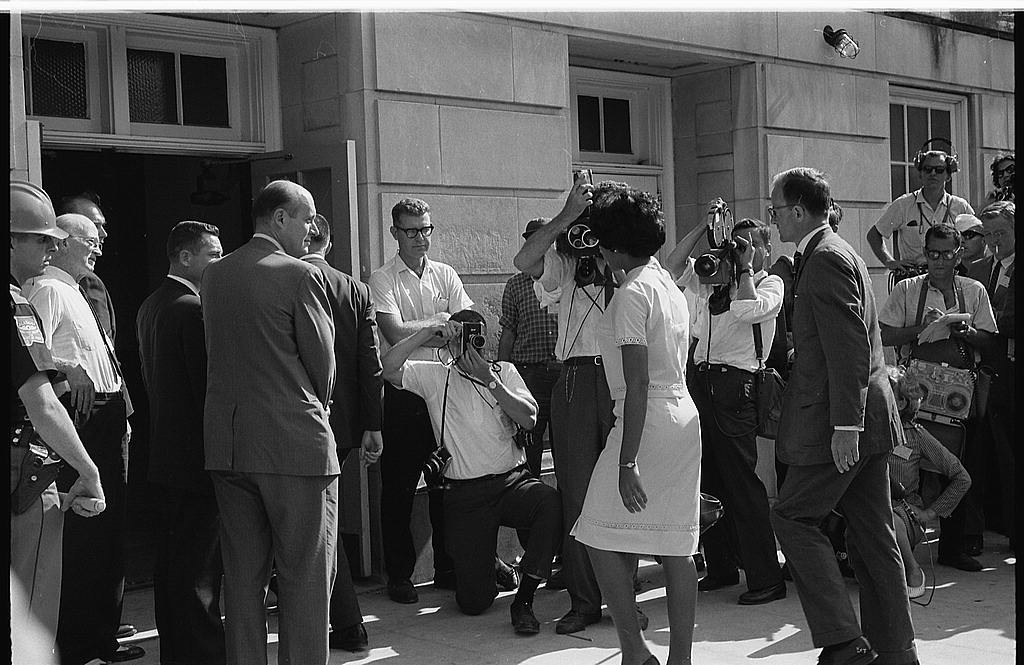
Vivian Malone entering Foster Auditorium to register for classes at the University of Alabama. Photo: Warren K Leffler /US Library of Congress. reproduced in Simerg
Vivian Malone entering Foster Auditorium to register for classes at the University of Alabama. Photo: Warren K Leffler / US Library of Congress.

Katzenbach confronted the governor and handed him the president’s orders to step aside. When Wallace refused, the president was informed, and he signed Executive Order 11111 federalizing the Alabama National Guard. The commander of the Guard, General Henry V. Graham, politely asked the governor to move. Wallace then spoke further, but eventually moved, and Malone and Hood completed their registration, but Wallace believed he had won because America had witnessed his stand. That night, President Kennedy addressed the nation on television and radio.

He explained what happened in Alabama that day, and announced his commitment to a far-reaching civil rights bill. Please read the transcript below, followed by a link to the speech by President Kennedy. Teachers — and parents who have assumed the role of teachers during Covid-19 — will find the page curricular resources useful for further learning and education.

_________________________


Transcript and Video of President John F. Kennedy’s Address to the American People on June 11, 1963

23 August 1962: President Kennedy addresses the AMVETS convention in New York City by telephone. White House, Oval Office. Photo: Abbie Rowe, National Park Service, in the John F. Kennedy Presidential Library and Museum, Boston.

By PRESIDENT JOHN F. KENNEDY

Good evening, my fellow citizens:

This afternoon, following a series of threats and defiant statements, the presence of Alabama National Guardsmen was required on the University of Alabama to carry out the final and unequivocal order of the United States District Court of the Northern District of Alabama. That order called for the admission of two clearly qualified young Alabama residents who happened to have been born Negro.

That they were admitted peacefully on the campus is due in good measure to the conduct of the students of the University of Alabama, who met their responsibilities in a constructive way.

I hope that every American, regardless of where he lives, will stop and examine his conscience about this and other related incidents. This Nation was founded by men of many nations and backgrounds. It was founded on the principle that all men are created equal, and that the rights of every man are diminished when the rights of one man are threatened.

Today we are committed to a worldwide struggle to promote and protect the rights of all who wish to be free. And when Americans are sent to Viet-Nam or West Berlin, we do not ask for whites only. It ought to be possible, therefore, for American students of any color to attend any public institution they select without having to be backed up by troops.

speech continues after photo
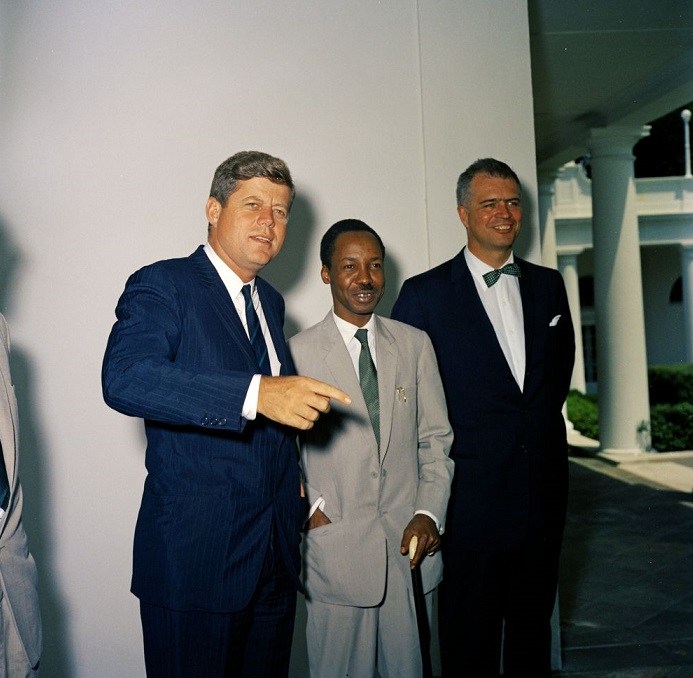
President Kennedy and Julius Nyerere
17 July, 1961: President John F. Kennedy is seen with Prime Minister Julius Nyerere of Tanganyika at the West Wing Colonnade, White House, Washington, D.C. Also in picture is Assistant Secretary of State for African Affairs G. Mennen “Soapy” Williams. Photo credit: Robert Knudsen. White House Photographs. John F. Kennedy Presidential Library and Museum, Boston.

It ought to be possible for American consumers of any color to receive equal service in places of public accommodation, such as hotels and restaurants and theaters and retail stores, without being forced to resort to demonstrations in the street, and it ought to be possible for American citizens of any color to register and to vote in a free election without interference or fear of reprisal.

It ought to be possible, in short, for every American to enjoy the privileges of being American without regard to his race or his color. In short, every American ought to have the right to be treated as he would wish to be treated, as one would wish his children to be treated. But this is not the case.

The Negro baby born in America today, regardless of the section of the Nation in which he is born, has about one-half as much chance of completing a high school as a white baby born in the same place on the same day, one-third as much chance of completing college, one-third as much chance of becoming a professional man, twice as much chance of becoming unemployed, about one¬seventh as much chance of earning $10,000 a year, a life expectancy which is 7 years shorter, and the prospects of earning only half as much.

This is not a sectional issue. Difficulties over segregation and discrimination exist in every city, in every State of the Union, producing in many cities a rising tide of discontent that threatens the public safety. Nor is this a partisan issue. In a time of domestic crisis men of good will and generosity should be able to unite regardless of party or politics. This is not even a legal or legislative issue alone. It is better to settle these matters in the courts than on the streets, and new laws are needed at every level, but law alone cannot make men see right.

We are confronted primarily with a moral issue. It is as old as the scriptures and is as clear as the American Constitution.

speech continues after photo
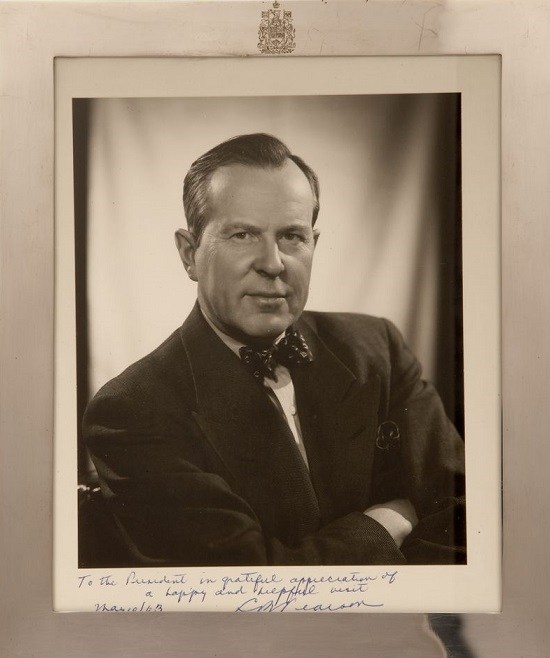
This photograph was given to President John F. Kennedy by Lester B. Pearson, Prime Minister of Canada (1963-1968), during his state visit to the White House on May 11, 1963.
This photograph was given to President John F. Kennedy by Lester B. Pearson, Prime Minister of Canada (1963-1968), during his state visit to the White House on May 11, 1963, exactly a month before the President addressed the Americans on Civil Rights.

The heart of the question is whether all Americans are to be afforded equal rights and equal opportunities, whether we are going to treat our fellow Americans as we want to be treated. If an American, because his skin is dark, cannot eat lunch in a restaurant open to the public, if he cannot send his children to the best public school available, if he cannot vote for the public officials who represent him, if, in short, he cannot enjoy the full and free life which all of us want, then who among us would be content to have the color of his skin changed and stand in his place? Who among us would then be content with the counsels of patience and delay?

One hundred years of delay have passed since President Lincoln freed the slaves, yet their heirs, their grandsons, are not fully free. They are not yet freed from the bonds of injustice. They are not yet freed from social and economic oppression. And this Nation, for all its hopes and all its boasts, will not be fully free until all its citizens are free.

We preach freedom around the world, and we mean it, and we cherish our freedom here at home, but are we to say to the world, and much more importantly, to each other that this is a land of the free except for the Negroes; that we have no second-class citizens except Negroes; that we have no class or caste system, no ghettoes, no master race except with respect to Negroes?

Now the time has come for this Nation to fulfill its promise. The events in Birmingham and elsewhere have so increased the cries for equality that no city or State or legislative body can prudently choose to ignore them.

speech continues after photo

President Kennedy reaches out to crowd in Texas, photo reproduced in Simerg
22 November 1963 President Kennedy reaches out to the crowd gathered at the Hotel Texas Parking Lot Rally in Fort Worth, TX, 22 November 1963. Photo: Cecil Stoughton / John F. Kennedy Presidential Library and Museum, Boston.

The fires of frustration and discord are burning in every city, North and South, where legal remedies are not at hand. Re-dress is sought in the streets, in demonstrations, parades, and protests which create tensions and threaten violence and threaten lives.

We face, therefore, a moral crisis as a country and as a people. It cannot be met by repressive police action. It cannot be left to increased demonstrations in the streets. It cannot be quieted by token moves or talk. It is a time to act in the Congress, in your State and local legislative body and, above all, in all of our daily lives.

It is not enough to pin the blame on others, to say this is a problem of one section of the country or another, or deplore the fact that we face. A great change is at hand, and our task, our obligation, is to make that revolution, that change, peaceful and constructive for all.

Those who do nothing are inviting shame as well as violence. Those who act boldly are recognizing right as well as reality.

Next week I shall ask the Congress of the United States to act, to make a commitment it has not fully made in this century to the proposition that race has no place in American life or law. The Federal judiciary has upheld that proposition in a series of forthright cases. The executive branch has adopted that proposition in the conduct of its affairs, including the employment of Federal personnel, the use of Federal facilities, and the sale of federally financed housing.

But there are other necessary measures which only the Congress can provide, and they must be provided at this session. The old code of equity law under which we live commands for every wrong a remedy, but in too many communities, in too many parts of the country, wrongs are inflicted on Negro citizens and there are no remedies at law. Unless the Congress acts, their only remedy is in the street.

speech continues after photo

July 12, 1961: President John F. Kennedy meets with representatives from the National Association for the Advancement of Colored People. Photo: Robert Knudsen, White House / John F. Kennedy Presidential Library. photo reproduced in Simerg
July 12, 1961: President John F. Kennedy meets with representatives from the National Association for the Advancement of Colored People. Photo: Robert Knudsen, White House / John F. Kennedy Presidential Library.

I am, therefore, asking the Congress to enact legislation giving all Americans the right to be served in facilities which are open to the public-hotels, restaurants, theaters, retail stores, and similar establishments.

This seems to me to be an elementary right. Its denial is an arbitrary indignity that no American in 1963 should have to endure, but many do.

I have recently met with scores of business leaders urging them to take voluntary action to end this discrimination and I have been encouraged by their response, and in the last 2 weeks over 75 cities have seen progress made in desegregating these kinds of facilities. But many are unwilling to act alone, and for this reason, nationwide legislation is needed if we are to move this problem from the streets to the courts.

I am also asking Congress to authorize the Federal Government to participate more fully in lawsuits designed to end segregation in public education. We have succeeded in persuading many districts to desegregate voluntarily. Dozens have admitted Negroes without violence. Today a Negro is attending a State-supported institution in every one of our 50 States, but the pace is very slow.

Too many Negro children entering segregated grade schools at the time of the Supreme Court’s decision 9 years ago will enter segregated high schools this fall, having suffered a loss which can never be restored. The lack of an adequate education denies the Negro a chance to get a decent job.

The orderly implementation of the Supreme Court decision, therefore, cannot be left solely to those who may not have the economic resources to carry the legal action or who may be subject to harassment.

speech continues after photo

President Kennedy photo reproduced in Simerg
President John F. Kennedy meets with representatives from the National Association for the Advancement of Colored People (NAACP). President Kennedy; Ted Berry, member of NAACP Ohio Committee for Civil Rights Legislation (later Mayor of Cincinnati) (second from right); others unidentified. Lincoln Bedroom, White House, Washington, D.C. Photo: Robert Knudsen, White House / John F. Kennedy Presidential Library and Museum.

Other features will be also requested, including greater protection for the right to vote. But legislation, I repeat, cannot solve this problem alone. It must be solved in the homes of every American in every community across our country.

In this respect, I want to pay tribute to those citizens North and South who have been working in their communities to make life better for all. They are acting not out of a sense of legal duty but out of a sense of human decency.

Like our soldiers and sailors in all parts of the world they are meeting freedom’s challenge on the firing line, and I salute them for their honor and their courage.

My fellow Americans, this is a problem which faces us all – in every city of the North as well as the South. Today there are Negroes unemployed, two or three times as many compared to whites, inadequate in education, moving into the large cities, unable to find work, young people particularly out of work without hope, denied equal rights, denied the opportunity to eat at a restaurant or lunch counter or go to a movie theater, denied the right to a decent education, denied almost today the right to attend a State university even though qualified. It seems to me that these are matters which concern us all, not merely Presidents or Congressmen or Governors, but every citizen of the United States.

speech continues after photo

23 November, 1963 : President Kennedy’s wife and daughter kneel at the casket as the President’s body lies in state in the Rotunda of the Capitol Building. Photo: Abbie Rowe, National Park Service / John F. Kennedy Presidential Library and Museum. Boston.

This is one country. It has become one country because all of us and all the people who came here had an equal chance to develop their talents.

We cannot say to 10 percent of the population that you can’t have that right; that your children can’t have the chance to develop whatever talents they have; that the only way that they are going to get their rights is to go into the streets and demonstrate. I think we owe them and we owe ourselves a better country than that.

Therefore, I am asking for your help in making it easier for us to move ahead and to provide the kind of equality of treatment which we would want ourselves; to give a chance for every child to be educated to the limit of his talents.

As I have said before, not every child has an equal talent or an equal ability or an equal motivation, but they should have the equal right to develop their talent and their ability and their motivation, to make something of themselves.

We have a right to expect that the Negro community will be responsible, will uphold the law, but they have a right to expect that the law will be fair, that the Constitution will be color blind, as Justice Harlan said at the turn of the century.

This is what we are talking about and this is a matter which concerns this country and what it stands for, and in meeting it I ask the support of all our citizens.

Thank you very much.

________________________

Video of President John F. Kennedy’s Address to the American People on June 11, 1963

Please click on image for speech.

Date posted: June 11, 2020.

Before departing this website please take a moment to review Simerg’s Table of Contents for links to hundreds of thought provoking pieces on a vast array of subjects including faith and culture, history and philosophy, and arts and letters to name a few.

____________________

Please also see our sister website’s Photo Essay: Remembering President John F. Kennedy (May 29, 1917 – November 22, 1963)

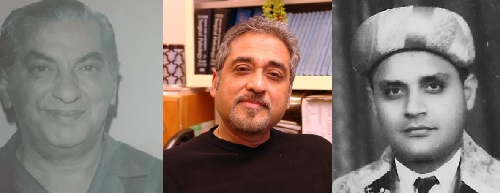
Remembering Ismailis we have lost since Jamatkhana closures and during the coronavirus pandemic

Simerg invites Ismaili families around the world to submit short obituaries or tributes to members of their families who have passed away during the Coronavirus pandemic, either due to Covid-19 OR any other cause. Please read the first part of tributes by clicking here or on the photo below. Submit the tribute to the editor, Malik Merchant, at simerg@aol.com. The tributes we have published are good examples for a tribute you may wish to write for your family member.

Date posted: June 8, 2020.

__________________

“The Last Anointing” – an amazing must read piece in the New York Times

EDITOR’S NOTE: Ismaili Muslim families whose family members are seriously ill or are in the last stages of their lives seek out their Jamatkhana leaders — the Mukhis and Kamadias — to offer some specific prayers, blessings and rites on the sick members of the family, who may never recover from the illness. Many of us familiar with our sacred and age old traditional ceremonies will be able to relate to this remarkable piece that I have just finished reading in the print edition of the Sunday New York Times (June 7, 2020). Because the piece relates to Covid-19, the newspaper offers it as a free-read on its on-line edition, without having to subscribe. Please read it!

Mukhi Alidina Jamal, Dr. Allaudin Daya, and Alwaez Shamshu Bandali Haji Simerg Featured Image

The 3 Unforgettable Ginan Singers in My Life: A Tribute to Alidina Jamal, Allaudin Daya and Shamshu Bandali Haji

By MALIK MERCHANT
(Publisher-Editor,  Simerg, Barakah, and Simergphotos)

I consider Alidina Jamal, Allaudin Daya and Shamshu Bandali Haji to be among the list of my heroes for their inspiring and uplifting recitations of Ginans in East Africa and Canada. My first hero, in chonological sequence, was Alidina Jamal of Upanga Jamatkhana in Dar es Salaam, Tanzania. I still recall the day when I brought home miserable results from my Form 1 final term exams. While I had stood 2nd in the class during the first two terms, my indulgence in cricket had set me back a few dozen places and I was at the bottom of the class – 42 out of 44! I had never seen my late dad, Alwaez Jehangir Merchant (1928-2018), as mad as he was on that day, but he was a loving dad too. After all the scolding — and more — that I received, there was one piece of advice he gave me that held true throughout my life.

He asked me to be in attendance in the Jamatkhana well before the first Dua was recited, so that I would avail myself of the truth and beauty of the holy Ginans composed by Ismaili Pirs centuries earlier. My dad desired that I should carry in my heart Muslim values that the Pirs taught, as well as gain an understanding of the Shia Ismaili faith, which are articulated well in the Ismaili Pirs’ compositions.

article continues after photo

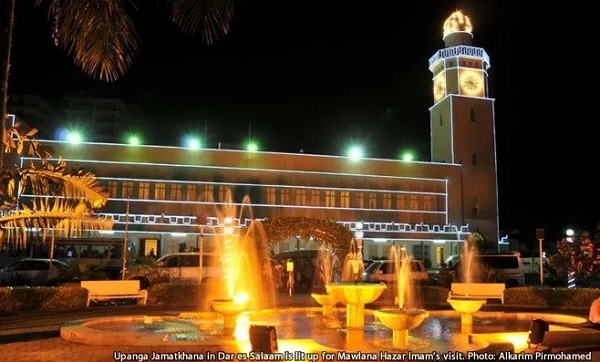
Upanga Jamatkhana Dar es Salaam Simerg, Barakah
Upanga Jamatkhana, Dar es Salaam. Photo: Alkarim Pirmohamed

I followed the advice he gave me and started arriving at the Upanga Jamatkhana several minutes before the dusk Dua, as often as I could. This is how I was introduced to Alidina Jamal — and later to Allaudin Daya and Shamshu Bandali Haji — through his almost daily routine of singing numerous verses from Pir Hasan Kabirdin’s monumental composition, Anant Akhado. The recitation brought me an awareness of the magnificent Ismaili tradition of Ginans. I was then in my teen years. The importance of Ginans has been emphatically made in the following quote by Mawlana Hazar Imam at an evening of Ginan recitations or concert (mehfil) held in Karachi in December 1964.

“I would be surprised if ever such a big Mehfil-e-Ginan has ever been held…many times I have recommended to my spiritual children that they should remember ginans, that they should understand the meanings of these ginans and they should carry these meanings in their hearts. It is most important that my spiritual children…hold to this tradition which is so special, so unique and so important to my Jamat…I have been deeply happy tonight, deeply happy because I have seen the happiness in the hearts of my Jamat and this is what makes Imam happy” — Mawlana Hazar Imam, Karachi, December 16, 1964, published by the Ismailia Association for Pakistan.

article continues after photo

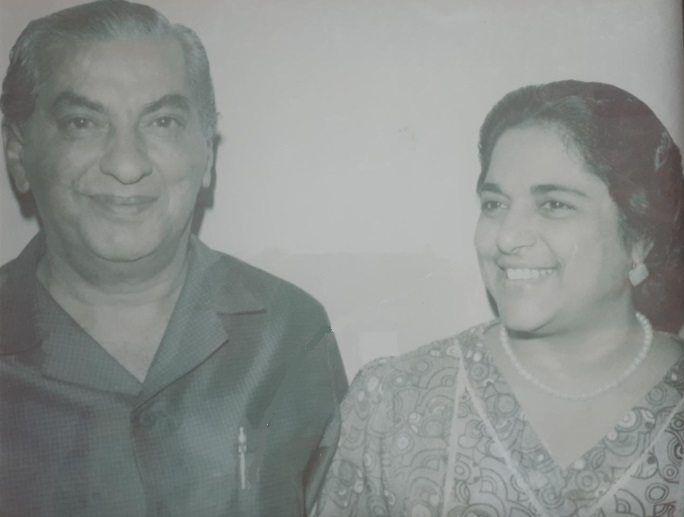
Mukhi Alidina Jamal Ismaili Ginan reciter Simerg
Mukhi Alidina and Mukhiani Roshankhanu Jamal. Photo: Amin Jamal Collection, Calgary.

I could see the joy on the late Mukhi Alidina’s face as he would seat himself comfortably on the floor in front of the main podium for a series of selections that covered numerous themes. His commencement of the Ginan with “Ashaji…” had the power to lift the spirit of this rather young and indifferent teenage boy, and take it to a higher plateau. The entire Jamat would join Alidina, as he gained strength, verse after verse, until he would finally come to a stop a minute or two before the first Dua. In the ten to fifteen minutes of a highly charged performance, our temporal and mundane mind-set was transformed to a spiritual plane. I should say the same for Allaudin Daya and Shamshu Bandali Haji. Through their passion for the Ginanic tradition, all three of these individuals brought the Jamat to the realization of life’s basic principles of patience, tolerance, honesty, avoiding ninda (backbiting) and good ethics (such as in Eji namata, khamta gurji sun rakho), the importance of morning and evening prayers (Eji sandhya veda, biji sandhya and triji sandhya), the Ismaili principles of service (Eji panch mi bari dasondh…) and of course, the obedience to the teachings of Prophet Muhammad (S.A.S.) and the guidance of the Imam of the Time. Their great recitations would prepare us for the prayers that would follow.

article continues after photo

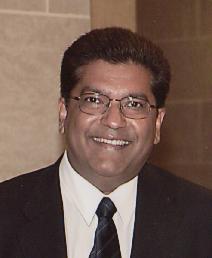
Dr. Allaudin Daya
Dr. Allaudin Daya.

How did Allaudin Daya become my hero? When Karimabad Jamatkhana opened, it became my primary Jamatkhana, as it was a lot closer to our flat on United Nations Road than Upanga Jamatkhana was. The congregation was much smaller than Upanga’s, as was the Jamatkhana building itself, and I wondered if anyone would ever be able to come close to Mukhi Alidina Jamal’s recitations. A young medical student at the nearby Muhimbili Hospital by the name of Allaudin Daya stepped in to fill the void that I was beginning to feel. Dr. Daya’s recitations were superb, and he was a blessing for the new Karimabad Jamat. His eloquent recitations of the same Anant Akhado that I had heard from Mukhi Jamal, sent chills down my spine, gave me goose bumps and uplifted my spirit. I never dared ask him whether Mukhi Alidina had ever been his coach. I didn’t think so. He resided at the hospital quarters, and I would often meet up with him on the way to the Jamatkhana.

Once I was inside the prayer hall and seated, my eyes wandered to the centre podium area, hoping and wishing to see Dr. Daya rise from his place, and go to the stage to start the recitation like his senior and older compatriot Alidina Jamal, who by now had assumed the role of Mukhisaheb at Upanga Jamatkhana. On most days, Dr. Daya would be called up by the Mukhi, showing the respect the youth commanded in the new Karimabad Jamat. Once I left Dar es Salaam for London, England, the opportunities to attend Jamatkhana became scarcer, as Jamatkhana was a long (and expensive) tube ride away from where I was staying, and I was very busy with my studies. However, Mukhi Alidina Jamal and Dr. Daya had firmly instilled in me a deep love for Ginans. The tradition was solid in my heart.

article continues after photo

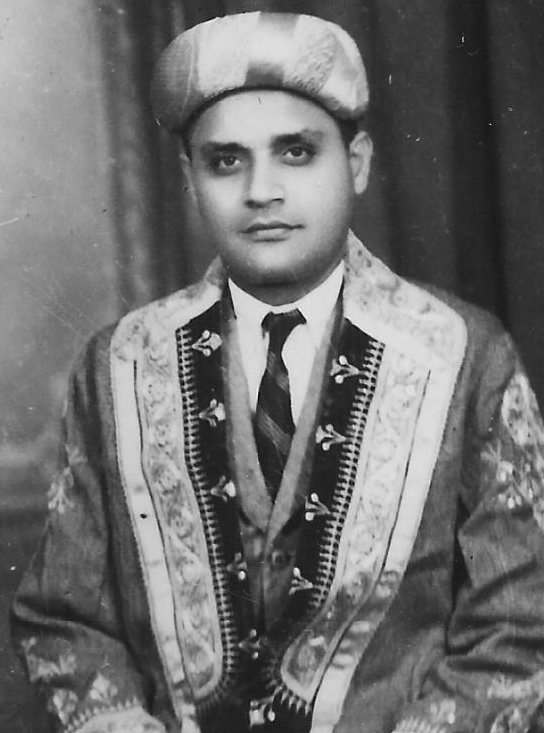
A portrait of Alwaez Shamshu Bandali Haji in his early days.
A rare portrait of Alwaez Shamshu Bandali Haji from his early years. Photo: Shamshu Bandali Haji Family Collection

Then several years later, upon my arrival in Canada and initial settlement in Edmonton, I wondered who would assume the roles of my two East African ‘Ashaji’ icons. To my absolute happiness and delight, the role was filled by none other than the late Alwaez Shamshudin Bandali Haji, who sang Anant Akhado in a truly masterful fashion. I might add that during Mawlana Hazar Imam’s Silver Jubilee year (1982-1983), the pleasant and cheerful Alwaez Bandali Haji, completed the entire Anant Akhado of several hundred verses by picking new verses, each time he got the opportunity to sing before the first Dua at Edmonton’s South Side Jamatkhana. In addition to Anant Akhado, Alwaez Haji’s singing of the Chogadiya made the Ginan an instant hit for me, so much so that one day, not having heard the Chogadiya for some time, I went to the Mukhisaheb and requested that Alwaez be invited to recite it. Alwaez, alas, was late that evening but there were numerous future opportunities that came along. 

These are the three individuals I shall never forget during my lifetime for their outstanding contribution to the Ginanic tradition.

“Meritocracy” Mawlana Hazar Imam once observed, “is not only limited to intellectual endeavours.” Mukhi Alidina Jamal, Alwaez Shamshuddin Bandali Haji and Dr. Allaudin Daya were meritocratic individuals in their own right who, through their inspiring singing raised the spirit of the Jamat, and have immensely contributed to the Jamats’ increased love for the Imam of the Time. To these three, I would like to add the name of Dr. Hafiz Jamal whom I used to hear reciting the verses of Anant Akhado in Ottawa. He is an outstanding Ginan reciter and an absolute joy to listen to.

I have been able to access the recitations of Anant Akhado by Shamshuddin Bandali Haji on the website of Ginan Central. Here are two tracks consisting of several verses from the Ginan:

article continues after Ginan recordings:

_______________

Please listen to more recitations at http://ginans.usask.ca/recitals/recitals.php?type=album&id=104274

May the souls of Mukhi Alidina Jamal and Alwaez Shamshuddin Haji rest in peace and as for Dr. Allaudin Daya, I sincerely hope to hear him at least once during the coming years. I also look forward to listening to Dr. Hafiz Jamal.

We invite you to share your thoughts about Alidina Jamal, Shamshu Bandali Haji and Allaudin Daya as well as many others like them whom you know for their outstanding Ginan recitations.

I end this piece with a verse of supplication by Pir Hasan Kabirdin from his Anant Akhado to the Imam of his Time, Mawlana Islam Shah. For Ismailis, each Imam is the same irrespective of his own age or the time he lives in, as he is the bearer of the same Noor (Light) of Imamat.

Ashaji jugpati jugnath Sri Islam Shah
ham man tere umayoji
kayam svami ha(n)sajina raja
ja(m)pudipme shah avo
Ali ana(n)t ana(n)t
Ali anatejo svami shah
anata jo a(n)t tuhi jane ji

Oh Lord Islam Shah, the Lord and the Master of the Age;
My mind (and heart) supplicates to you;
You are the eternal Lord and the King of the soul;
Come to the Indian subcontinent;
Ali You are eternal and unlimited, Ali You are the
Lord of unlimited souls or eternity;
You are the only Knower of the limits of the unlimited.

Date posted: June 7, 2020.
Last updated: July 1, 2020 (photo of Allaudin Daya added)

Before departing this website please take a moment to review Simerg’s Table of Contents for links to hundreds of thought provoking pieces on a vast array of subjects including faith and culture, history and philosophy, and arts and letters to name a few.

_____________________

We welcome feedback/letters from our readers. Please use the feedback box which appears below. If you don’t see the box please click please click Leave a comment. Your comment may be edited for length and brevity, and is subject to moderation. We are unable to acknowledge unpublished letters.

Malik Merchant Publisher Editor Simerg Barakah and Simergphotos

Malik Merchant is the founding publisher/editor of Simerg (2009), Barakah (2017) and Simergphotos (2012). A former IT consultant, he now dedicates his time to small family projects and other passionate endeavours such as the publication of this website. He is the eldest son of the Late Alwaez Jehangir Merchant (1928-2018) and Alwaeza Maleksultan Merchant, who both served Ismaili Jamati institutions together for several decades in professional and honorary capacities. His daughter, Nurin Merchant, is a veterinarian. He may be contacted at Simerg@aol.com.

His Highness the Aga Khan and Jehangir Merchant in Lourenco Marques, Mozambique

Ismaili doctrines of faith: Short lessons from the writings of Alwaez Jehangir Merchant: (1) Tawhid or Unity of God

Introduced by Malik Merchant
(Publisher-Editor,  Simerg, Barakah, and Simergphotos)

Alwaez Rai Jehangir Merchant (1928-2018) — picture above with Mawlana Hazar Imam, His Highness the Aga Khan — is fondly remembered everyday single day by his beloved wife of 66 years, Alwaeza Raisaheba Maleksultan Jehangir Merchant, and all her family members.

He passed away 2 years ago on May 27, 2018 at approximately 1:15 AM. We pray that his soul may rest in eternal peace. Amen.

Jehangir  and Maleksultan Merchant
Jehangir and Maleksultan in front of a large
portrait photo of Mawlana Hazar Imam.

My dad was a prolific writer. In England, he edited the flagship Ismaili religious magazine, Ilm, for several years while he served with my mother with the Ismaili Tariqah and Religious Education Board (ITREB). His articles related to the faith, history, principles and doctrines of the Ismaili faith, along with insightful interpretations of Qur’anic verses, as well as moving narratives of Mawlana Hazar Imam’s Mubarak visits to different parts of the world, richly contributed to the Jamats’ understanding of the faith. The closure of Ismaili religious magazines in the very early 1990’s created a significant void in the dissemination of religious material that was deemed to be “official.” I am referring here to insightful articles in monthly or quarterly magazines published by ITREBs around the world, and not to literary and scholarly books, which the Institute of Ismaili Studies has done a fantastic job of publishing over the past 30 years.

From the time this website, Simerg.com, was launched in 2009, Alwaez Merchant was able to devote time to editing and adapting his Ilm pieces for publication on this website for the benefit of readers on the World Wide Web. Links to those pieces are provided at the end of this article. Ill-health prevailed, and he was no longer able to fully complete the remainder of his Ilm pieces for publication on Simerg.

Ilm Ismaili religious magazine edited by Jehangir Merchant
Ilm magazine – one of Alwaez Jehangir’s magnificent contributions to the Ismaili literary scene. Jehangir edited and wrote extensively for the journal.

Now, I am going to take his unpublished essays from Ilm — many of which were quite lengthy — and share them as short pieces of learning over the coming weeks and months. We begin the Jehangir Merchant series, if I may call it that, with the Concept of Tawhid, which forms the first component in his essay entitled “Fundamental Aspects of Ismaili Doctrine.” It appeared in Ilm, Volume 7, Number 1 & 2, July-November 1981, pp. 2-12.

Tawhid

By (LATE) JEHANGIR A MERCHANT

Jehangir and Maleksultan Merchant, Ismaili missionaries
Jehangir and Maleksultan Merchant served the Imam of the Time and Ismaili institutions for more than 60 years.

In all Shi‘a tariqahs of Islam, Tawhid (belief in the Unity of God), Nubuwwah (Prophethood), Imamah (the Institution of the Divine Guide) and Qiyamah (Day of Judgement), are considered as the doctrines of the faith. My brief explanation of each of these 4 doctrines of faith for publication on Simerg are based on a much broader discussion that I provided on these subjects in my original article published in Ilm magazine, which also included a detailed historical background on the subject of Imamat.

The belief in the Unity of God (Tawhid) is the cornerstone of faith (Iman) for all Muslims.

It is articulated in the pronouncement: La ilaha ill-Allah: “There is no god but Allah.”

This doctrine of Unity of God is beautifully summarised in Sura Tauhid, popularly known as Suratul Ikhlas (112:1-4), which says: “Say, He Allah is One; Allah is Absolute, Independent. He did not beget nor He was begotten and there is none like unto Him.”

We know, however, that the Holy Qur’an, ascribes a number of attributes to Allah. God is spoken of as ar-Rahim (The Merciful), al-Wadud (The Loving), al-Sami (The Hearing), al-Barir (The Seeing) etc. The Qur’an also talks about Wajahullah (the Face of God), Yadullah (the Hand of God), and so on.

While there are numerous references which attribute human qualities to God in the Holy Qur’an, the scripture states in very plain words that Allah is above all material conceptions.

For example, the Qur’an says: “Vision comprehends Him not and He comprehends all vision.” (6:104) and “Nothing is like a likeness of Him.” (42:11)

The Unity of God (Tawhid) implies that God is One in His Dhat (essence) and One in His Sifat (attributes).

The concept of Tawhid appears in the works of many Ismaili dais (missionaries) and philosophers. Their works on the subject place an emphasis against anthropomorphising God, that is, giving human attributes to God.

article continues after image

Fatimid coin Imam al-Zahir
The inscription in the inner margin of this Fatimid coin minted during the reign of Imam al-Zahir reads: la ilah illa / allah wahdahu / la sharik lahu; “no god but God, unique, He has no associate.” Photo: David Museum, Copenhagen.

God is declared in their works as One, Absolutely Transcendent, Omnipotent, Omnipresent, Omniscient, Incomprehensible and a Quality-less Being. A Ginanic verse makes this clear:

La thi un dhat kahave, tanki baat kahi nav jai; Dubki le le gotha khave, Pir Paighambar tai na pavey

Translation:

The Dhat [essence] is from nothingness and nothing can be said about it. Pirs and Prophets delve deep in this knowledge but in vain.

The concept that God has no qualities difficult to grasp, because the human mind cannot comprehend a total lack of qualities, a concept which it has not experienced before. We cannot imagine a man, if we can for the moment call such a being a man, who has no colour, no shape, no size, no special existence, who is neither alive nor dead.

Hence, the notion that God is quality-less becomes unintelligible and the Qur’an, therefore, attributes a number of qualities to God. If we consider the qualities applied to God and examine them carefully we find that the grounds for all of these attributes lie in our own experience of this material world.

Pir Shiahbu’d-din Shah writes in his work Risala dar Haqiqati Din (True Meaning of Religion):

“…people speaking about God (Haqq) attribute to Him any such (perfections) as they can imagine. For instance, regarding blindness as a defect, they say about God that He sees everything. They regard ignorance as a defect, and thus say that God is All-Knowing. Thus, whatever they find in themselves as a vice and defect they attribute to God a perfection opposite to that. Most probably, even animals create their own God free from their own defects, ascribing to Him (the opposite) perfections. Imam Muhammad Baqir says that the tiny ant probably imagines his god as having two stings, because it regards the possession of only one sting as a defect.”

So, when the Qur’an attributes qualities to God, it is to help convey to man the idea of God and not that these terms express the true nature of God, or that they are perfect indicators to His Being.

Ismaili doctrine upholds the belief in a single transcendent Being, whose nature is beyond the comprehension of the human mind and who is inexplicable. This is because our definitions are based on our experiences of the material world, and these definitions cannot be applied to this Being.

Pir Shihabu’d-din Shah, again in his previously cited book, says:

“All that is beyond thy imagination, Is merely the limit of thy fantasy, not God. Wisdom can attain a knowledge of His Substance Only in the case if a piece of straw can sink to the bottom of the sea. And Imam Ja’far-as-Sadiq said: “What God is, Man cannot think: and what Man thinks God is not. Yet man lives by God, and God is nearer to him than himself.”

Thus, in the Doctrine of Tawhid, lsmailism completely avoids any form of anthropomorphism and remains purely monotheistic.

We will continue our next discussion on another Shia doctrine of faith, namely, Nubuwwah or Prophethood which will then be followed by Qiyama (the Day of Judgement) and Imamah (the hereditary leadership in Islam).

Date posted: May 27, 2020.

Before departing this website please take a moment to review Simerg’s Table of Contents for links to hundreds of thought provoking pieces on a vast array of subjects including faith and culture, history and philosophy, and arts and letters to name a few.

_______________________________

The following are links to Alwaez Jehangir Merchant’s articles that have been published on this website:

  1. Ghadir-Khumm and the Two Weighty Matters (a Simerg original, I Wish I’d Been There Series)
  2. An Esoteric Interpretation of the Mi’raj (adapted from Ilm magazine)
  3. The Establishment of the Fatimid Caliphate (adapted from Ilm magazine)
  4. The Parable of Moses and Khidr in the Holy Qur’an (adapted from Ilm magazine)
  5. Jehangir Merchant’s Thank You Letter to Da’i Al-Mu’ayyad al-Shirazi (a Simerg original, Thank You Series)
  6. Text and Explanation of “Eji Shah Islamshah Amne Maliya” (adapted from Ilm magazine)
  7. The Story of Noah’s Ark in the Holy Qur’an (adapted from Ilm magazine)
  8. A Translation and Brief Commentary of Pir Sadardin’s Ginan “Jem Jem Jugatsu Preet Kareva” (adapted from Ilm magazine)
  9. The Frontispiece of the Ismaili Jamatkhana in Mashhad, Iran (adapted from Ilm magazine)
  10. “One Jamat” (proposal, with Malik Merchant)
  11. The 1979 London Didar: The Experience (adapted from Ilm magazine)
  12. Imams Muhammad al-Baqir and Ja’far as-Sadiq on Love for the Imam (with Alnoor Bhatia, adapted from Ilm magazine)

Also see:

We welcome feedback/letters from our readers. Please use the feedback box which appears below. If you don’t see the box please click please click Leave a comment. Your comment may be edited for length and brevity, and is subject to moderation. We are unable to acknowledge unpublished letters.

Well I Never….


By ROXANA JAFFER

Well I Never …

Order of the day: “Stay at home”
An opportunity to relax n catch up with sleep

COVID 19, you came to destruct,
And Lockdown 20, you came to obstruct

Or a chance to question His existence deep
No resistance now in the discovery of NUR?

An – NUR the sacred sound of the universe
Found in every nook and cranny like a poetic verse

Well I Never …

To the garden perambulating the home
Round and Round; looking for the Unknown

As Adam found Eve in His Garden of Eden
Many jewels in my garden; blatant to my Oblivion

All speaking in color and shape, flower bush and tree
Iqra – Read, Read what you know not, come set yourself free

Learn the sound of NUR through the birds of the sky
Recite with the mind; find the power of the butterfly

Well I Never …

NUR exists; in the many shades of red and pink
Juxtaposed with variegated greens all in sync

Green berries flowering to pink; Honey bees in search of nectar
Confused with beautiful butterflies on their path as protector

Cant but just appreciate what I never saw before
Blessings manifold of the birds in their original couture

The Neem, the Lime, the Chikoo & Moringa opening their boughs
Guests invited to perch are the parrot, the dove and the crows

Well I Never …

Look everywhere and there is diversity in total harmony
Not castles in the air, but the moon dancing round the planets

Under the moonlight am I, a whirling dervish on the lawn
Moving to the rhythm of NUR, not aware when night becomes dawn

Twirling in happiness becoming submerged in His current
He who is above all else, only His cell is totally apparent

COVID 19, did you really come to destruct?
Really you helped to right the wrongs and reconstruct

Date posted: May 26, 2020.

Before departing this website please take a moment to review Simerg’s Table of Contents for links to hundreds of thought provoking pieces on a vast array of subjects including faith and culture, history and philosophy, and arts and letters to name a few.

______________________

Roxana Jaffer, Simerg

Kenyan born Roxana Jaffer, is an accountant by profession, and currently lives in the UAE. She is striving to make the world a better place, and is the founder of the NGO -– ‘abc: an Advent for Building human Capital’ (see www.myabcfoundation.org) which accords English to the unemployed in Hunza and Delhi, resulting in a 70% impact as youth get growth.

Her creativity is taking a different turn as she expresses spirituality through poetry she pens. We were delighted to welcome her into the Simerg fold with her recent composition Devotion Through Dhikr.

______________________

We welcome feedback/letters from our readers. Please use the feedback box which appears below. If you don’t see the box please click please click Leave a comment. Your comment may be edited for length and brevity, and is subject to moderation. We are unable to acknowledge unpublished letters.

Translucent Night


By NAVYN NARAN

A night view of the Ismaili Centre with its distinctive glass dome, illuminated warmly against a dark sky.

A grain of sand,
Held in its shell.
A pearl is born, hidden from sight
These are reflective within the whole
Under the opaque crystal
Of the peaked Ismaili Centre dome
Here grains of sand
transform into pearls.
A mountain peak risen
From circular white granite
The translucent glass faces
His one time home.

The moon is peeking out
As it waxes on a journey
The clearest night paves the way
towards a seventh heaven
No clouds to deter the clarity and blessings
of quanta and waves.
Piercingly clear, nothing interferes.
The dome sits majestically, still as thin air
In the bright night lit of stars
Where all souls pray.

Those who eat of the fruits of that which is within
In the peace of the night
Light enters through the transparent glass
You search for the spiritual nature of being
Between the opaque and the transparent.

Peace tonight as Shawwal arrives
Then dawn will break clearly
And rustle of wings and hymns of birds will be heard,
As buds have been born
Tulip has bloomed
Russian sage is waking
Cherry blossoms are done
Serviceberry smart in rows, salutes
Infinity pools await water,
Thoughts take root.

And so we wonder,
What is under this dome?

Ismaili Centre Toronto Dome
The dome of the Ismaili Centre Toronto

Date posted: May 25, 2020.

__________________________

A close-up portrait of a smiling woman with shoulder-length hair, wearing a patterned top.

About the author: A regular contributor to this website, Dr. Navyn Naran was born in Dar es Salaam, Tanzania, to Anaar (1936-2017) and Badrudin Naran (1930-1979). She is currently in Toronto working in pediatrics and volunteering at the Aga Khan Museum.

____________________

We welcome feedback/letters from our readers. Please use the feedback box which appears below. If you don’t see the box please click Leave a comment. Your comment may be edited for length and brevity, and is subject to moderation. We are unable to acknowledge unpublished letters.

Before departing this website please take a moment to review Simerg’s Table of Contents for links to hundreds of thought provoking pieces on a vast array of subjects including faith and culture, history and philosophy, and arts and letters to name a few.


You must watch the 72 hour Shukrana concert on Ismaili.TV – don’t let anything stop you!

by MALIK MERCHANT
(Publisher-Editor,  Simerg, Barakah, and Simergphotos)

I’ve been watching the special Eid ul-Fitr presentation Shukrana since it was launched on Ismaili TV Sunday, May 24 2020, at 2 am! Yes! You are reading the hour correctly. When Saba Rawjani of Ottawa was performing on Sunday, my daughter Nurin was doing her gardening under sunny skies and a temperature of 25c in Ottawa! I urged her to get back and watch Saba (see photo at top of post). What a sweet and charming talent Saba is, and what about the control of her voice! Of course, I have heard her in Ottawa since she was a child, but how much she has grown over the years! Then, on Sunday morning the Syrian performance was incredible. Truly, every performance has been top class! And what about those messages from little children — I’m glad they are repeated every so often. Keep one thing in mind: every composition has been done with the artists’ love for Mawlana Hazar Imam, and in the spirit of ONE JAMAT.

I will review the concert at a later time but in the meantime I simply urge you to leave everything aside, for a few hours everyday, and watch the superb musical talent of the Jamat from every corner of the Ismaili world.

You still have more than 24 hours of continuous watching. What have I been doing during my absolutely essential sleeping time? Take my notebook into my bedroom, lay it on the dresser beside me, with the screen facing my bed! Something or the other nudges me to open my eyes, and I stare at the screen with delight. My ears are always open! I feel rested, and I owe it to delightful voices and instruments of Ismaili artists! What a wonderful intrusion!

WATCH IT, and ask your family members to join you! Sorry, but make the Shukrana viewing mandatory, at least for a few hours of the remaining time that is left! Please click Ismaili.tv.

Date posted: May 25, 2020, 01:05 AM.

Before departing this website please take a moment to review Simerg’s Table of Contents for links to hundreds of thought provoking pieces on a vast array of subjects including faith and culture, history and philosophy, and arts and letters to name a few.

_______________________

Malik Merchant
Malik Merchant of Simerg

Malik Merchant is the founding publisher/editor of Simerg (2009), Barakah (2017) and Simergphotos (2012). A former IT consultant, he now dedicates his time to small family projects and other passionate endeavours such as the publication of this website. He is the eldest son of the Late Alwaez Jehangir Merchant (1928-2018) and Alwaeza Maleksultan Merchant, who both served Ismaili Jamati institutions together for several decades in professional and honorary capacities. His daughter, Nurin Merchant, is a veterinarian. He may be contacted at Simerg@aol.com.

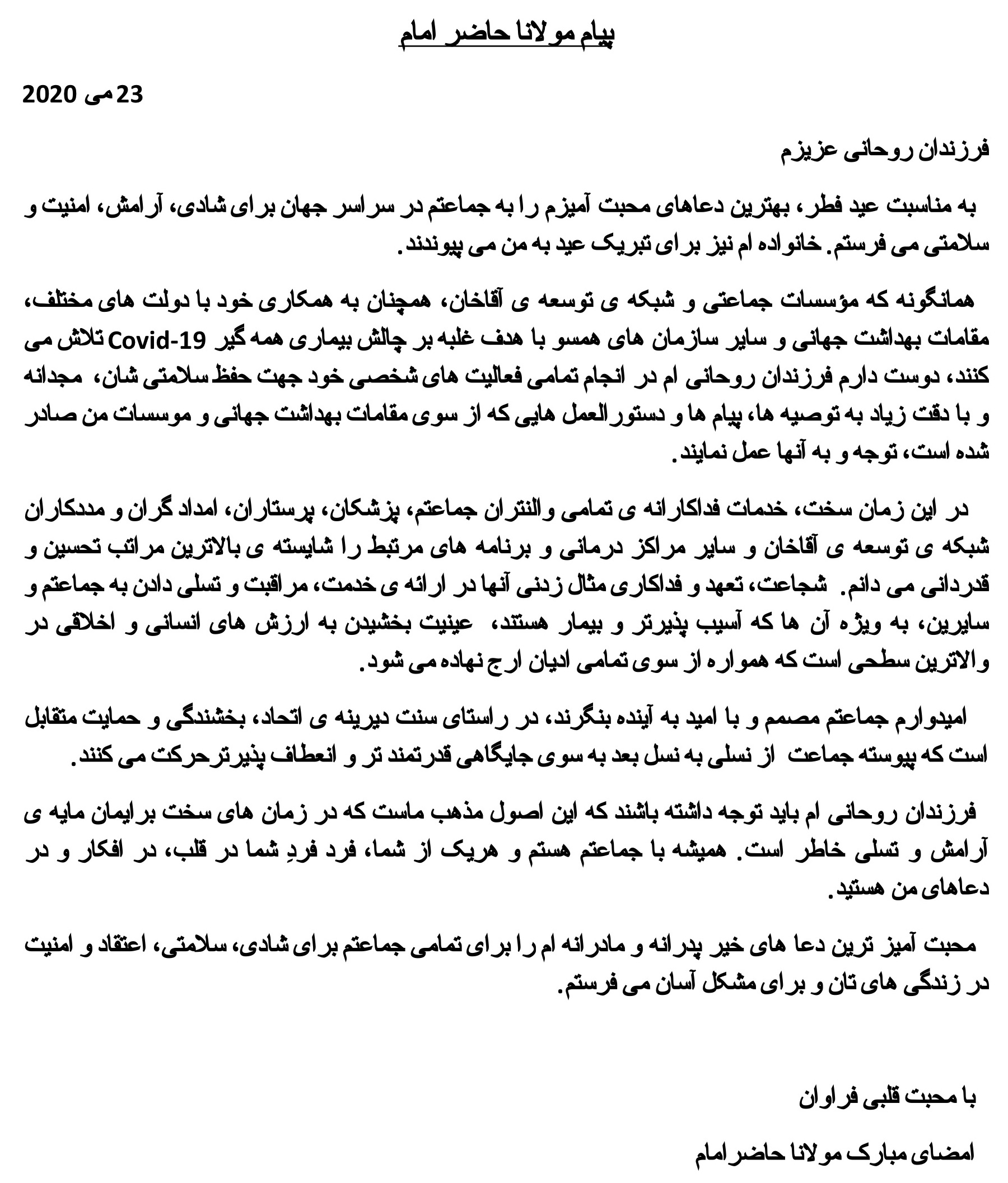
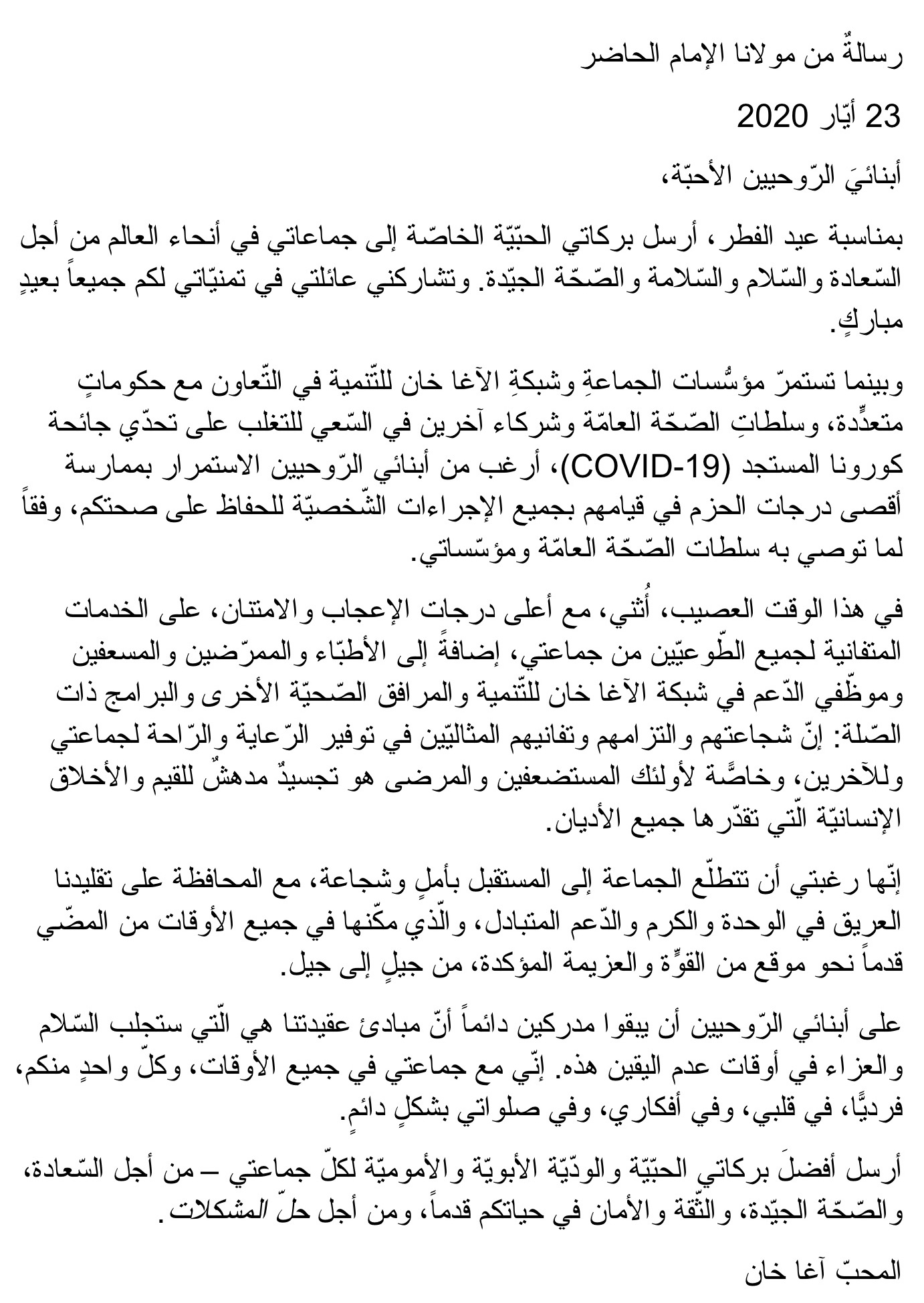
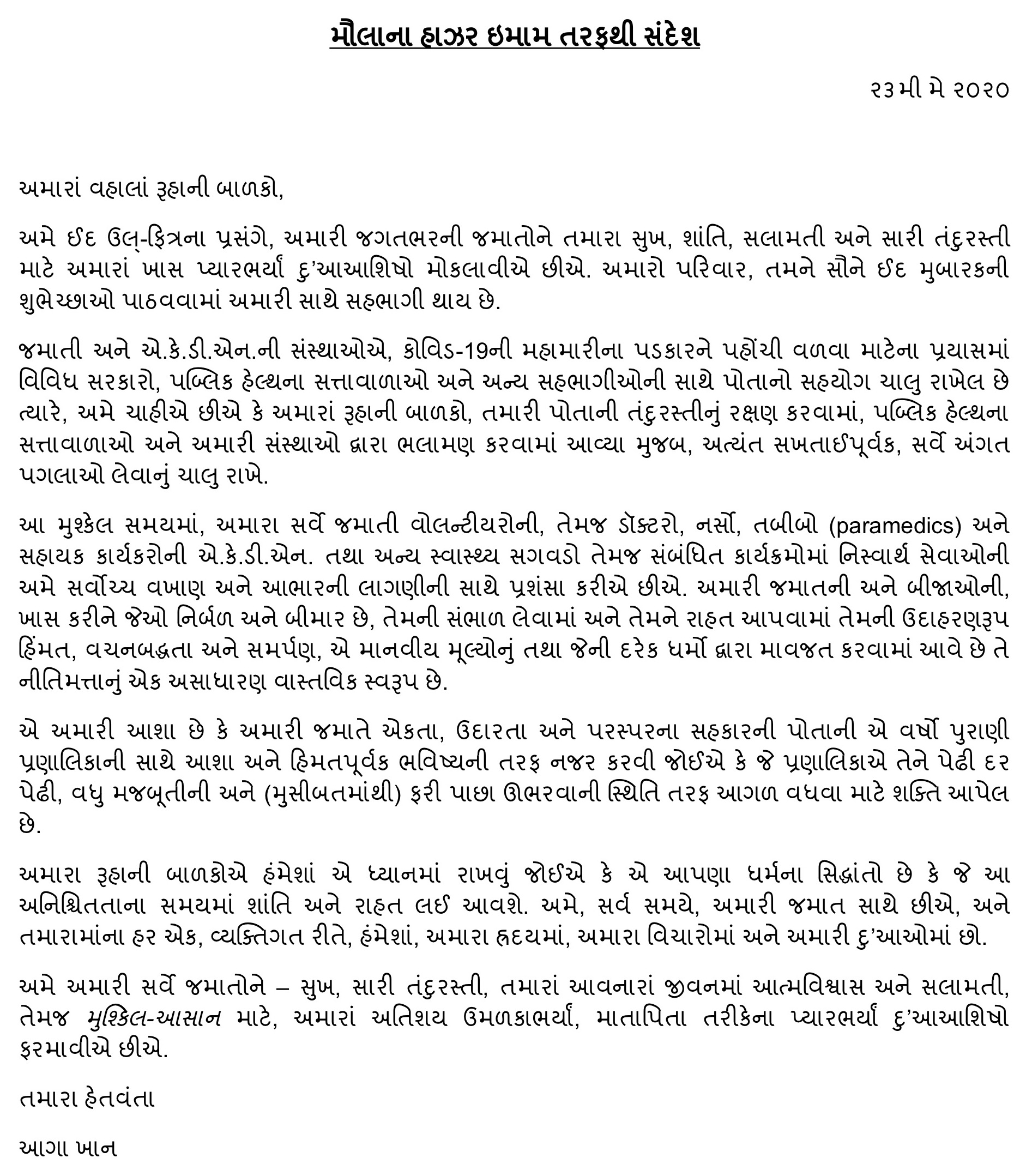
Mawlana Hazar Imam’s message and loving blessings to the worldwide Jamat on the occasion of Eid ul-Fitr, with translations in 8 languages

The following message in English and all the translations that follow are reproduced from the The Ismaili, the official website of the community. After reading the message, please scroll to the bottom of this post to read our supplication to Mawlana Hazar Imam — it follows the Tajik translation. For another version of this post, please visit our sister website Barakah, which is exclusively dedicated to Mawlana Hazar Imam and his family.

Message from Mawlana Hazar Imam (English)

His Highness the Aga Khan, Mawlana Hazar Imam

My beloved spiritual children,

On the occasion of Eid ul-Fitr, I send my special loving blessings to my Jamats throughout the world for your happiness, peace, safety, and good health. My family joins me in wishing you all Eid Mubarak.

As the Jamati and AKDN institutions continue their collaboration with various governments, public health authorities and other partners in the endeavor to overcome the challenge of the COVID-19 pandemic, I would like my spiritual children to continue to exercise the utmost rigor in undertaking all personal measures to safeguard your own health, as recommended by the public health authorities and my Institutions.

At this difficult time, I applaud, with the highest admiration and gratefulness, the selfless services of all my Jamati volunteers, as well as the doctors, nurses, paramedics and support workers in the AKDN and other health facilities and related programmes: Their exemplary courage, commitment and dedication in extending care and comfort to my Jamat and others, and especially to those who are vulnerable and sick, is an outstanding actualization of the human values and ethics that all faiths cherish.

It is my wish that my Jamat should look to the future with hope and courage, in keeping with its age-old tradition of unity, generosity and mutual support which has at all times enabled it to move forward to a position of enhanced strength and resilience, from generation to generation.

My spiritual children should always remain mindful that it is the principles of our faith that will bring peace and solace in these times of uncertainty. I am with my Jamat at all times, and each of you, individually, is always in my heart, in my thoughts and in my prayers.

I send my most affectionate paternal, maternal loving blessings to all my Jamat – for happiness, good health, confidence and security in your lives ahead, and for mushkil-asan.

Yours affectionately,

Aga Khan

___________________

Message from Mawlana Hazar Imam (French)

Mawlana Hazar Imam seated in traditional attire, smiling, against an ornate decorative background.

MESSAGE DE MAWLANA HAZAR IMAM


Le 23 Mai 2020,

Mes chers enfants spirituels,

En cette occasion de Eid-ul-Fitr, j’envoie mes bénédictions affectueuses spéciales aux Jamats du monde entier pour votre bonheur, pour la paix, la sécurité et pour une bonne santé. Ma famille se joint à moi pour vous souhaiter à tous Eid Mubarak.

Alors que les Institutions Jamaties et AKDN poursuivent leurs collaborations avec les gouvernements, les autorités de santé publique et d’autres partenaires pour surmonter le défi de la pandémie COVID-19, je voudrais que mes enfants spirituels continuent à appliquer avec la plus grande rigueur toutes les mesures personnelles pour protéger sa santé, en lien avec les recommandations des autorités de santé publique et de mes Institutions.

En ces temps difficiles, je rends hommage, avec ma plus grande admiration et reconnaissance, aux service dévoués de mes volontaires du Jamat, ainsi qu’aux médecins, infirmiers, personnels paramédicaux, et à tous ceux qui travaillent au sein d’AKDN, des autres établissements de santé et des programmes associés. Leur courage exemplaire, leur engagement et leur dévouement pour apporter soins et réconforts au Jamat et en dehors, et plus spécifiquement aux membres vulnérables et malades, sont une représentation exceptionnelle des valeurs humaines et de l’éthique chères à toutes les religions.

C’est mon souhait que mon Jamat regarde vers le futur avec espoir et courage, en gardant sa tradition séculaire d’unité, de générosité et d’entraide, qui nous a permis en tout temps d’accroître notre position de résilience et de force à travers les générations.

Mes enfants spirituels doivent toujours garder à l’esprit que ce sont les principes de notre foi qui nous apporteront la paix et le réconfort en ces temps incertains. Je suis avec mon Jamat en tout temps et, chacun de vous, individuellement, est toujours dans mon cœur, dans mes pensées et dans mes prières.

J’adresse à mon Jamat mes meilleures bénédictions paternelles et maternelles les plus affectueuses – pour le bonheur, pour une bonne santé, pour la confiance et la sécurité dans votre avenir, et pour Mushkil-asan.

Affectueusement,

Aga Khan

___________________

Message from Mawlana Hazar Imam (Portuguese)

A man in elegant traditional attire, sitting in a decorative chair, smiling warmly.

MENSAGEM DE MAWLANA HAZAR IMAM

23 de maio de 2020

Meus amados filhos espirituais, 

Por ocasião do Eid ul-Fitr, envio as minhas especiais e amorosas bençãos aos meus Jamats por todo o mundo, para a vossa felicidade, paz, segurança e boa saúde. A minha família junta-se a mim para vos desejar, a todos, Eid Mubarak. 

Enquanto as instituições Jamati e as da AKDN continuam a colaborar com os vários governos, autoridades de saúde pública e outros parceiros na tentativa de ultrapassar o desafio da pandemia da COVID-19, gostaria que os meus filhos espirituais continuassem a exercer o máximo rigor na tomada de todas as medidas individuais para salvaguardar a sua própria saúde, tal como recomendado pelas autoridades de saúde pública e pelas minhas Instituições.

Neste período difícil, aplaudo, com a maior admiração e gratidão, os generosos serviços prestados por todos os meus voluntários do Jamat, assim como os prestados pelos médicos, enfermeiros, paramédicos e pelos auxiliares quer na AKDN quer nas outras instituições de saúde e entidades relacionadas: A sua coragem exemplar, compromisso e dedicação na prestação de cuidados e conforto ao meu Jamat e aos outros, e em especial àqueles que são vulneráveis e doentes, é uma afirmação notável dos valores humanos e da ética que todas as fés partilham.

É meu desejo que o meu Jamat olhe para o futuro com esperança e coragem, mantendo a sua longa tradição de união, generosidade e apoio mútuo, que lhe permitiu, em todos os momentos, de geração em geração, seguir em frente para uma posição reforçada de força e resiliência.

Os meus filhos espirituais devem ter sempre em mente que são os princípios da nossa fé que nos trazem paz e consolo nestes tempos de incerteza. Estou com o meu Jamat em todos os momentos, e cada um de vocês, individualmente, está sempre no meu coração, nos meus pensamentos e nas minhas orações.

Envio as minhas mais afetuosas bênçãos paternais e maternais a todo o meu Jamat – para felicidade, boa saúde, confiança e segurança nas vossas vidas futuras, e para mushkil-asan.

Afetuosamente,

Aga Khan

___________________

Message from Mawlana Hazar Imam (Farsi)

Aga Khan seated and smiling, wearing traditional attire with a decorative backdrop.
Aga Khan Eid ul-Fitr Message Farsi
Message from Mawlana Hazar Imam (Farsi)

___________________

Message from Mawlana Hazar Imam (Arabic)

A dignified man wearing traditional attire and a cap, seated in an ornate chair with intricate patterns in the background.
Aga Khan Eid ul-Fitr Message Arabic
Message from Mawlana Hazar Imam (Arabic)

___________________

Message from Mawlana Hazar Imam (Gujarati)

Mawlana Hazar Imam smiling, seated in traditional attire against an ornate background.
Aga Khan Eid ul-Fitr Message Gujarati
Message from Mawlana Hazar Imam (Gujarati)

___________________

Message from Mawlana Hazar Imam (Russian)

Aga Khan, dressed in traditional attire, smiles while seated against an intricately designed background.
Aga Khan Eid ul-Fitr Message Russian
Message from Mawlana Hazar Imam (Russian)

_______________________

Message from Mawlana Hazar Imam (Urdu)

A man in traditional attire with a decorative background, smiling warmly.
Aga Khan Eid ul-Fitr Message Urdu
Message from Mawlana Hazar Imam (Urdu)

___________________

Message from Mawlana Hazar Imam (Tajik)

A man wearing traditional attire and a cap, seated in a decorative setting with intricate patterns in the background.
Aga Khan Eid ul-Fitr Message Tajik
Message from Mawlana Hazar Imam (Tajik)

___________________

Shukrana and Supplication

We submit our humble gratitude to our beloved Mawlana Hazar Imam for his blessings to the world wide Jamat on the occasion of Eid ul-Fitr

We submit the following supplications from verse 1 of Pir Hasan Kabirdin’s Ginan Sahebe Farman Lakhi Mokalea:

“O brother! Listen, My Lord Ali has written and sent a Farman. The beloved Lord has remembered this servant today with kindness in his heart”

Date posted: May 23, 2020.

_______________

Before departing this website please take a moment to review Simerg’s Table of Contents for links to hundreds of thought provoking pieces on a vast array of subjects including faith and culture, history and philosophy, and arts and letters to name a few.

Please like Simerg’s joint Facebook page with Barakah and follow us at http://twitter.com/simerg.

We welcome feedback/letters from our readers. Please use the feedback box which appears below. If you don’t see the box please click Leave a comment. Your comment may be edited for length and brevity, and is subject to moderation. We are unable to acknowledge unpublished letters.

______________

Tributes to Ismailis who have passed away during the Covid-19 pandemic: Issue no. 1 of a multipart series

As announced a few days ago, we commence a special series of tributes to Ismailis as well as non-Ismaili members of Ismaili families who have passed away during the Coronavirus pandemic, either due to Covid-19 or any other cause. For details on submitting your tribute to a deceased family member or a very close friend, please read TRIBUTES and write to Malik Merchant at Simerg@aol.com; you must include your full name and contact information.

___________

Inna lillahi wa inna ilayhi raji’un
“Surely we belong to God and to Him we return” — Holy Qur’an, 2:156

Alnoor Ramji
(Canada)

Submitted by Abdulrasul Allibhai Ramji and Lilly Ramji

Alnoor Ramji, Simerg
Alnoor Ramji, age 62 (d. April 14, 2020)

It was the beginning of March 2020. Alnoor’s 62nd birthday was just 3 weeks away. But he had cancer, and was in the last stages of his life. He did not let it control him. Rather, he coped with it, accepted it and carried on with his passion of raising funds for the Aga Khan Foundation’s annual World Partnership Walk (WPW). In each of the previous years, he had raised between $13,000 to $15,000. With all the passion that he had developed over the years for the work of the Imamat around the world, he started sending out a message that simply said, “Donate to WPW [World Partnership Walk].” For him, that would be the most cherished birthday gift anyone could ever give him. In a little more than 3 weeks, Alnoor raised $18,000.

He passed away on April 14, 2020, but not before the Mukhi and Kamadiasahebs of Toronto’s Headquarters Jamatkhana at the Ismaili Centre, made a conference call to him. He answered them with the greeting Ya Ali Madad. They bestowed Dua (prayers) on him, and Alnoor responded with the word “Amen” each time – a total of four times.

His funeral was held in Toronto on April 17, 2020. He leaves behind his parents, Abdulrasul Allibhai Ramji and Lilly Ramji. His two sisters, Nilam (Naushadaly) in Edmonton, Alberta, and Rubina (Craig) in Sydney, Nova Scotia, were both unable to attend the funeral.

Editor’s note: An obituary for Alnoor Ramji was published in The Toronto Star on April 17, 2020. Please click HERE to read the detailed piece.

_____________________________

Goulzare Foui
(France)

Submitted by Nigar Ribault

Goulzare, France, Simerg
Goulzare Foui

« Ma chère Goulzare Foui, 

Vous m’aviez dit de ne pas m’inquiéter parce que vous aviez juste la grippe. Vous connaissiez si bien mon caractère angoissé : « mais qu’est ce qu’on va faire de toi avec ces angoisses mon petit ? ».

Et soudain, en quelques jours, vous avez été emportée par ce virus. 

Je vous appelle et je vous cherche depuis 40 jours que vous êtes partie … 

Et vous êtes là ! : 

Les roses ont fleuri et me font signe. Je vous vois Goulzare (Jardin fleuri) dans ces fleurs. Je vois votre beau sourire lumineux. J’entends votre voix dans le chant des oiseaux du printemps. Vous chantez comme un rossignol dans le grand jardin de Mowla Bapa.

Vous ne m’avez pas quittée : vous êtes dans mon cœur pour toujours et dans ce que vous m’avez transmis. Je vous aime ma Goulzare Foui. La petite sœur de mon papa. 

Votre Nigar »

~~~~~~~~~~~~

Translation by Dr. Nurin Merchant

My dear Goulzare Foui,

You told me not to worry, that it was just the flu. You knew my anxious character well — “what are we going to do with you and all of your anxieties my little one?”

And suddenly, in just a few days, this virus had taken you from us.

I call you, I seek you ever since the day you left us 40 days ago.

And there you are!

The roses have bloomed, giving me a sign. I see you Goulzare (flowery garden). I see your beautiful and radiant smile. I hear your voice in the song of the spring birds. You are singing like a nightingale in Mowla Bapa’s big garden.

You have not left me: you are here. Here in what you shared with and passed down to me, and forever in my heart. I love you my Goulzare Foui. My dad’s little sister. 

Your Nigar.

Translators note: In the translation, I have tried to keep the meaning of Nigar’s beautiful tribute to her aunt as best as I could.

_____________________________

Amirali S. Nagji
(USA)

Submitted by Akberali Nagji

Tribute to Amir Nagji, Simerg
Amirali Nagji, age 78 (d. April 2, 2020)

Amirali Nagji passed away of natural causes on April 2, 2020 in Albuquerque, New Mexio, USA. He was 78. Originally from Mtwara, Tanzania, Amirali was very hardworking and generous; he was known for helping many people by giving free accommodation in his motel.

He served Jamati institutions for twenty years, and had also held the position of Mukhisaheb of Albuquerque Jamat.

Outside Ismaili institutions, he served seniors at a local hospital. His ever-smiling face and friendly demeanor provided comfort to many.

Amirali loved to travel and was fond of Bolywood music. As well as being a good dancer, he had a wonderful sense of humour, for which he was greatly admired.

He is survived by his wife Nurjehan, daughter Alia and her husband Shafin, and two grandchildren.

We pray that his soul may rest in eternal peace. Amen.

___________________________

Sultan Piroj Maknojiya Methanwala
(India)

Submitted by the families of Nazarali Kasamali Momin and Akbarali Kasamali Momin

Sultan Methanwalla, Simerg
Sultan P. M. Methanwala (d. May 16, 2020)

Sultan Bhai Piroj Maknojiya Methanwala passed away on May 16, 2020 in Vaishali Nagar Jogeshwari West, Mumbai.

He was a prominent leader both within and outside the Ismaili Jamat. He had served as the Mukhisaheb of the Jamat with great distinction, and was deeply loved by members of the Jamat.

He was also a life long social worker, and reached out to all communities to provide care and assistance.

He will be deeply remembered and missed by his family, the Vaishali Nagar Jamat and other communities whom he served selflessly.

May Mawla rest his soul in eternal peace and may Mawla give strength to his family members and the Jamat to bear the loss of a commendable leader of the Jamat. Amen.

___________________________

Salima Wanda Arthurs
(Canada)

Submitted by Shaida Hussein

Salima Wandra Arthurs, Simerg
Salima Wanda Arthurs, age 64 (d. April 24, 2020)

Salima Wanda Arthurs, 64 years old, passed away in Calgary, Alberta, Canada, on Friday April 24, 2020, the first day of Ramadhan, from cancer.

Her mum, Margaret, sister Linda, some friends and myself, Shaida Hussein, attended the funeral ceremony. Like other Ismaili funerals that take place during the current pandemic, the funeral and post burial ceremonies such as chaanta, last respects, samar and zyarat were conducted according to physical distancing and other guidelines that have been established by each province.

Salima  embraced the Ismaili Muslim faith in 1985, and was a committed volunteer in jamati (community) services. She contributed to the work of Ismaili Tariqah and Religious Education Board on the literature counter and served in the admissions committee, as well as participated in other institutional projects and programs. She was a humble and a compassionate person, and will be fondly remembered and missed by the Calgary Jamat as well as her family and friends.

We pray for her soul to rest in eternal peace. We also pray that Almighty God grants her family and friends the strength and courage to bear this loss.

_____________________

To submit a tribute to your family member who has passed away due to Covid-19 or any other cause, please read TRIBUTES and write to Malik Merchant at Simerg@aol.com; please include your full name and contact information.

Before departing this website please take a moment to review Simerg’s Table of Contents for links to hundreds of thought provoking pieces on a vast array of subjects including faith and culture, history and philosophy, and arts and letters to name a few.

We welcome tributes from our readers to individuals portrayed in this piece. Please use the feedback box which appears below. If you don’t see the box please click Leave a comment.