Simerg is an independent initiative dedicated to Ismaili Muslims, the Aga Khan — their Hereditary Imam — and the Ismaili Imamat, and Islam in general through literary readings, photo essays and artistic expressions
Editor’s note: As children, we have created some stunning works of art and written beautiful essays that we might have long forgotten. However, for our parents, these creations are not just objects, but the threads that weave our family memories, preserving our childhood in their hearts. A model of Hasanabad, a 3-month labour of love and creativity by Sarah and Sophia Ladha some 14 years ago, remains a cherished part of the Ladha family home in Toronto. It stands as a testament to the role of childhood creations in preserving our family memories, even as the two girls embark on their journeys in distant cities. We present their story, celebrating the enduring connection that childhood creations bring to our families.
If there is an iconic piece of art or object related to Ismaili Muslim culture that your children made years ago and remains part of your family’s proudest moment, we would like to hear about it. The Ladha sisters have set an excellent example with their inspiring project, and we encourage you to follow in their footsteps. Write to mmerchant@simerg.com and be part of this inspiring initiative. Simerg and its sister websites Barakah and Simergphotos are independent platforms, committed to encouraging the pursuit of knowledge in all areas of Ismaili history, art and culture, the Divine Institution of Imamat and His Highness the Aga Khan.
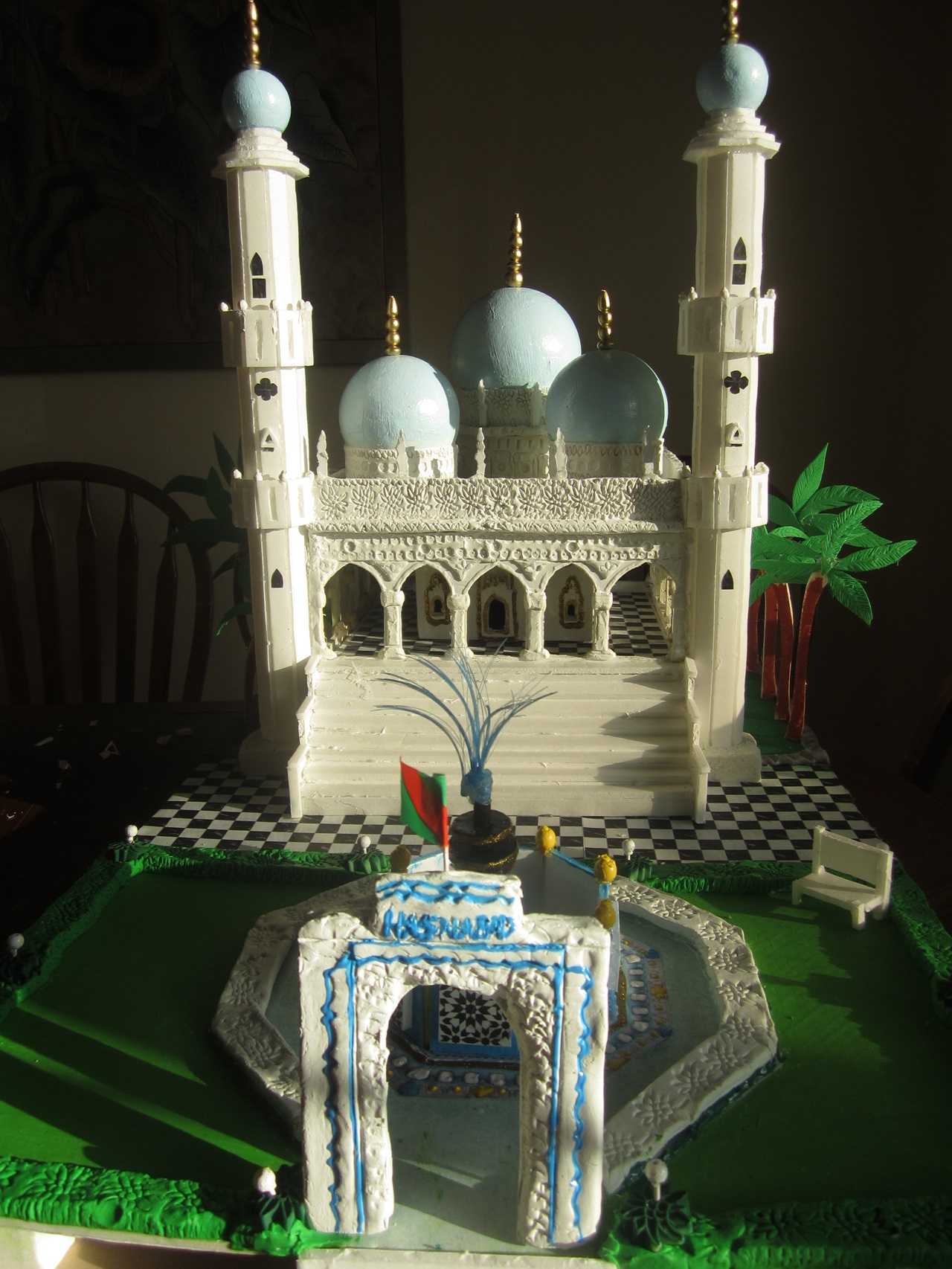
The Hasanabad Model
Hasanabad Model, 29″ x 19″, by Sarah and Sophia Ladha. Photograph: Murad Ladha family collection.
We were inspired to create the Hasanabad model after a profoundly personal visit to Hasanabad and its grounds, which include a Jamatkhana and a housing complex in Mumbai in 2011. This trip was particularly meaningful to us because Hasanabad is where my dad, Dr. Murad Ladha, spent his formative years as one of five children of Amina Ladha and Moledina Ladha. Experiencing its breathtaking architecture up close and learning about its historical significance left a lasting impression on us.
Hasanabad, more than just an architectural marvel, is a place of profound historical significance. It is the final resting place of the 46th Ismaili Imam, Mawlana Hasan Ali Shah, who in 1846, journeyed from Iran to Mumbai, establishing the Seat of Imamat in India after centuries in Persia.
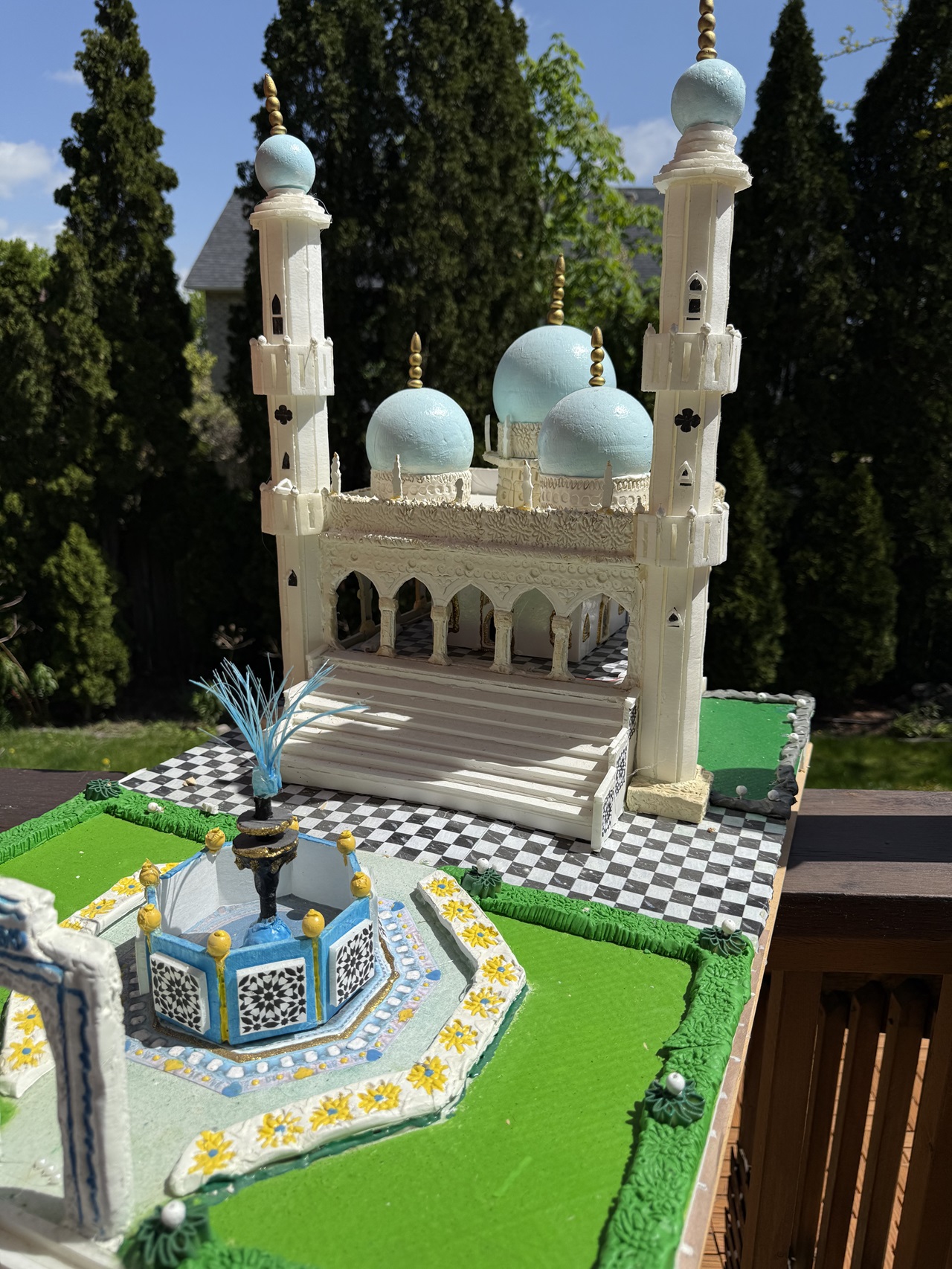
Inspired by the grandeur of the Taj Mahal, Hasanabad’s design features intricate detailing, majestic domes, and perfect symmetry, making it a remarkable landmark and the only Ismaili historical site in India. Inside the Hasanabad Dargah — where Imam Hasan Ali Shah (Aga Khan I) is buried — there is intricate Islamic art decorating the interior of the kuba (the dome). However, due to architectural limitations and lighting, visitors do not readily see or appreciate this artwork. To address this, the fountain in the model was intentionally designed to help reflect and highlight the variety of Islamic artistic elements within the Dargah. This allows members of the Jamat, especially those unable to visit in person, to engage with and appreciate the spiritual and artistic heritage embodied in the structure.
Moved by its historical and cultural significance, we dedicated three months to meticulously crafting our 29″ x 19″ model, striving to capture every detail. Using materials like clay, styrofoam spheres, beads, and pastels, we sought to bring the essence of Hasanabad to life.
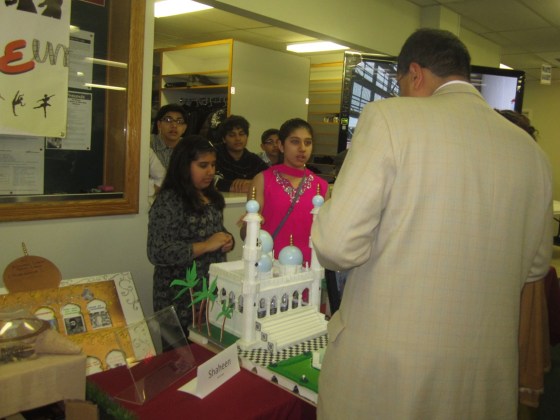
Members of the Jamat view the model of Hasanabad created by sisters Sophia and Sarah Ladha. Photo: Murad Ladha family collection.
~~~~~~~~
The fountain featured in front of historic Hasanabad is not part of the building but was created by Sarah and Sophia Ladha to depict some of the artistic work in the dome inside the building. Photograph: Murad Ladha family collection.
~~~~~~
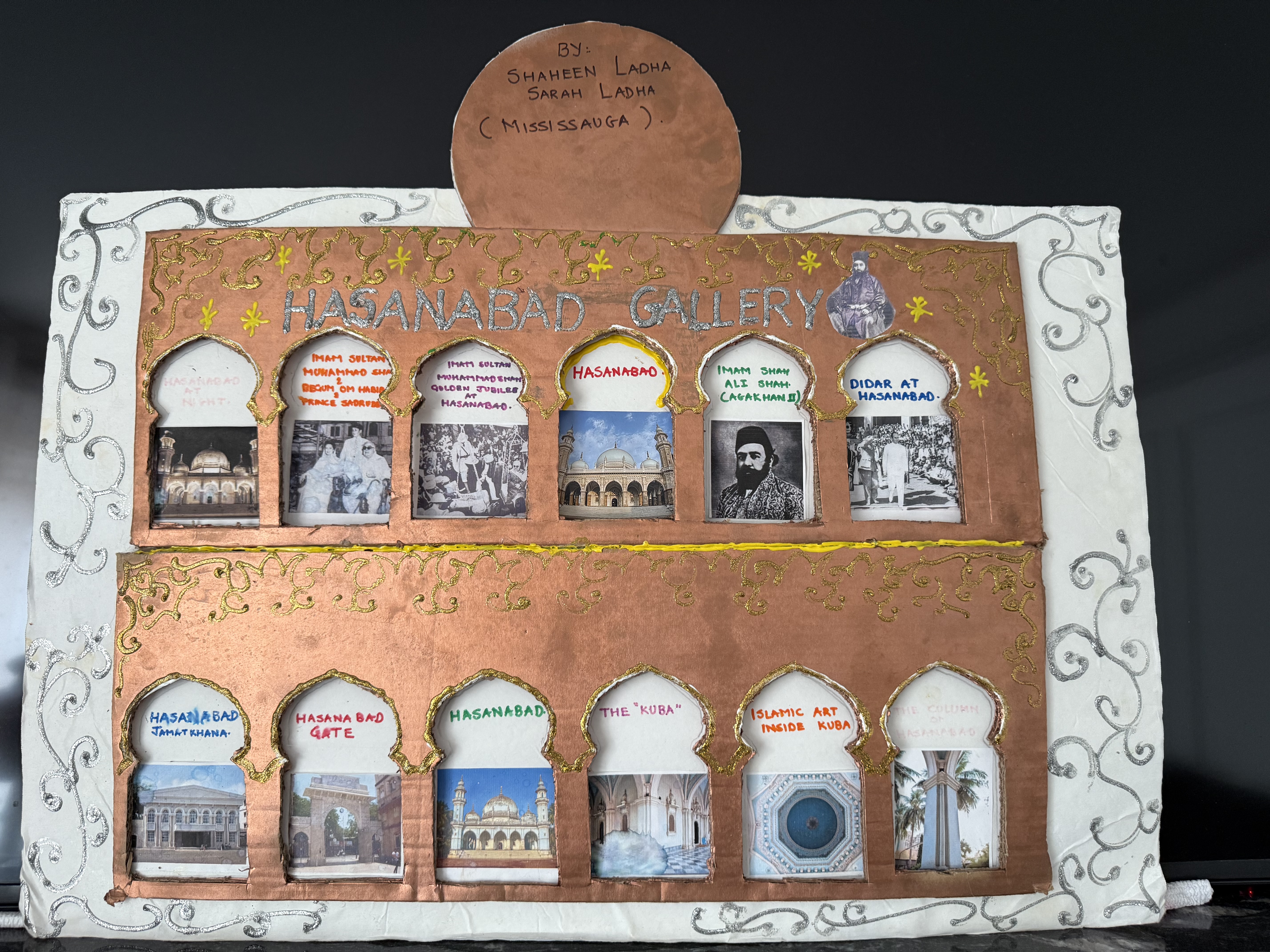
Hasanabad Gallery, accompanying the model exhibit. Photograph: Murad Ladha family collection.
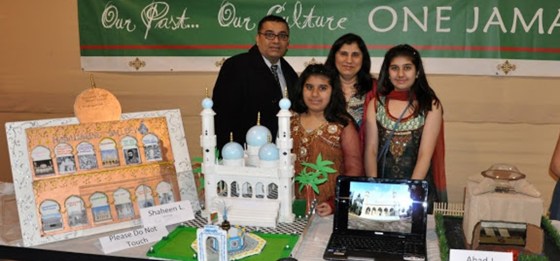
The Ismaili Art and Cultural Committee recognized our model for its craftsmanship, attention to detail, and the story behind it. They appreciated how it highlighted Hasanabad’s architectural beauty and helped share its rich history with others. We displayed the model in Etobicoke Jamatkhana, along with a PowerPoint presentation explaining the the significance of historic Hasanabad to the Jamat. Subsequently, the model was displayed at the Toronto’s International Centre, during a large Navroz gathering of the Greater Toronto Area Jamats. This allowed even more members to experience and connect with this unique representation of Ismaili heritage. Today, the model is a treasured object in our parents’ home in Toronto, and we hope that other children, who have created interesting art work related to Ismaili culture and history will come forward and share their projects through this website.
Featured photo at the top of the post: Sophia and Sarah with their parents, Mr. and Mrs. Murad Ladha, during the Hasanabad model exhibit at Etobicoke Jamatkhana.
Date posted: June 8, 2025. Last updated: September 24, 2025.
___________________
ABOUT THE ARTISTS
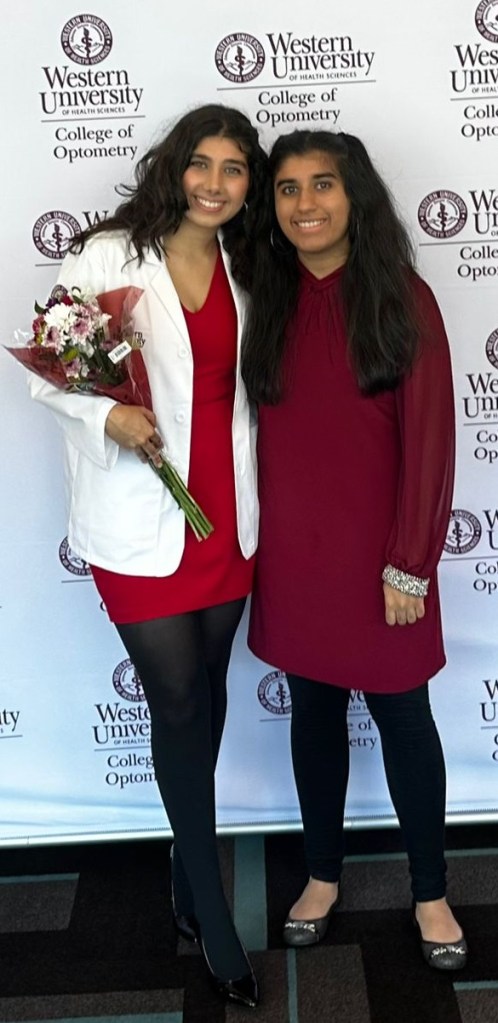
Sisters Dr. Sophia (left) and Sarah Ladha.
Dr. Sophia Ladha is a dedicated optometrist who recently completed her Doctor of Optometry degree at Western University of Health Sciences. She also holds a Bachelor of Science in Optometry from City University in the United Kingdom. Dr. Ladha is passionate about providing patient-centered eye care, combining clinical expertise with a compassionate approach. Outside of the clinic, she enjoys exploring Islamic art and calligraphy, finding harmony between scientific precision and creative expression.
Sarah Ladha is a medical student currently studying in Pennsylvania. Outside of medicine, she has a deep passion for architecture and design. She is fascinated by how structure, form, and function converge to create spaces that are not only visually striking but also purposeful. Sarah draws inspiration from the stories behind buildings — the history, culture, and intention that shape their design. Exploring these elements allows her to see architecture not just as construction, but as a form of living art.
We welcome your feedback. Please click LEAVE A COMMENT. If you are unable to post your comment, please email it to mmerchant@simerg.com. Simerg, an independent platform, has published over 2,000 pieces on all aspects of Ismaili and Islamic history, culture and thought since its launch in 2009. Please see our Table of Contents in 2 parts — 2009-2019 and 2020-Current. Please visit Simerg’s sister websites, Barakah, which is dedicated to His Highness the Aga Khan, and Simergphotos that features photo essays on history, culture and travel. Follow the publisher/editor Malik Merchant on @Facebook, @X and @LinkedIn
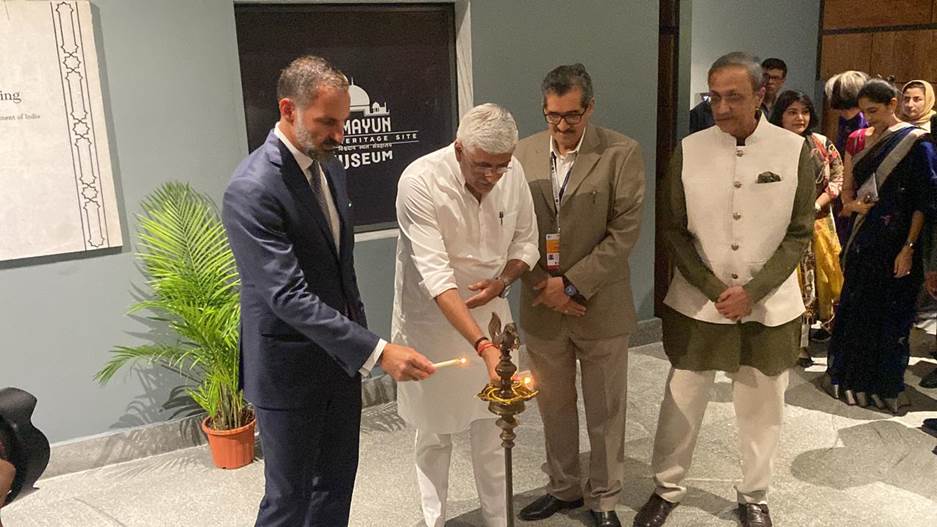
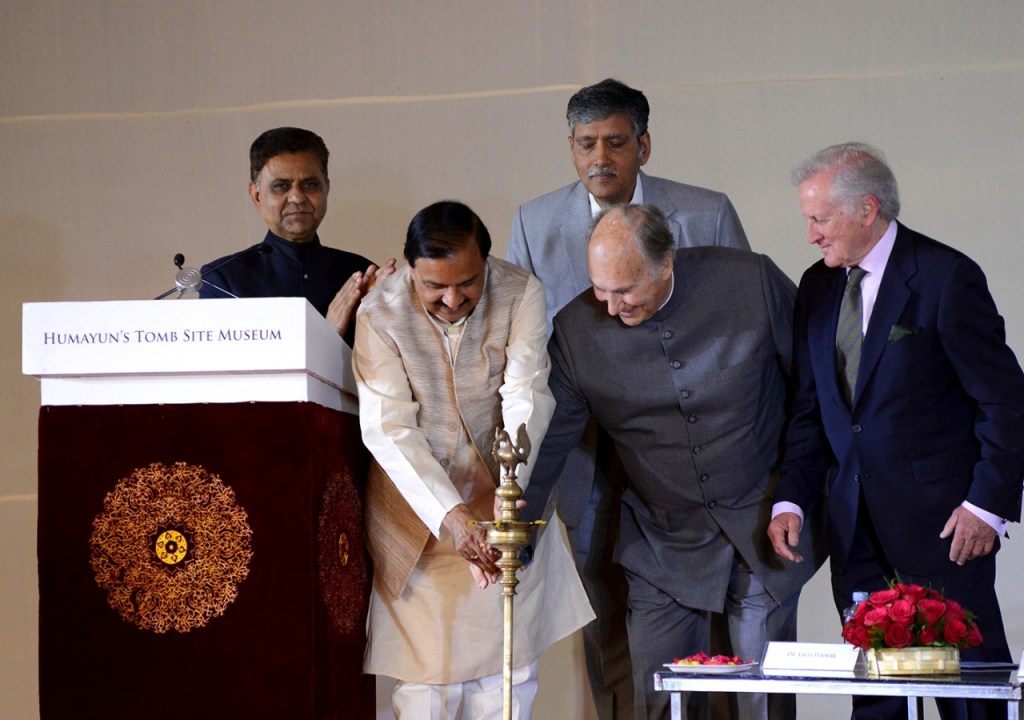
Prince Rahim Aga Khan and India’s Minister of Culture and Tourism, Shri Gajendra Singh Shekhawat, perform a lamp-lighting ceremony to formally inaugurate the Humayun Tomb World Heritage Site Museum in New Delhi on July 29, 2024. Photograph: PIB/Government of India.
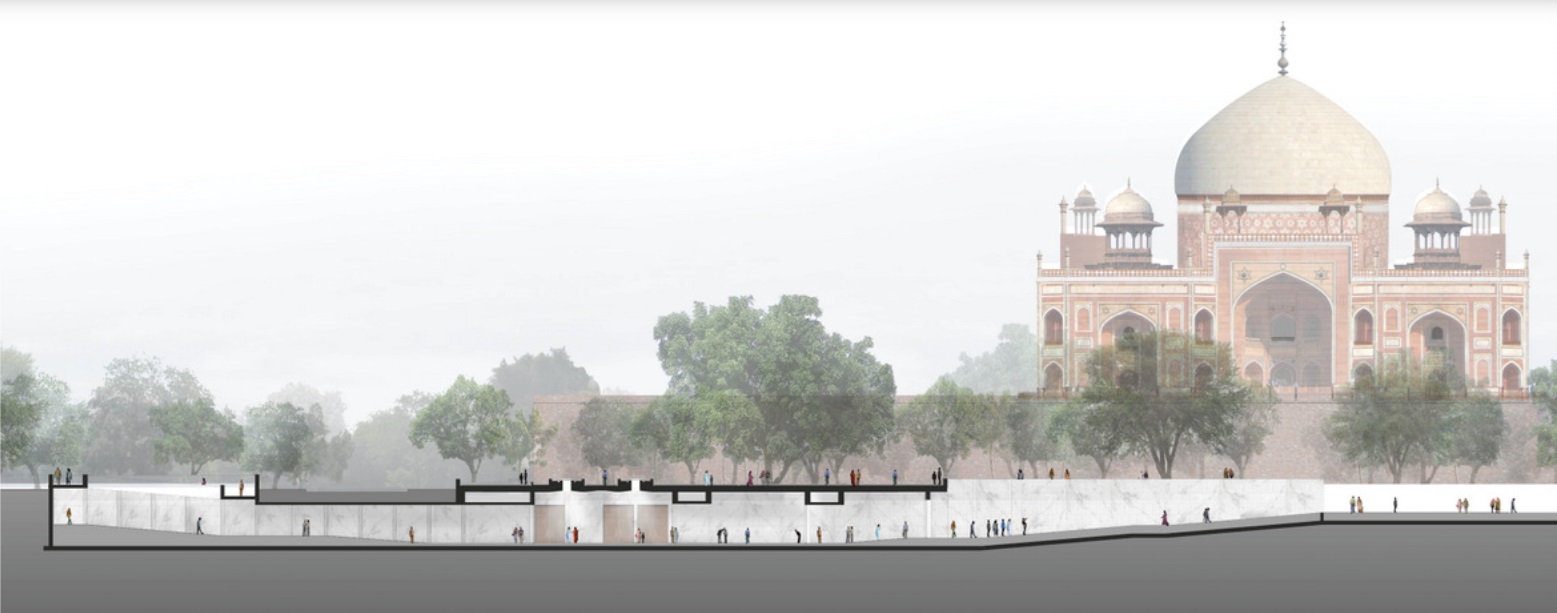
India’s Minister of Culture and Tourism, Shri Gajendra Singh Shekhawat, inaugurated the sprawling 100,000 square feet state-of-the-art Humayun’s Tomb World Heritage Site Museum at the Humayun’s Tomb, a UNESCO World Heritage site in New Delhi, on July 29, 2024. The museum, equipped with the latest technology and innovative design, promises an immersive and enlightening experience for all visitors.
The inauguration event was graced by the presence of Prince Rahim Aga Khan, the oldest son of Mawlana Hazar Imam, His Highness the Aga Khan, the Ismaili Muslims’ 49th Hereditary Imam in direct lineal descent of the Prophet Muhammad (may peace be upon him and his family). Ismailis number 12 million worldwide, and Canada’s highly organized and respected Ismaili community has more than 100,000 members. The Ismaili Imamat’s projects in Canada include the iconic Aga Khan Museum in Toronto, the beautiful Aga Khan Garden in Edmonton and the Global Centre for Pluralism in Ottawa.
The Humayun Tomb Museum, a facility of the Archaeological Survey of India designed and built in collaboration with the Aga Khan Trust for Culture (AKTC), is a significant step in preserving India’s rich cultural heritage. It opened to visitors on July 30, 2024. Please click HERE to read a report on the opening ceremony on our sister website, Barakah.
Tweet
Hon'ble Minister for Culture & Tourism, Shri @gssjodhpur , along with Prince Rahim Aga Khan, and other key dignitaries from Ministry of Culture, ASI inaugurated the state-of-the-art Humayun’s Tomb #WorldHeritageSite Museum in New Delhi. pic.twitter.com/NkJruGDeRQ
— Archaeological Survey of India (@ASIGoI) July 29, 2024
Simerg and its sister website, Barakah, are buzzing with excitement as we provide a brief background story of the Humayun World Heritage Site Museum, which is set to be inaugurated in New Delhi on Monday, July 29, 2024. The anticipation is palpable as we await the grand opening by Prince Rahim Aga Khan, eldest son of Mawlana Hazar Imam, His Highness the Aga Khan, the 49th Hereditary Imam of the Ismaili Muslims. Gajendra Singh, India’s Minister of Tourism and Culture, will join him on this momentous occasion.
The Humayun World Heritage Site Museum, as described by the Indian edition of Condé Nast, is a gateway to understanding the unique cultural significance of one of the city’s most notable Mughal-era monuments. Anuja Jaiswal, writing for the Times of India, includes a statement by the CEO of the Aga Khan Trust for Culture. He says that each of the museum’s exhibits, meticulously preserved, has a unique and fascinating story to tell.
With its rich historical significance, the museum is a treasure trove of enlightenment for any cultural researcher. The Indian Express, in a thought-provoking question, asks: “Did you know that Humayun travelled three times more than Marco Polo, the famed explorer, covering 34,000 kilometres in his life? Or that he was so obsessed with astronomy and astrology that he wore a specific colour each day of the week to align with the planet of the day? Or that he was so fond of books that he used to carry his libraries on camelbacks during his travels?”
Story continues below
Mawlana Hazar Imam, His Highness the Aga Khan, and the then Minister of Tourism and Culture, Dr. Mahesh Sharma, on April 7, 2015, laid the foundation of a site museum to be situated at the Humayun’s Tomb complex. Prince Rahim Aga Khan will inaugurate the sunken museum on Monday, July 29, 2024. Photograph: The Ismaili/Aziz Ajaney.
~~~~~~~~
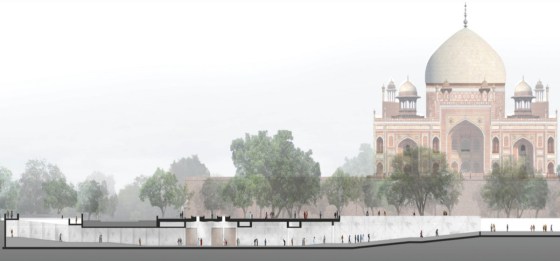
Artist rendering of Humayun’s Tomb Complex Site Museum in New Delhi, India. Photograph: AKDN. Please click on image for enlargement
When His Highness laid the museum’s foundation stone in April 2015, he observed:
“This Museum, as you may know….is located at the juncture of three historically connected sites: Humayun’s Tomb and its Gardens, Hazrat Nizamuddin Basti, and the Sundar Nursery. In connecting these sites, the Museum will also serve as a bridge between the present and the past — linking the modern city of Delhi to its remarkable heritage — and thus providing a Gateway to a truly extraordinary period of human history. That remarkable chapter in the human story extended over 170 years — the era of the Mughal empire. It was a time of enormous accomplishment — and enormous significance. Geographically it covered much of what is now India, Pakistan, Bangladesh, Afghanistan, and Tajikistan. In terms of governance, it included hundreds of millions of people, covering an enormous spectrum of religious faiths, cultural practices, and ethnic identities. It was led by men whose talents in statehood and in military affairs were remarkable — and their impact was felt in virtually every dimension of human existence, both within the empire and outside. Many of the Mughal rulers, perhaps most of them, were also exceptional leaders in the acumen and insight which they brought to their leadership roles. They were statesmen who would have excelled in any time.” — For full speech on the Ismaili wesbite, click HERE.
For the latest news, articles and literary pieces about His Highness the Aga Khan, members of his family and the Ismaili Imamat, please visit Barakah.
Date posted: July 27, 2024.
_____________________
A different version of this story appears on Simerg’s sister website, Barakah.
[This post has two components: In the first piece, Professor Karim H. Karim examines the Aga Hall Project currently under construction in Mumbai, India. His inspiration for the piece comes from His Highness the Aga Khan’s advice to his Ismaili followers to ask hard questions about issues affecting the community. Dr. Karim inquires about the $365 million Aga Hall project’s luxury 54-storey Mumbai skyscraper. His soul-searching article examines the site redevelopment in the context of the Aga Khan Development Network (AKDN) ethics, Ismaili Muslim values and the current program to address ultra-poverty that designates India as a high-priority country.
The next piece, submitted by an Ismaili Canadian visitor to India, is a disturbing eyewitness report of some terrible social habits and health issues within the Indian Jamat as well as the physical state of the Karimabad apartment complex and two historical Mumbai Jamatkhanas.
The post underscores the crucial role of the Ismaili community and its institutions in addressing pressing social and ethical issues, empowering them to take action — Ed.]
~~~~~~~~~~
(I). Asking Hard Questions about the Aga Hall Project: The “Iconic” Mumbai Redevelopment Raises Troubling Social Justice Concerns
The author, Karim H. Karim, has shaped this piece based on in-person and online Aga Hall Estate redevelopment team presentations, related documents, social media discussions, and communications with several individuals. The views expressed here are his.
The superlatives used in selling luxury apartments at the Aga Hall Estate in India will make even the most unrestrained publicity agents blush. Marketing presentations speak of the building as “exceptional,” “breathtaking,” “at the heart of everything,” “most exclusive,” “state-of-the-art,” “world-class,” “pre-eminent,” “ageless,” “ultimate,” “infinite,” “better than best,” “perfect,” “iconic.” Consider these boasts in the light of the following two translated passages, the first a verse from the Holy Qur’an and the second from the Ismaili Ginan (hymn) “Maal Khajina Bahotaj Bhariya” attributed to Sayyid Gulmali Shah:
The servants of the All-Merciful are those who walk in the earth modestly — Qur’an (25:63)
Wealth and treasure abound But you will not keep them This lovely palace will be forgotten And your place will be the jungle In what slumber do you sleep? Recall the Lord, recall Mawla — Ismaili Ginan
Many decades ago, a religious education teacher cautioned me against carelessly using absolutes because perfection does not exist in the material world. But that does not seem to apply to the South Mumbai Aga Hall redevelopment project, which has endowed itself with a heavenly aura.
Its promoters say that it is inspired by descriptions of paradise, claiming that “there will be delight, luxury, and comfort at every square foot” of this heaven on earth. Furthermore, it will have fabulous views of the Arabian Sea, which they declare “represents infinity” (an attribute of God).
This over-inflated balloon of self-congratulatory hype dropped to earth when an audience member at a presentation asked whether the building’s sightlines would always remain unobstructed. A project spokesperson was compelled to admit that such a guarantee could not be given because “in Mumbai, anybody builds anything anywhere, anytime.”
The glorious visions of all-pervading luxury and Eden-like delight also make for a jarring contrast with the reality of the grinding poverty of 2.5 million of Mumbai’s residents. Muslims are disproportionately the most deprived in the megapolis. Many Ismailis in Mumbai and around India are also among the country’s ultra-poor, whose upliftment remains the responsibility of the community’s leadership in India. The Aga Hall developers constantly speak of the accolades that the project has received for being environmentally friendly and “iconic” in design. However, the criteria for such awards and certifications do not account for the social justice values relating to poverty alleviation, which is a major concern of the Ismaili Imamat.
Aga Hall Estate’s current redevelopment is led by the Prince Aly Khan Hospital Charitable Trust, with the logo of Aga Khan Agency for Habitat (AKAH), a body within the Aga Khan Development Network (AKDN), also appearing on the project’s brochure. The AKDN is an organization that has become well-known since the 1980s for its institutions’ innovative and successful initiatives to raise the quality of life of Ismaili Muslims and the communities among whom they live.
However, the Rs. 2,000 crore ($365 million Canadian) Aga Hall redevelopment does not appear to fit into AKDN’s dominant models of funding and operation. Notwithstanding the rationale that the “profit” from this project will go to the hospital, the promotional discourse of the project has drastically shifted course in making the wealthy its primary focus.
This article is concerned with the ethical and social justice implications of the Aga Hall Estate’s prioritization of the interests of the rich.
What is the Aga Hall Estate Project?
The 46th Nizari Ismaili Imam (Hasanali Shah, Aga Khan I) established his residence at Aga Hall (also known as Wadi) in South Mumbai’s Mazgaon locality in 1848. (His beautiful marble and sandstone mausoleum is north of this site at Hasanabad). Aga Khan II (Imam Shah Ali Shah) and Aga Khan III (Imam Sultan Mahomed Shah) also resided at Aga Hall. The Wadi Jamatkhana was built in 1900 on the estate’s lands that occupy several acres.
Additional community buildings were constructed over time. Ismaili Housing Society residences, the Diamond Jubilee School, and the Aly Khan Hospital have graced it since the mid-20th century. (There was another Imamat residence nearby in Malabar Hill, west of Hasanabad, which the present Imam, Aga Khan IV, Mawlana Hazar Imam, donated to accommodate housing for the poor in the early 1980s.)
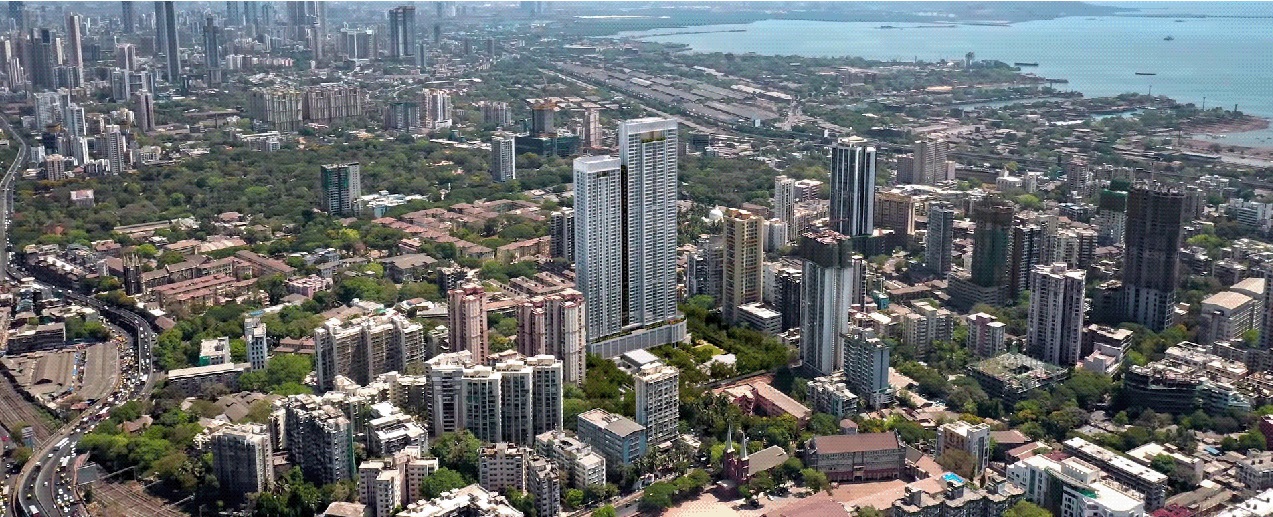
Under the current redevelopment, the hospital is being remade into a “state of the art” medical facility, and the school will become an International Baccalaureate institution. Wadi Jamatkhana will be reconstructed. The housing society’s structures are being demolished to be replaced by a 45-storey “tenant” tower that will stand next to the project’s 54-floor commercial skyscraper, whose 373 freehold apartments are for sale on Mumbai’s real estate market. Mughal-themed gardens will intersperse the buildings designed in Islamic and Rajasthani architectural styles. The 140-year-old gates and fountain are being preserved for reinstallation. India’s “highest green building certification” has been obtained for the redevelopment.
The rationale provided for the project’s luxurious commercial tower is that its “surplus” will be used to upgrade the Aly Khan Hospital. Sometimes, the word “profit” is used at presentations, even though surplus and profit technically mean different things. The preferred audiences for the Aga Hall redevelopment’s promoters are well-off Ismaili and non-Ismaili Non-Resident Indians (NRIs).
Asking Hard Questions
“In dealing with the issues that lie ahead of us, we will look at them straight in the face, we will ask the hard questions. If we cannot find immediate answers, we will go on asking the same questions until inshallah, we are inspired to find the answers, but we will not give up. We will not go back to an obscurantism, to a form of intellectual retreat into something which is neither beneficial for the present and certainly not constructive for the future.” — His Highness the Aga Khan, November 11, 1986
Many questions remain unanswered despite the project team’s international publicity blitzes.
Why is a development network building luxury apartments?
Why is an institution that describes itself as endeavouring “to realize the social conscience of Islam” foregrounding the interests of the rich?
Why is a habitat agency whose mandate is to “work with communities to help them prepare for and respond to natural disasters and the effects of climate change” involved with the construction of investment property?
Has there been an unannounced change in the long-standing policy that has focused solely on providing homes for the lower and middle classes?
Why is one Ismaili housing society being upgraded to “world-class” standards while many others in India and elsewhere have languished for decades in varying states of disrepair and neglect?
Does this apparent change in direction signal an overall shift in the priorities and modus operandi for the entire AKDN organization?
There are larger questions about the effect of this development on the Ismaili community:
What impact will the seeming turnaround have on the way Ismailis conceptualize some of their fundamental values?
How will those who are feeling disaffected with the community’s institutions respond?
Wealth and the Quality of Life
Like other branches of Islam, the Ismaili faith does not prohibit the accumulation and enjoyment of private wealth, including real estate. However, sacred teachings emphasize moral responsibilities and ethical behaviour in acquiring income. Believers are expected to avoid excess and ostentation and to be humble and modest. Thoughtfulness and kindness towards the less fortunate are integral to the faith’s practice. Philanthropy is strongly encouraged, and there has long been a tradition of generous giving. These values have been beneficial for setting up Ismaili infrastructures under the guidance of the Imamat.
The establishment of health, educational, financial, and social facilities that began in the last century led to substantial material advancement of the community. Proper housing in many places of Ismaili presence became a major priority for the Imamat at the Golden Jubilee of Imam Sultan Mahomed Shah (1936), with the objective of improving and safeguarding the quality of murids’ lives. Flats were built in “colonies” (a term used in India and Pakistan) for members of the Jamat in the middle and lower socio-economic classes.
Ismailis are encouraged to contribute monetarily (and with service) to the network’s institutions. Whereas a significant proportion of the community donates to numerous causes, the most consistent financial donors are certain wealthy community members whose generosity is vital to the institutions. Fundraising has been highly systematized.
The social development programs of the Ismaili Councils and the AKDN have sought to improve the quality of life of the less privileged. Jamati members of various socio-economic classes benefit from mixed-use sites with adjacent housing, schools, and/or medical facilities.
It does not appear that any previous residential buildings were designed only for the benefit or use of the wealthy, who already have material access to high living standards.
However, the current construction of apartments in the Aga Hall complex’s commercial tower requires substantial financial resources beyond the reach of the less well-off. Whereas the “tenant” tower is being purpose-built to accommodate residents of the former buildings of the housing society, this is probably the first time the community is raising a separate structure exclusively for the rich.
Shifts in Perspective in Last Decade
The Aga Hall Estate has been under consideration for redevelopment since the mid-1990s. A 2014 design report for the AKDN stated that the estate, “including its buildings and adjacent areas (footpaths, access roads, gardens), are in a state of disrepair and require significant upgrades in terms of infrastructure.” The document’s proposals highlighted the site’s religious ethos and the Mumbai population’s socio-economic and cultural diversity. It described the Jamatkhana as “the jewel of the redevelopment complex.” There was an emphasis in that plan on blending “the spiritual and the material aspects of life that promotes a balanced way of life within the Islamic context.” The designer’s website refers to the movement from “Shariah to Hakikah.”
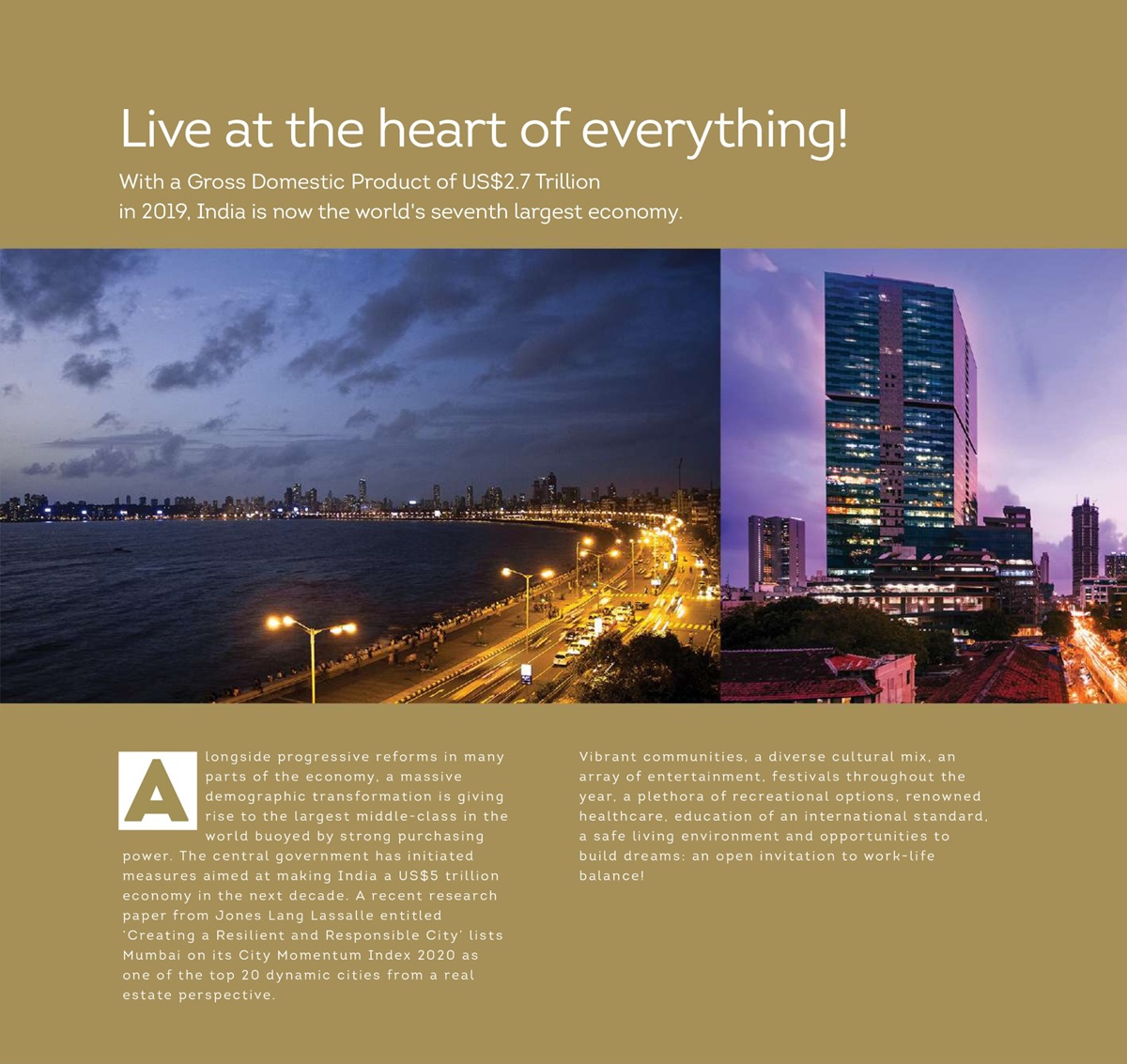
However, significant shifts in perspective appear to have occurred over the past decade. Whereas the 2014 report spoke about the balance between the material and the spiritual, the current brochure only speaks of “work-life balance.” Dunya (the material world) has become dominant,and din (faith) seems to have receded. The brochure boasts of the location’s “ultimate spectrum in urban living” that includes the “most desirable shopping destinations,”; “selection of international brands,”; “the trendy ‘Socials’”; “the exclusivity” of a racecourse and sports clubs; and “state of the art business district.” It declares that “With a Gross Domestic Product of US$2.7 Trillion in 2019, India is now the world’s seventh-largest economy” and invites prospective Ismaili and non-Ismaili buyers to “live at the heart of everything!”
However, these enthusiastic statements omit grim truths about the country’s deep and growing inequalities. Oxfam International’s 2023 report, “Survival of the Richest: The India Story”, notes as follows:
“Following the pandemic in 2019, the bottom 50 percent of the population have continued to see their wealth chipped away. By 2020, their income share was estimated to have fallen to only 13 percent of the national income and have less than 3 percent of the wealth. Its impact has been exceptionally poor diet, increase in debt and deaths. This is in stark contrast to the top 30 percent, who owns more than 90 percent of the wealth, with the top 10 percent owning more than 80 percent of the wealth concentrated in the top three deciles.”
It is not certain what proportions of the Jamat in Mumbai fall into the categories of rich and poor, but Mawlana Hazar Imam has instructed institutions to address the needs of murids who live in “ultra-poverty” during his Golden and Diamond Jubilees. He has indicated inadequate housing as a major problem and has identified India as a priority country for this international program. In late 2023, a Talika (a written message) reiterated his concern for the ultra-poor again. The Ismaili Leaders’ International Forum reviewed progress on the program to deal with the elimination of poverty at it meeting in June 2024. This issue is clearly not the focus of those selling Aga Hall Estate apartments.
It seems noteworthy that the book The Psychology of Money: Timeless Lessons on Wealth, Greed, and Happiness was prominently displayed alongside a spokesperson during a video presentation on the project. Also interesting is that the commercial tower caught the attention of the online Indian newspaper Money Control, which wrote about it glowingly for a readership attracted to luxury and conspicuous consumption.
Ethics in Action?
The AKDN has described itself as endeavouring to “realize the social conscience of Islam” and its projects are called “ethics in action.” Unfortunately, not everyone in the vast network seems to understand what such an institutional position entails. There are multiple layers of problems in the manner that the promoters of the Aga Hall redevelopment have situated their project with respect to ethics.
In misinterpreting the Institute of Ismaili Studies’ document on the network’s ethical framework, they refer to “AKDN’s eight ethics”. Neither IIS’s nor AKDN’s materials state that the ethical principles are only eight in number. Various publications of the IIS identify additional ethics that are also important to the network’s ethos. Nevertheless, the Aga Hall project has designed its logo to represent the supposedly eight-fold ethical structure of AKDN. We are told that the symbol is based on the eight-petalled flower called Dryas Octopetalia. As it turns out, the flower is not native to tropical Mumbai, where the redevelopment is located, but to the arctic-alpine regions of the world. Such incongruities appear to underline the conceptual shallowness of the project.
The Aga Hall promotors state that the first of AKDN’s ethics is “inclusiveness.” Yet, the project’s own promotion materials, including its brochure, contradictorily emphasize the words “exclusive” and “exclusivity” to describe the nature of the site. The nullification of inclusiveness is embedded in the character of the commercial building, which is financially exclusionary. Indeed, the brochure, videos, and presentations about the project are pitched only to upper-class audiences.
Article continues below
Cover page, Aga Hall brochure.
~~~~~~~~~
Page 26, Aga Hall brochure.
In many of the community’s decrepit housing societies in India, governance (one of the other “eight ethics”) has been a sore issue. However, the Wadi housing society’s political economy seems to be intriguing in its distinctness. Among the current occupants of the colony are elite Ismaili individuals, including a high-ranking member of the Aga Khan Council of India and a Maharashtra state politician. It is unclear how decisions will be made on applications from less privileged Jamati families in Mumbai who want to reside in this highly desirable “tenant tower.”
Prince Aly Khan Hospital is to be converted to a state-of-the-art facility. Unfortunately, upgrades to some other AKDN health institutions, including Aga Khan University Hospitals, have made them more expensive and inaccessible for middle — and lower-class families. The Diamond Jubilee School will be transformed into an international baccalaureate educational institution. However, it is not clear what arrangements will be made for the neighbourhood’s children who do not meet its elevated entrance standards.
The Aga Hall project’s promotional materials strongly imply that Ismaili presence in Mumbai began with the arrival of Aga Khan I and his entourage of Persian followers in 1846. This would be patently incorrect. Documents from the celebrated Aga Khan Case (1866) reveal that the Khoja Jamat was well-established in Bombay before the end of the 1700s. The community’s wealthy members assisted many who migrated from Gujarat to the city, especially during periodic famines. Whereas the word “heritage” is used to promote the Aga Hall redevelopment, it is applied in a very exclusionary sense that erases the long-standing Khoja presence from the city’s pluralist history.
“Community” is a term used in the redevelopment’s materials to refer to all the future residents and users (Ismaili and non-Ismaili) of Aga Hall. It is presumed here that everyone will have shared access to the site’s open areas. However, the sales team does not explain how potential disagreements between the commercial tower’s occupants and others will be navigated. Experience has shown that those who have purchased property at premium prices tend to demand exclusive entitlements and privileges.
What is the Road Ahead?
“… an exclusionary narrative can deepen tensions and divisions between groups. These dynamics shape societal interactions for generations and can be challenging to change.” — Princess Zahra Aga Khan, Global Centre for Pluralism, May 19, 2021
Wealth generation has been important to the Ismaili community in ensuring services for the Jamat. It has helped to build Jamatkhanas and secular institutions that have embodied the faith’s values. Central to these values has been the improvement of the quality of life of those who are less fortunate. The generosity of the Jamat’s wealthy members has been a source of strength for the community. Whereas donors have been given certain recognitions and advantages, the community has generally sought to be inclusive of all socio-economic backgrounds and has hitherto not structurally supported class divisions in the Jamat.
A long-existing for-profit sector in communal institutions now mainly operates under the Aga Fund for Economic Development. It is mandated to remain distinct from the social development activities of institutions such as the Aga Khan Foundation. The major funding sources for AKDN’s social development programs are the Imamat, international development aid agencies, private foundations, and Jamati members. For-profit activities have not been given as overt a place in the network’s social development sector as is currently happening in the Aga Hall project. This tendency appears to be creeping into non-profit sections of the Network.
The change at Aga Hall is not merely the injection of commercialization in redeveloping the mixed-use site but the remarkable shift of prioritizing the people who purchase apartments in the 54-storey tower. Regardless of the rationale that the “profit/surplus” from this structure will flow to the hospital, the promotional discourse of the project has made an overt qualitative change in making the rich its main concern. Its language emphasizes exclusive elite access and conspicuous consumption. It subscribes to the materialist values of an opulent lifestyle that appears contrary to the AKDN’s and the Ismaili faith’s normative stance.
Whereas one could argue that there is a place in society for the high life and that there is nothing inherently wrong with such a sales pitch whose ultimate aim is social development, the unintended and insidious danger is that the Aga Hall project’s commercial discourse normalizes and reinforces the divisions between rich and poor. It is troubling that the context in which this is taking place is the severe shortage of affordable housing in India and the sharply deepening gap between the haves and the have-nots.
Adherents of the faith have been nurtured on beliefs of gaining entry to heaven through spiritual endeavour. But the Aga Hall’s materialist promotions promise paradisical happiness through a monetary transaction. This appears contradictory to Jamati members, who wonder if the value orientation has changed. Concerns in this regard are often raised by the community’s intelligentsia, and among youth in social media discussions.
I end this article by asking some additional questions that need to be addressed.
How is the apparently new focus on the interests of the rich to be explained to the community for whom a central Shia Ismaili value is social justice?
How are those who are struggling to find adequate housing for themselves and their children to rationalize the institutional construction of luxury residences?
How will the Aga Khan Council of India explain to the underprivileged in their Jamat the special advantages that are being proffered to wealthy resident and non-resident Indians?
How will fund-raisers for AKDN and Jamati projects justify the Aga Hall Estate’s “most exclusive” development?
Aga Hall’s commercialization appears to be sending mixed messages. The luxury apartment tower will be the highest building constructed in the community’s history. What will this Ismaili “icon” signal to the world about the community?
What will the project say to future generations of the Jamat about Ismaili values?
It is worth recalling that “The servants of the All-Merciful are those who walk in the earth modestly” (Qur’an, 25:63).
Date posted: July 22, 2024.
____________________
About the Author
Professor Karim H. Karim delivering his remarks on March 23, 2024, at the Ismaili Centre in London upon being presented the Institute of Ismaili Studies inaugural Alumni Recognition Award. Photograph: Institute of Ismaili Studies/via Karim H. Karim.
Karim H. Karim is Chancellor’s Professor at Carleton University. He has served as Co-Director of the Institute of Ismaili Studies (IIS) and Director of Carleton’s School of Journalism & Communication and Centre for the Study of Islam. Dr. Karim has held visiting scholarly appointments at Harvard University, the Aga Khan University (AKU), and Simon Fraser University. He has also been a senior advisor for the AKU and the Central Asian University and has served as a member of the AKDN’s Higher Education Forum. Professor Karim is an award-winning author who has published numerous critically-acclaimed and globally-cited writings. He and his wife have established The Karim and Rosemin Karim Prize that recognizes research excellence in understudied areas of Ismaili Studies. Karim received the inaugural IIS Alumni Recognition Award in March 2024.
______________________
(II). Quality of Life of Ismaili Jamati Members: Is it a Reality or Myth?
The following is an eyewitness account by a Canadian Ismaili who spent several weeks in India. The writer is known to the editor and wishes to remain anonymous. We honour his request.
There has been a lot of emphasis on improving the quality of life (QoL) of the global Jamati members. The QoL was even a Diamond Jubilee Project. May I also note that the elimination of poverty, an integral part of QoL, was raised by Mawlana Hazar Imam during his Golden Jubilee Year, which began on July 11, 2007. He repeatedly stressed about its elimination by the end of the Jubilee year, which concluded on December 13, 2008. Subsequently, he has raised the same matter over and over again.
Every country where our Jamati members reside has a specific goal-oriented methodological approach to improve the lives of its members. Quality of life or well-being refers to the wealth and comfort of individuals, communities, and society based on material and non-material factors important to people’s lives, such as health and social connections. Four domains common to QOL in health have been defined as physical health, mental health, social health and functional health. Other relevant domains include::
Material living conditions (income, consumption and material conditions)
Leisure and social interactions.
Economic security and physical safety.
Governance and fundamental rights.
Natural and living environment.
On my recent visit to India, I made a few specific observations about some aspects of QoL that I would like to share. I had the opportunity to visit Jamatkhana in four cities: Bhuj, Mumbai, Pune, and Hyderabad. I observed specific conditions and behaviours affecting our Jamati members’ QoL in each city.
It’s urgent that we address these issues to ensure the well-being of our Jamat. I observed that most youths and some senior members were chewing packed tobacco in all these cities. Tobacco chewing has a characteristic aroma; the smell disturbs the peaceful and serene atmosphere inside the Jamatkhanas. These packets are readily available and at an affordable cost. Health research findings have proved that this addiction is the leading cause of oral cancers and many other problems related to oral hygiene, like darkening of the teeth and premature loss of teeth. Thus, the QoL of our Jamat in India is at a potential risk. I sincerely wish the leadership in India is aware of this and has a preventive program in place. If not, it is time to study this health issue and address it appropriately.
Another issue that caught my attention during my visit was the prevalence of obesity among our Jamati members. This chronic lifestyle metabolic syndrome is a growing concern that we cannot ignore. We need to understand the extent of this issue: what is the prevalence of this health problem compared to national data, and what are the specific interventional strategies for the Jamat? Data and strategies are crucial in addressing this issue, and a systematic approach is needed to tackle this epidemic.
My visit to Mumbai also brought to light the state of our housing complexes. The Karimabad complex is in a run-down state. We must provide safe, modern, and acceptable housing for our Jamat. Even the Jamatkhana in that complex is dire, with falling window frames, depilation, etc. Similarly, the Darkhana (Dongree Jamatkhana) is in dire need of repairs. The urgency of improving our living spaces and places of prayer cannot be overstated.
I was told that the new Ismail complex in Hyderabad was built to accommodate members of the Jamat from Bhuj (the Jamat is at risk due to earthquakes). When I was there, this relocation had not taken place, and perhaps there is a need to investigate this, as it could significantly improve the safety and quality of life for the Jamat members.
“Historically and in accordance with Ismaili tradition, the Imam of the time is concerned with spiritual advancement as well as improvement of the quality of life of his murids. The Imam’s ta’lim lights the murid’s path to spiritual enlightenment and vision. In temporal matters, the Imam guides the murids and motivates them to develop their potential.“
The Jamat and its institutions must catch up based on the Imam’s concern, continuous advice and motivation to develop our potential and rid the Jamat of poverty. This will require a comprehensive approach that addresses not only the immediate health and housing issues but also the underlying social and economic factors that contribute to the overall quality of life of our Jamat.
Karim H. Karim. (2022, Nov. 23). Contemporary Nizari Thought’s Pragmatic Turn and the Centrality of Ethics. Ismaili Studies Conference: State of the Field. Institute of Ismaili Studies. London, UK.
Karim H. Karim. (2014). The Aga Khan Development Network: Shia Ismaili Islam. In Stephen M. Cherry and Helen Rose Ebaugh (Eds.), Global Religious Movements Across Borders. London: Ashgate Publishers.
Simerg’s new feature Short Historical Insights is intended to make history educational, interesting and stimulating for readers through anecdotes, facts, stories as well as images related to Ismailis and their Imams, in no more than 500 words. Information in the series will be unearthed from a maze of documents, including those that are not easily accessible due to their sheer size or location, or material which, in the broader scope, would be of interest for research on specific themes. Of course, we will also rely on other well-known (or lesser-known) treatises and texts as well as libraries and museums for this new feature.
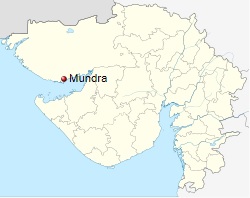
For the first episode, we go to a massive work called The Collected Works of Mahatma Gandhi and reveal a story that appears in Volume 33, which is dedicated to the period from September 1925 to February 1926 in Gandhi’s life. During his visit to Mundra in Gujarat, the father of India, is frustrated with members of his own faith with respect to their treatment of the Untouchables* and, somewhat grudgingly, praises the work of one Khoja (Ismaili) named Ibrahim Pradhan Saheb, who has unselfishly built a school for the outcast children.
This anecdote, by none other than Mahatma Gandhi, is an excellent example of the Ismaili spirit of loyalty to their countries of birth or adoption, a matter which Ismaili Imams have placed on their followers as one of their two principal obligations during their lifetime, the other being their loyalty to the Ismaili Muslim faith. Ibrahim Pradhan was an exemplary Ismaili in this regard, and we are pleased to provide a short account of his contribution from Mahatma’s own two speeches made in 1925.
Readers are invited to contribute to this new feature by submitting their pieces to Simerg@aol.com. We always acknowledges letters and submissions from non-anonymous sources.
Ibrahim Pradhan’s Meritorious Deed As Recorded By Mahatma Gandhi
102 – Gandhi’s Speech at Mundra, November 1, 1925, page 177 – 181
Mahatma Gandhi spinning yarn in the 1920’s. Photo: Wikipedia.
(It is noted by Mahadev Desai that Mahatma Gandhi began his speech with “Antyaja brothers and sisters, their sympathizers, and other Hindu brothers and sisters”)
” ….It is wrong to invite me to a place where the entire public believes in untouchability. It is an insult to invite me to a place where the untouchables are treated with nothing but contempt. After having come here, I heard of the school for the untouchables. I felt that at such a place the Antyajas [lit. the last born – ed] would receive service. I would congratulate Ibrahim Pradhan Saheb on the school but the Hindu public deserves no such congratulations. Its existence puts the Hindus to shame. It is a matter of shame for me if a Muslim builds a Siva temple for my benefit. I was pleased to see the school’s activity of spinning and weaving; however, I immediately felt that neither I nor the Hindus could take credit for this meritorious deed. I can have no sense of satisfaction if a Muslim recites the Gayatri mantra instead of me. I can only feel satisfied when a Brahmin comes along and offers to recite the Gayatri for me. However, in this case, the Khojas are doing the work that should be done by Hindus. Here, no one is bothered in the least about the Antyajas. I do not see any non-Antyajas except the guests sitting among the Antyajas here before me. Even those who go around with me during the day have abandoned them and are seated in the enclosure for high-caste gentlemen. If you could rip open my heart today, you would find it crying — ‘O Lord! Could this be the Hindu dharma, where no one cares for the Antyajas? Is there not a single person in the town who will come to their rescue’?…
103 – Gandhi’s Reminiscences of Kutch, November 1, 1925, pages 181-187
Location of Mundra in the Kutch district of India’s Gujarat State. Image: Wikipedia.
I had my bitterest experience in Mundra. I found only hypocrisy, insincerity and play-acting there. Even Muslims were made to sit in the enclosure for those who supported untouchability as if they too believed in it. Hence, only my companions and the Muslim volunteers remained in the section reserved for Antyajas. Many among the Hindu volunteers, though they claimed that they did not believe in untouchability at all, were nevertheless kept in the enclosure meant for those who did believe in it.
There is a school for the Antyajas in Mundra but it is a philanthropic Muslim gentleman, Sheth Ibrahim Pradhan, who runs it at his own expense. The school may be regarded as good up to a point. The children are kept very clean. The building is in the centre of the city. The children had even been taught Sanskrit verses, [which they recited] in a broken accent. Spinning, carding, ginning and weaving were taught in the school itself. Only children’s clothes were not made of khadi [handspun and hand-woven cloth – ed.]; however, the organizers had gone in for the cloth believing it to be pure khadi. The reader might perhaps conclude that this school would give me some satisfaction. It gave me no satisfaction but caused me grief, rather, as the credit for it would not go to a Hindu. I have already mentioned the name of the gentleman who finances it.
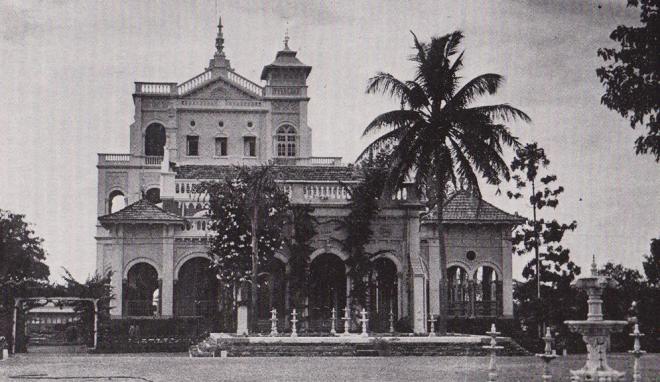
Yerawada (or Aga Khan) Palace, now the Gandhi Memorial, was built by the 48th Ismaili Imam to provide a means of livelihood to the famine stricken people in Pune. Historically, the palace holds great significance. Mahatma Gandhi, his wife Kasturba Gandhi and his secretary Mahadev Desai were interned in the palace from 9 August 1942 to 6 May 1944. In 1969, the current 49th Ismaili Imam, Prince Karim Aga Khan, donated the Palace to the Indian people as a mark of respect to Gandhi and his philosophy. Today, the palace houses a memorial on Gandhi where his ashes were kept.
The gentleman in charge of this school is the heir of the Aga Khan in Mundra. Sheth Ibrahim Pradhan deserves all praise for his charity, as I was informed that this school is not being run for the purpose of converting the untouchables or schoolchildren to Islam, but in order to enable them to make progress as Hindus. The people of Mundra also informed me that the gentleman in charge, Mauledina Meghji was a Vedantin [belonging to a school of Indian philosophy – ed.] and a learned person. All this must be regarded as satisfactory. However, what is the contribution of the Hindus? Untouchability is an ugly blot on the Hindu religion, it is a sin. The Hindus alone can do prayaschitta [atonement for sins] for it. The dirt on my body will go only when I myself remove it.
This institution adds to the prestige of Sheth Ibrahim Pradhan, and to that extent to the shame of the Hindus.
Date posted: July 26, 2015, word count, appx. 400 words.
_____________
Notes and references:
*Untouchables are outcasts—people considered too impure, too polluted, to rank as worthy beings. Prejudice defines their lives, particularly in the rural areas, where nearly three-quarters of India’s people live….Although the Indian constitution makes caste discrimination illegal, Untouchables living at the bottom of society are subjected to indignities” — from http://ngm.nationalgeographic.com/ngm/0306/feature1/
Toronto based Ismaili author, M..H. Velshi whose book excerpt can be read by clicking on the image or link below
The year is 1936, and the setting for a serious dialogue between a brother and his sister is Mumbai’s famous Chawpati on Marine Drive – with the continent of Africa in the distant horizon, thousands of miles away….
“To Africa,” she said.
She looked at his startled face and continued, “That’s your future. So many of my friends have gone and bought shops or farms, or found work on the railways…You know for many years our Imam, Mowlana Sultan Mohammed Shah, has been issuing firmans to us Ismailis to migrate to Africa. Now the Ismailis have built large jamatkhanas in Africa where people can pray and meet freely every day. You won’t be alone. When I heard one of his firmans…I knew it was a message meant for you. It’s your way out.”
“There can be no keener revelation of a society’s soul than the way in which it treats its children” – Nelson Mandela
A close-up of a detail of a South African Hundred Rand banknote, featuring an engraving of the face of iconic statesman Nelson Mandela, giving his trademark smile. South African wildlife and African designs form the watermarked background. Photo: Istockphoto. Copyright.
By Zulfikarali M. Khoja (special to Simerg)
My diverse background has provided me with three world-class heroes. As a Gujarati speaking Canadian, Ghandi stands out as my hero. The Mahatma found the roots of his policy of non-violence in South Africa where he experienced racism in its extreme form. There is a saying that India gave South Africa Ghandi and in return South Africa gave India the Mahatma.
Heroes Gandhi, Mandela, and Pearson. Image: Wikipedia photos.
As a proud Canadian I found my hero in Lester Pearson, Nobel Prize winner for Peace. It is while sitting in a geography class in a segregated school in Pretoria that I was introduced to this figure who originated the Blue Helmeted Peace Keepers to the world. At that time I dreamt of going to Canada. My dream came true!!
As a South African born Canadian there is so much one could write about Madiba, My Hero! I shall restrict myself to two things.
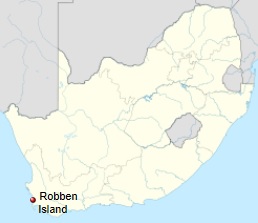
Nelson Mandela was imprisoned on Robben Island for 18 of the 27 years he served behind bars before the fall of apartheid. Map: Wikipedia.
Mandela’s cell at Robben Island. Photo: Wikipedia.
His capacity for forgiveness was so deep and pure that it is difficult to imagine. I was fortunate enough to visit Robben Island. The small cell he spent 27 years and the conditions under which he had spent day after day breaking rocks was heart breaking. Tears rolled down my face as I stood in the middle of the quarry. Yet under these awful conditions he stood as a role model for his fellow prisoners, he studied at night, including Afrikaans, the language of his oppressors. How else would he be able to communicate with his prison guards and understand his enemy? How else would be able to negotiate without knowing his enemy. He believed very strongly that forgiveness does not change the past but opens the future. A future for all South Africans and for the world where is civil strife.
In one of the interviews he was asked what did you miss the most while in prison. His response was the interaction with children. Soon after he became the President of new South Africa he established the Nelson Mandela Children’s Fund (NMCF). Fifty percent of his salary was donated to establish this fund. With headquarters in Johannesburg the NMCF has affiliates in various parts of the world, including Canada.
Nelson Mandela with Graça Machel created a bold new movement to turn the world around for millions of children. Photo credit: UNICEF
I was fortunate to be the NMCF Chapter Chair for Ottawa. This opportunity to share the ideals and vision of Madiba to the youth of Ottawa through Youth Conferences on the Hill and extra-curricular activities in school was an enriching experience beyond measure. The Brookfield High School Choir sang South African songs throughout the city and at a variety of public events. This was only one of the ways in which Madiba’s vision was shared with Ottawa citizens.
As an educator and mediator I have been fortunate to have had these lifetime enriching experiences which I share with my children and especially my grandchildren. They are already following in their grandfather’s footsteps.
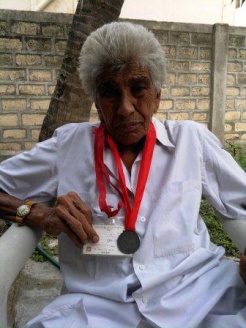
“The jamatbhai…was blind and for ‘wudu’ he used to draw water from a nearby well. Gulamhusen made sure that he was there to help the jamatbhai in the daily ritual. Through acts such as this, Gulamhusen began to serve the jamat of the town”….Read More
Long serving Ismaili, 77-year-old farmer Gulamhusen Alibhai Jamani of Mahuva, India, with a medal that was presented to him to recognise volunteers. Please click on image for story.
INTRODUCTION: His Highness the Aga Khan, or Mawlana Hazar Imam as he is affectionately and respectfully addressed by his Ismaili followers, will be visiting Bangladesh and India during the coming month. In July 2011, the 49th Ismaili Imam who is the direct descendant of the Prophet Muhammad (s.a.s.) made a highly successful visit to East Africa and Simerg provided a religious context of the visit by publishing a seven-part series on Imamat and what didar (lit. glimpse of the Imam of the Time) represents to an Ismaili.
Please click on photo to download Imamat and Didar series. Photo: Jehangir Merchant Collection.
We are pleased to provide the entire series which consists of thirty-five brief readings such as “Didar: Life’s Ultimate Purpose” by Imam Mustansir-Billah in PDF format. To download this highly educational and inspiring series, please clickSimerg’s Imamat and Didar Series. We invite you to share this post with your contacts around the world.
~~~~~~~~~~~~
A Note to Readers: Please scroll down or click Home page for other recent posts and click What’s New for links to all articles published on this blog since March 2009. Subscribe to this Website via the box near the top right of this page.










 Simerg - Insights from Around the World